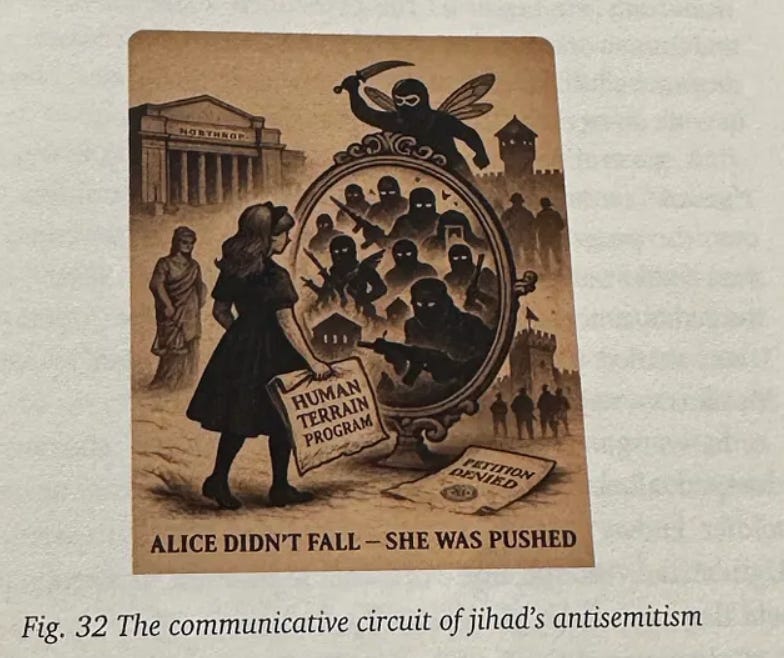
The communicative circuit of jihad’s antisemitism
(con’t) from preceding pages
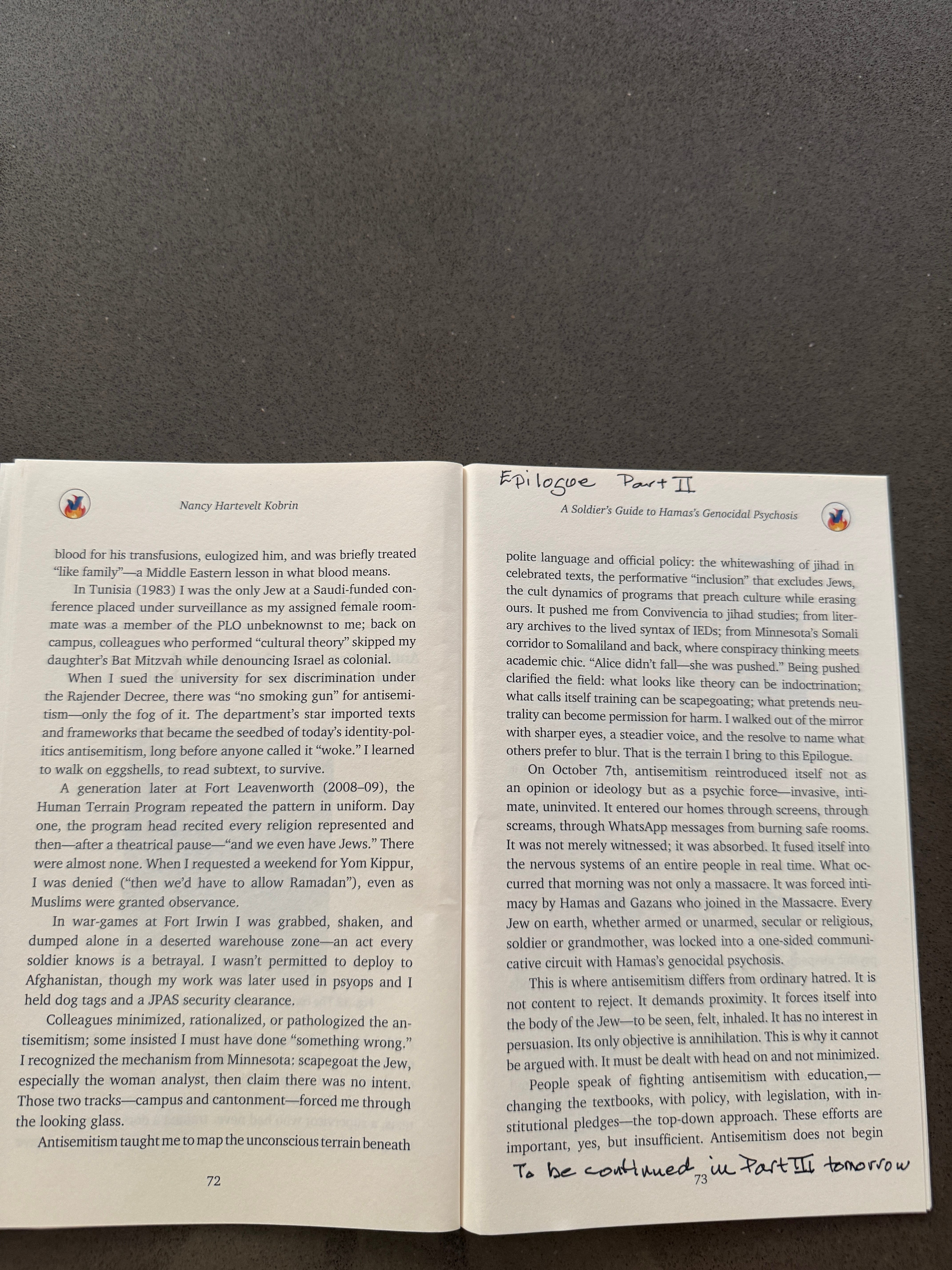
blood for his transfusions, eulogized him, and was briefly treated “like family”—a Middle Eastern lesson in what blood means.
In Tunisia (1983) I was the only Jew at a Saudi-funded conference placed under surveillance as my assigned female roommate was a member of the PLO unbeknownst to me; back on campus, colleagues who performed “cultural theory” skipped my daughter’s Bat Mitzvah while denouncing Israel as colonial.
When I sued the university for sex discrimination under the Rajender Decree, there was “no smoking gun” for antisemitism—only the fog of it. The department’s star imported texts and frameworks that became the seedbed of today’s identity-politics antisemitism, long before anyone called it “woke.” I learned to walk on eggshells, to read subtext, to survive.
A generation later at Fort Leavenworth (2008–09), the Human Terrain Program repeated the pattern in uniform. Day one, the program head recited every religion represented and then—after a theatrical pause—“and we even have Jews.” There were almost none. When I requested a weekend for Yom Kippur, I was denied (“then we’d have to allow Ramadan”), even as Muslims were granted observance.
In war-games at Fort Irwin I was grabbed, shaken, and dumped alone in a deserted warehouse zone—an act every soldier knows is a betrayal. I wasn’t permitted to deploy to Afghanistan, though my work was later used in psyops and I held dog tags and a JPAS security clearance.
Colleagues minimized, rationalized, or pathologized the antisemitism; some insisted I must have done “something wrong.” I recognized the mechanism from Minnesota: scapegoat the Jew, especially the woman analyst, then claim there was no intent. Those two tracks—campus and cantonment—forced me through the looking glass.
Antisemitism taught me to map the unconscious terrain beneath polite language and official policy: the whitewashing of jihad in celebrated texts, the performative “inclusion” that excludes Jews, the cult dynamics of programs that preach culture while erasing ours. It pushed me from Convivencia to jihad studies; from literary archives to the lived syntax of IEDs; from Minnesota’s Somali corridor to Somaliland and back, where conspiracy thinking meets academic chic. “Alice didn’t fall—she was pushed.” Being pushed clarified the field: what looks like theory can be indoctrination; what calls itself training can be scapegoating; what pretends neutrality can become permission for harm. I walked out of the mirror with sharper eyes, a steadier voice, and the resolve to name what others prefer to blur. That is the terrain I bring to this Epilogue.
On October 7th, antisemitism reintroduced itself not as an opinion or ideology but as a psychic force—invasive, intimate, uninvited. It entered our homes through screens, through screams, through WhatsApp messages from burning safe rooms. It was not merely witnessed; it was absorbed. It fused itself into the nervous systems of an entire people in real time. What occurred that morning was not only a massacre. It was forced intimacy by Hamas and Gazans who joined in the Massacre. Every Jew on earth, whether armed or unarmed, secular or religious, soldier or grandmother, was locked into a one-sided communicative circuit with Hamas’s genocidal psychosis.
This is where antisemitism differs from ordinary hatred. It is not content to reject. It demands proximity. It forces itself into the body of the Jew—to be seen, felt, inhaled. It has no interest in persuasion. Its only objective is annihilation. This is why it cannot be argued with. It must be dealt with head on and not minimized.
People speak of fighting antisemitism with education,—changing the textbooks, with policy, with legislation, with institutional pledges—the top-down approach. These efforts are important, yes, but insufficient. Antisemitism does not begin
To be continued in Part III tomorrow.
Stay tuned for The Epilogue Part III tomorrow.
Nancy Hartevelt Kobrin, PhD
nancykobrin.org
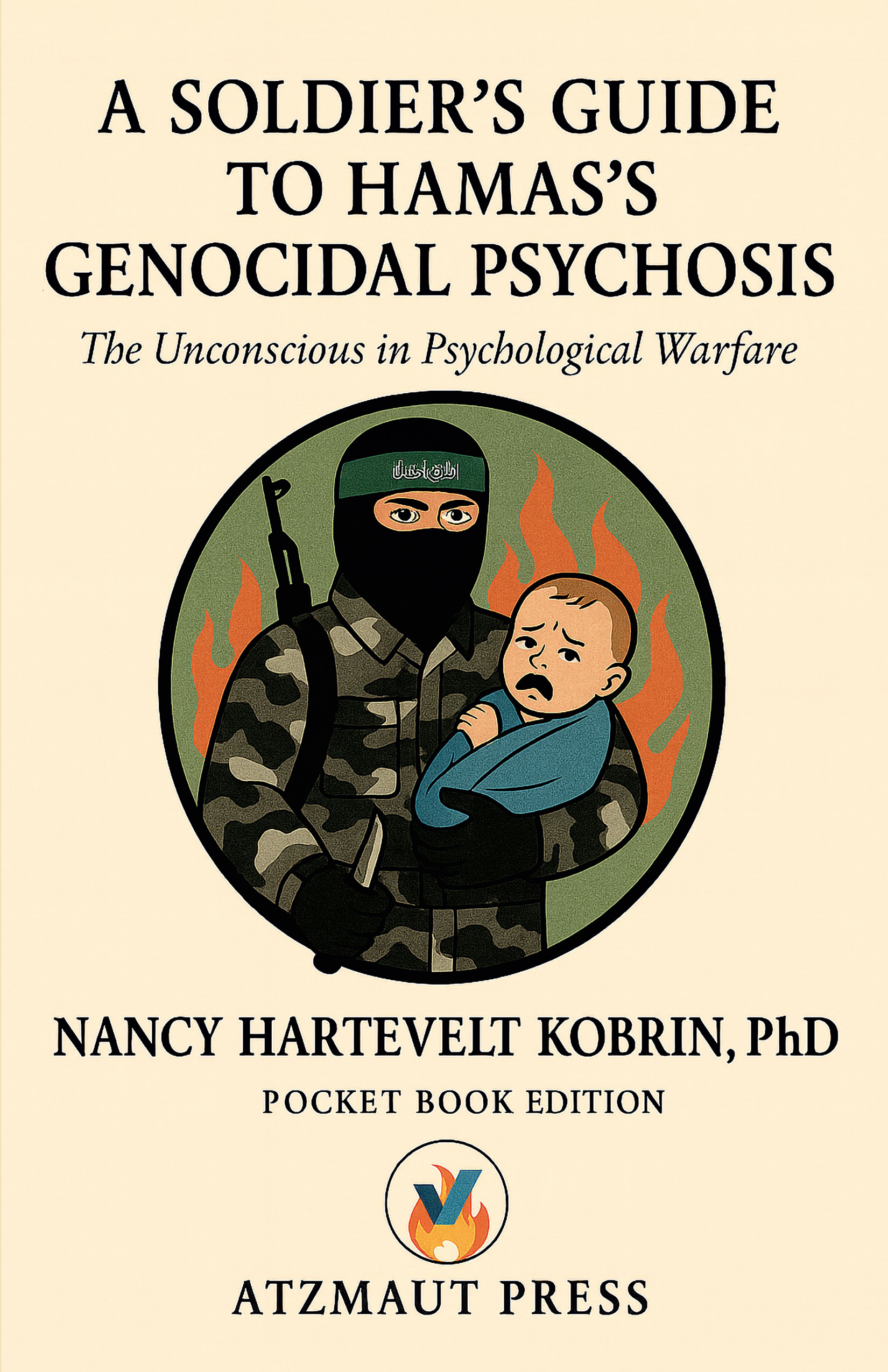
A Soldier’s Guide to Hamas’s Genocidal Psychosis
(Atzmaut Press, Tel Aviv, 2025)
As a PTSD expert focusing not only on the patients but as significantly on the mind of the predator, I estimate that this information will help 5-10% of those who have a need to understand the terror in detail. In turn this knowledge will have a ripple effect.