

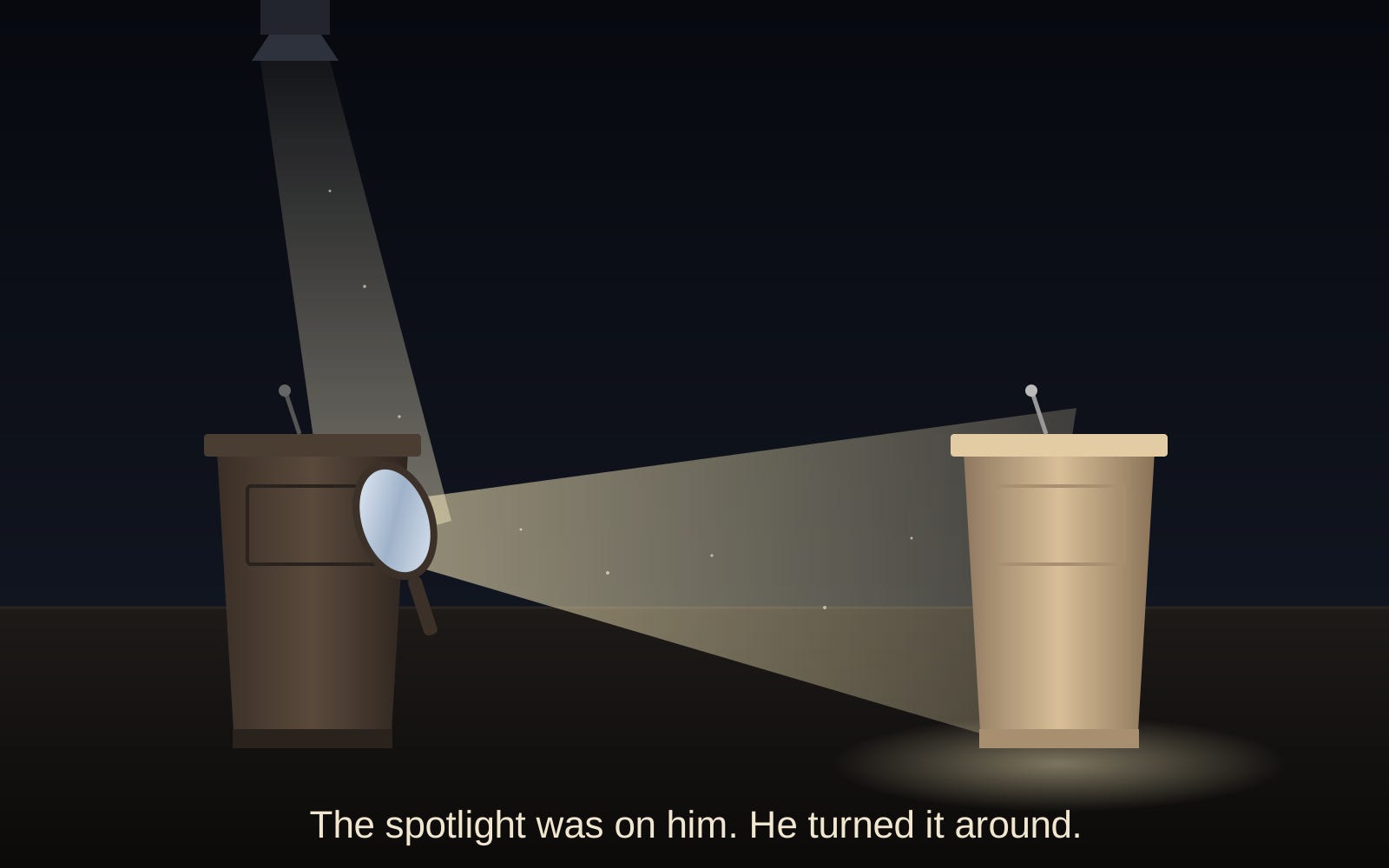
Wednesday night, in the final debate of Michigan’s Senate race, Republican Mike Rogers put the question to Abdul El-Sayed directly: are you for America, or for the terrorist groups overseas whose supporters have given to your campaign?
El-Sayed did not answer the question. He answered the questioner. It was, he said, “really quite beneath you, Mike,” to raise his ties to “an organization I’ve never been a part of.” Then he reached for the word that matters: the question, he said, was “really quite shameful.”
The Word He Chose
Of all the words available to him, he chose shame. Not wrong, not false, not unfair. Shameful.
There is a difference between guilt and shame. Guilt says, I did something wrong, and it can be repaired: you apologize, you make amends. Shame says, I have been seen, and it cannot be repaired, only hidden or thrown back. In a shame-honor culture, the worst thing is not to do wrong. It is to be exposed. When exposure comes, the shame must be returned at once to the one who exposed you.
That is what happened on the debate stage. A question about the Muslim Brotherhood became a question about Rogers’s character. The one who asked is now the one who should be ashamed.
Beneath You
Notice the other phrase: “beneath you.” That is the language of rank, of who stands above whom. In a culture of honor, the question is never only what is true. It is who has lost face. El-Sayed did not tell Michigan what his family’s ties were. He told Rogers he had lowered himself by asking.
He then moved the question onto ground where no one can follow. He spoke of the Constitution that guarantees “the right to pray as we choose to pray.” No one on that stage had asked about prayer. The question was about a political movement, and he turned it into an attack on his faith. We have seen this before. When his sister-in-law’s terrorist watchlist case surfaced, the answer was Islamophobia. Deny, attack, reverse victim and offender.
What the Record Shows
“An organization I’ve never been a part of” is a careful sentence. It answers membership, which no one has proven, and leaves untouched what has been reported. In 2012, The New York Times reported, he signed an open letter backing a purge of “the media and police” in Egypt after the election of Mohamed Morsi, the Brotherhood’s own man. His half-sister has posted openly about the family’s ties. And this week a campaign organizer, since fired, was recorded saying Abdul cannot reject Hamas without losing “the people that brought him up.” The campaign calls those remarks untrue. But each time the record comes close, the response is the same: not an answer, but an accusation.
Where Shame Begins
Erik Erikson placed the struggle between autonomy and shame in the second and third years of life, inside what I call the unseen years. It is the time when a child first stands on his own feet and first learns what it is to be looked at and found wanting. A child who is shamed too early, or too often, learns to defend himself not by owning the act but by hiding it, and by turning the gaze back outward.
I am not diagnosing Abdul El-Sayed. I am describing a type within Woke 2.0, and what this candidate says in public. But the debate gave us something rare: a man under pressure, choosing his own word. He chose shame.
Whose Shame Is It?
A question is not shameful. It is how a democracy finds out whom it is electing. What would be shameful is for Michigan voters to accept the reversal: to let a candidate turn every question about his record into a charge against the one who asked. When a man calls the question shameful, ask whose shame he is carrying, and why he needs so badly to hand it to someone else.
Sources:
Sudiksha Kochi, “El-Sayed, Rogers face off in last Michigan Senate debate: 3 takeaways,” The Hill, October 21, 2026.
Reuven Rosenfeld, “El-Sayed Campaign Organizer Fired After Undercover Video Alleges Overseas Donations and Hamas Concerns,” VINnews, October 19, 2026.
Ariella Roitman, “’Israel is not our friend’: Michigan’s El-Sayed doubles down on anti-Israel stance,” The Jerusalem Post, October 20, 2026.
Nancy Hartevelt Kobrin, PhD, is a Tel Aviv–based psychoanalyst and counterterrorism scholar.
https://www.amazon.com/Nancy-Kobrin/e/B002RF9D5Y