

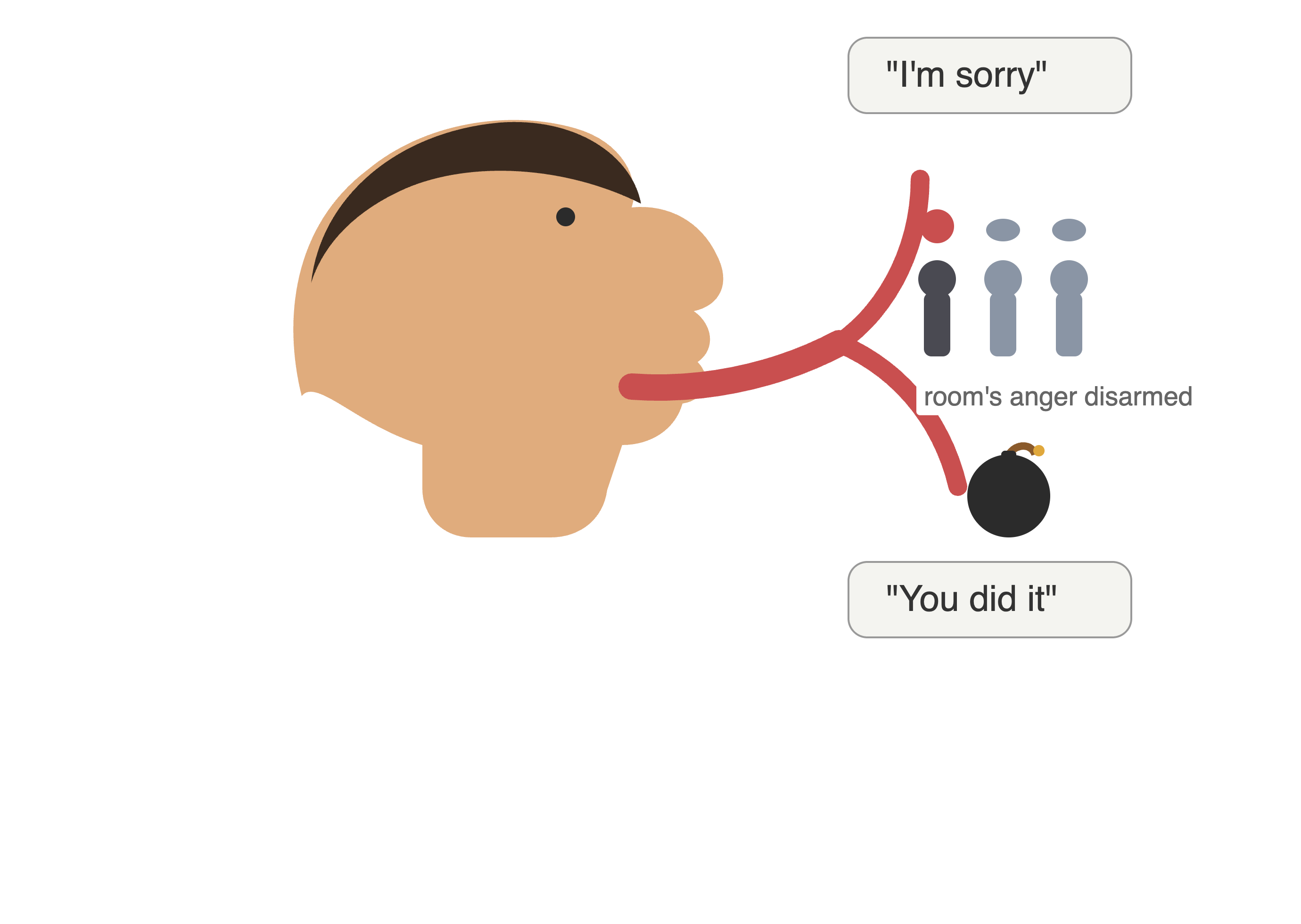
Abdul El-Sayed apologized on Saturday, in a room full of Michigan’s Jewish Democrats, for his “hurt people hurt people” comment on the Temple Israel synagogue attack. Minutes later, in the same room, he declined to affirm a two-state solution and returned to his taxes-versus-bombs formulation — money that should go to “your kids, and your schools,” he said, instead of being “dropped in the form of a bomb on somebody else, and their kids, and their school.” The bomb-dropper in that sentence is Israel. He apologized for excusing violence against Jews, then reloaded the accusation that casts Jews as the ones dropping bombs on children, in the same afternoon, without missing a beat.
The Tell
This is not two positions in tension. It is the tell.
A tell, in poker, is the involuntary sign — a tic, a pause, a shift in breathing — that gives away what a player is holding, even while his bet or his words say something else. The term has since traveled well beyond the card table, into any moment where behavior contradicts the story a person is telling. Here, the tell is not the apology and it is not the accusation. It is that neither one adjusts for the other.
Think DARVO
Psychologist Jennifer Freyd gave this sequence a name: DARVO — Deny, Attack, and Reverse Victim and Offender. Someone confronted with wrongdoing denies it, attacks the person raising it, and reverses the roles so the accuser ends up looking like the aggressor. El-Sayed’s version compresses the sequence into a single afternoon. He does not deny outright — he apologizes, which reads as accountability and buys him the room’s goodwill, but it is the non-apology. Then he attacks by returning to the taxes-and-bombs formulation. And in the same breath he reverses victim and offender, recasting the Jews in front of him as the ones responsible for dropping bombs on children. The apology is not separate from the maneuver. It is the opening move that makes the rest of it credible.
There is a difference between genuine reparation and its imitation. Real reparation means holding guilt for a specific harm done to a specific, whole person, and sitting with the discomfort of having hurt someone you also value. That discomfort is the whole point of it — guilt that stays in contact with the person it’s owed to. Apologize like that, and you cannot turn around minutes later and reload the same accusation in different words, because the guilt and the accusation would collide.
Here, they don’t collide. The apology addresses the Jewish caucus in front of him. The taxes-and-bombs line addresses a different target entirely, one that never has to answer to the first. When a person’s world runs in separate, non-communicating compartments, loving one and attacking another produces no internal friction. The absence of friction, not the words themselves, is what marks the difference. A non-apology like this is not insincere in the ordinary sense of a lie. It is what happens when nothing has fused these parts into a single self required to be consistent.
The Seduction by Abdul’s Forked Tongue
That is also why it works, even though it does not cohere. The apology’s real function was not repair but neutralization — it disarms the audience’s aggression before the room can fully feel its own rage. Rebecca Kasen, a Lansing-area Democrat in the room, said her opinion of El-Sayed improved because of the apology — she moved from reluctant to enthusiastic — while remaining uncomfortable with what he said afterward about two states. Relief from anger is seductive: it makes a room grateful to the very person who gave it cause for that anger. That gratitude did real relational work. It managed the audience’s aggression and bought back trust. It did not do the internal work reparation is supposed to do, because there was no single self inside him for the guilt to have belonged to in the first place. It was a maintenance procedure, not an event of remorse.
This connects to the unseen years — the same developmental window that shaped his enemy long before he had words for it. A person whose sense of self never fully came together does not have one continuous person for an apology to bind. “Sorry” costs him nothing, because there is no unified him for it to be true or false about.
Abdul’s forked tongue is not a rhetorical failure. It is the visible seam where the split runs, and no apology stitches it shut. Stop listening to what he says. Watch for the moment his own sentences refuse to answer to each other, and for his body language of deceit — that moment, not the apology, is the only thing about him worth believing.
Dr. Kobrin is a counterterrorism expert and psychoanalyst holding a PhD in Islamic literature. She is a graduate of the Human Terrain Program, Leavenworth, KS. Her most recent book is A Soldier’s Guide to Hamas’s Genocidal Psychosis: The Unconscious in Psychological Warfare -- Beyond Ideology, Before Words. Atzmaut Press 2025. She is currently working on her seventh book Between Empire and Covenant—The Jewish Bond: Lotman, The Refuseniks and The Bukharan Jews, 1977. See her full body of work at her Amazon author page: https://www.amazon.com/stores/author/B002RF9D5