

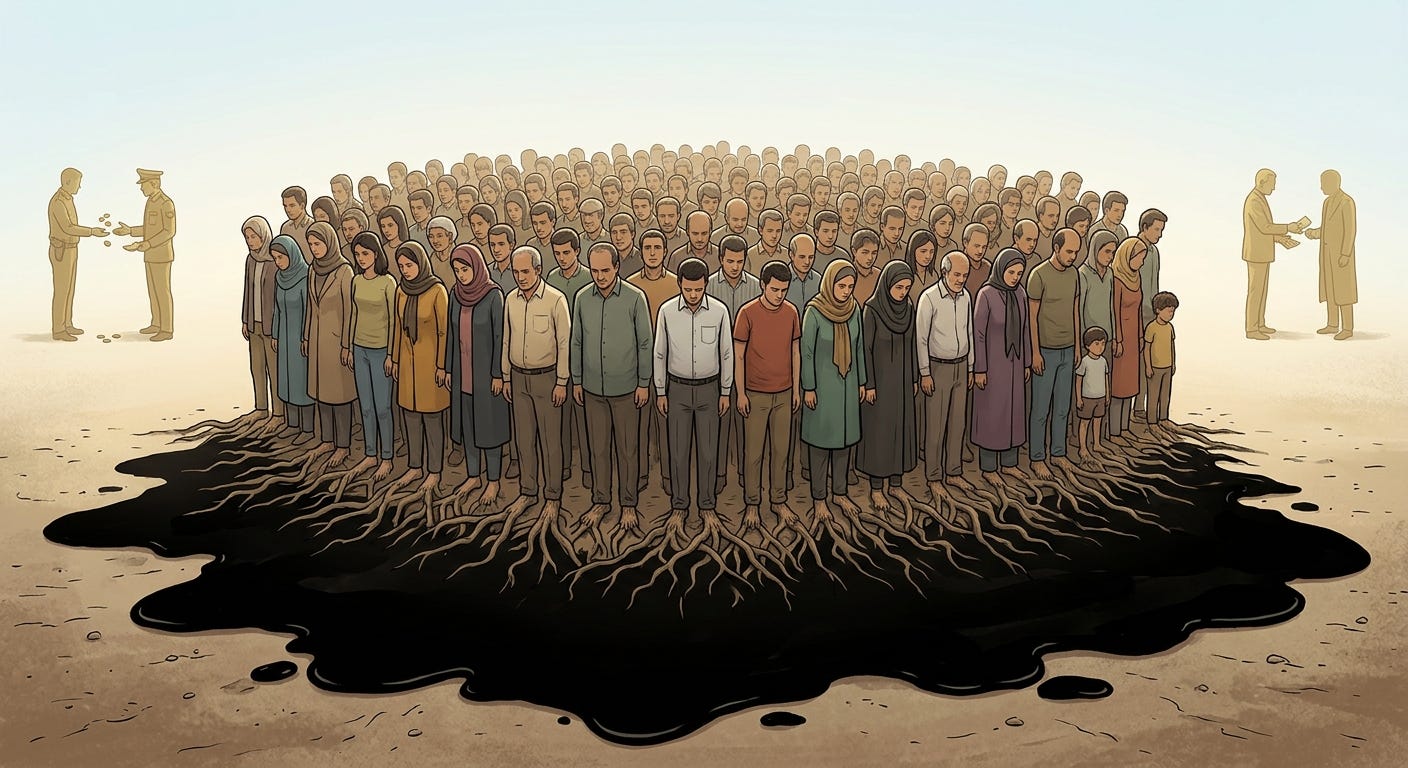
Coercion is not a policy category. It is a psychic one. Iran’s ruling ideologues have not persuaded their own population of anything, and they know it — so they reach for terror, which does something fear cannot: it bypasses the part of the mind that weighs costs and calculates resistance. Fear can be managed. A person who is afraid still calculates. A person who is terrorized cannot; terror throws the mind back into a state before calculation was possible, the helpless dependency of infancy, where the only available responses are submission or collapse. That regression, held in place on purpose, is what coercion actually buys.
Lewis Libby’s recent piece in the Washington Post treats the regime’s coercive apparatus as a matter of cash flow — cut off the oil revenue and the enforcers go unpaid. He is not wrong, but the payroll only explains one tier of the arrangement. The enforcer is bought; his loyalty is transactional and evaporates when the wage does. The population underneath him is not bought. It is terrorized, and terror does not run on the same ledger as payroll. A government can lose its capacity to pay and still hold a terrorized population in place for a long while, because what keeps that population still is not the next paycheck — it is the psychic residue of the last beating, the last disappearance, the last public hanging left to sway as a lesson.
Legitimate authority functions, psychically, as a container — Bion’s term for a mind, or an apparatus, that can receive a population’s raw anxiety and hand it back in a form that can be metabolized: a court, a vote, a grievance procedure, someplace frustration can go and become meaning instead of just accumulating. Iran’s ideologues offer no such container. They inflict terror and provide nowhere for it to go. It cannot be processed into political action because processing requires the very ego-function terror was designed to shut down. The population is left holding raw, undigested dread, which is precisely the condition a regime that cannot win an argument needs its subjects to stay in.
This is also why the regime’s negotiators are so exact about which lever they protect first. Sever the oil money and the enforcer tier destabilizes quickly — hired violence has no patience for an empty payroll. The terrorized tier underneath is slower to move, because it was never waiting on a wage. It is waiting on something else: proof, witnessed and repeated, that the regime’s power has limits. Until that proof arrives, the terror holds even after the enforcers have gone quiet, because the psychic residue outlasts the apparatus that produced it.
Washington’s task, then, is double, not single. Choking the payroll dismantles the transactional tier — the enforcers who show up only because they are paid to. It does nothing, by itself, for the tier underneath, the population still gripped by terror it has no way to metabolize. That population needs the second thing: visible, repeated evidence that the regime can be defied and survive the defying.
The proof has to do two things at once. It has to be witnessed, not merely true, and it has to show defiance going unpunished — a strike that wins a concession without its organizers disappearing, morality police pulling back from a neighborhood where women stay unveiled and nothing happens to them, a conscript’s refusal to fire on a crowd that costs him nothing visible, an execution announced and then quietly not carried out under pressure. A punished act of defiance only re-confirms the terror. An unpunished one is the only kind of evidence that can crack it, because what terror destroys first is the felt sense that survival after defying is possible and that one is not alone in wanting to try. This is also why the regime works harder to bury these moments than to deny them outright: buried, each stays a private, unverifiable rumor; witnessed, it becomes a shared fact a whole population can draw on. A rumor cannot do the psychic work that a crowd’s shared witnessing can.
Only that kind of proof reaches a hold that oil sanctions alone were never built to touch.
Dr. Kobrin is a counterterrorism expert and psychoanalyst holding a PhD in Islamic literature. She is a graduate of the Human Terrain Program, Leavenworth, KS. Her most recent book is A Soldier’s Guide to Hamas’s Genocidal Psychosis: The Unconscious in Psychological Warfare -- Beyond Ideology, Before Words.Atzmaut Press 2025. She is currently working on her seventh book Between Empire and Covenant—The Jewish Bond: Lotman, The Refuseniks and The Bukharan Jews, 1977. See her full body of work at her Amazon author page: https://www.amazon.com/stores/author/B002RF9D5Y