

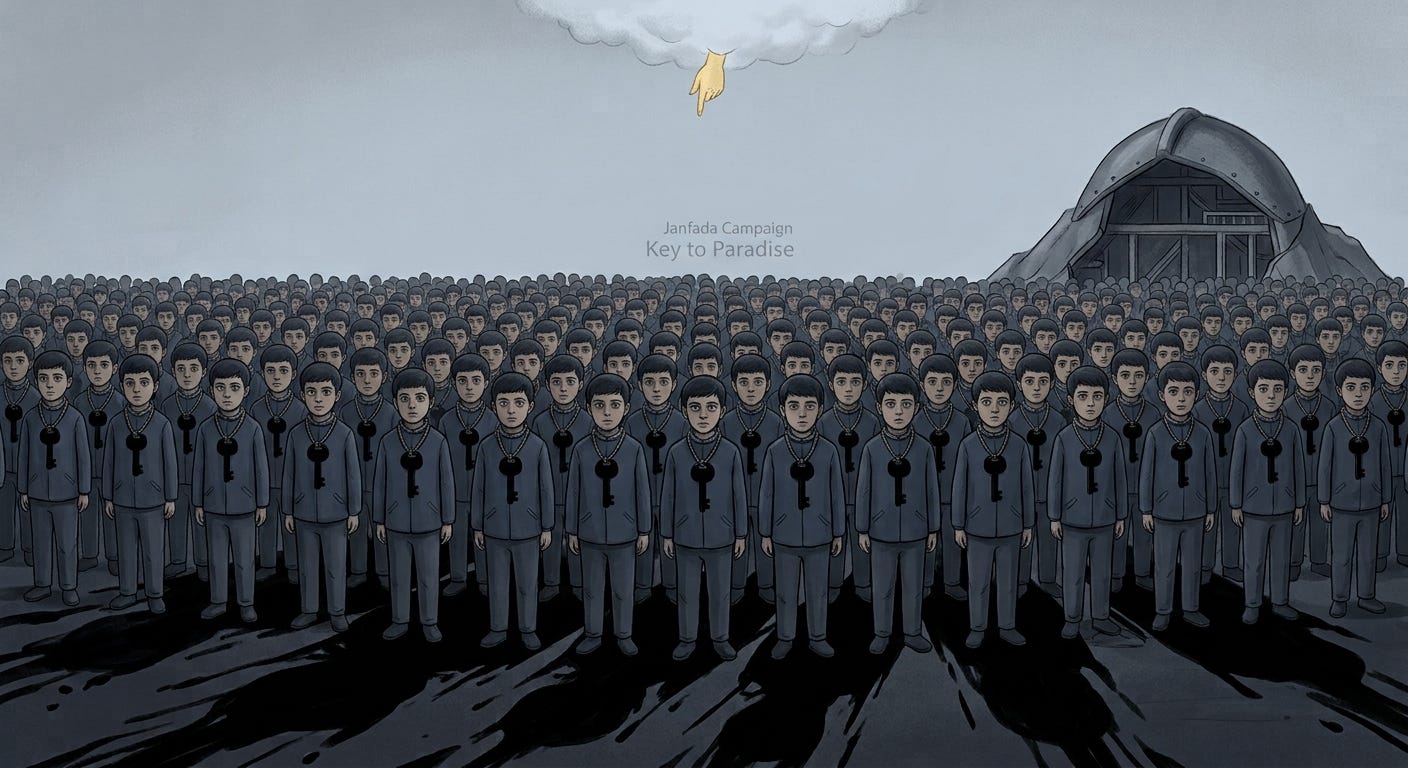
The Jerusalem Post reported this week that Iran’s Janfada — Persian for “one who sacrifices their life,” from jān, life, and fadā, sacrifice — campaign will soon train children under fifteen, with younger ages already being arranged for. In my previous post, Coercion, Not Conviction, I argued that terror works by throwing the adult mind back into a state before appraisal was possible — the helpless dependency of infancy. Janfada does something crueler and more efficient. It doesn’t need to force that regression. It recruits children before the mind has finished building the capacity terror is trying to undo in the first place.
Individuation is not a single event settled in infancy and then complete. Mahler’s early separation-individuation in the first years of life is only the first pass. Blos named the second: adolescence recycles the same developmental work at a higher register, building — through repeated passes, not one — the relatively autonomous, appraising self capable of weighing costs and choosing not to do something that they understood was hurtful. Each pass is supposed to leave a firmer self behind than the one before it.
This isn’t new to the regime; it is a return to method. During the Iran–Iraq War, the Ayatollah Khomeini ordered thousands of plastic keys from Taiwan to be hung around the necks of Iranian children sent to clear minefields with their own bodies, telling them and their terrorized parents that the key guaranteed entry into paradise (Kobrin, 2013, p. 31). The key was a psychic prosthesis in the plainest sense. A child that age has not yet built the apparatus to represent something as abstract as an afterlife on his own; the object did the holding his own mind could not yet do. But the key did a second, darker job as well: it let a regime that could not put its own terror into words hand that unspoken terror to a child directly, in the shape of an object, rather than as anything requiring language. The terrorist’s own inner deadness does not stay contained in him. It gets handed forward, concretely, to the next generation that cannot yet refuse it.
The body is not the only place this logic operates. In Shia practice, tatbir — striking the forehead with a blade during Ashura until it bleeds — carries the same instruction in its own root: the Persian tabar means axe. Children are cut too, and a child who watches, waiting his turn, carries what I’ve called the wordless knowledge that his body is not fully his to protect. Reich named the defense a vulnerable person builds character armor — casing that yields to nothing but a blow, once it has hardened. Tatbir enacts that logic directly on flesh, as devotion. A regime that buries its most guarded project under Pickaxe Mountain, named for the pickaxe required to break in, enacts the identical logic on a national scale. Across every register — the child’s forehead, the child’s psyche, the state’s own hidden interior — the working theory is the same: what is armored will not open to disclosure. Only the axe reaches it.
Janfada doesn’t need the plastic key or the blade, and the reason is worse than efficiency. A child raised inside a regime that reaches its own children this way — by object, by blade, and now by slogan — has typically had the developmental work symbolization requires — putting feelings into words, a genuine use of language, not a superficial one — foreclosed well before twelve. There is no undeveloped mind waiting for an object to hold its place; there is an impaired one that never finished building the capacity to symbolize at all. The slogan moves into that gap not as an idea the child has understood but as the latest instrument in a chain that already includes the key and the blade — force applied where language should have been. These children can sound devoted, can produce the sentences of belonging and sacrifice fluently, in exactly the way a language model (think AI) can produce fluent sentences without anything underneath organizing what the words refer to. It reads as conviction. It is closer to pattern than to meaning.
This is the deeper version of that earlier argument, and the four-decade arc shows how deliberate it is. An adult population is terrorized into a mind it once had and can, in principle, recover. A generation reached this way — key, blade, slogan, each engineered for its target — is not being regressed. It is being kept from ever finishing the pass that would have produced a mind capable of symbolizing its own experience, let alone resisting the regime’s. What is hidden inside a mountain can still be found, given enough force. What is foreclosed inside a child, once force replaces the word, is not something force can recover.
Dr. Kobrin is a counterterrorism expert and psychoanalyst holding a PhD in Islamic literature. She is a graduate of the Human Terrain Program, Leavenworth, KS. Her most recent book is A Soldier’s Guide to Hamas’s Genocidal Psychosis: The Unconscious in Psychological Warfare -- Beyond Ideology, Before Words.Atzmaut Press 2025. She is currently working on her seventh book Between Empire and Covenant—The Jewish Bond: Lotman, The Refuseniks and The Bukharan Jews, 1977. See her full body of work at her Amazon author page: https://www.amazon.com/stores/author/B002RF9D5Y