Steven Emerson’s six-part investigation of Abdul El-Sayed documents institutions, board minutes, appearances and public statements. Emerson is a meticulous investigative journalist, and I take his documents seriously. But they raise a harder question than whether El-Sayed ever joined the Muslim Brotherhood. Is membership the wrong test?
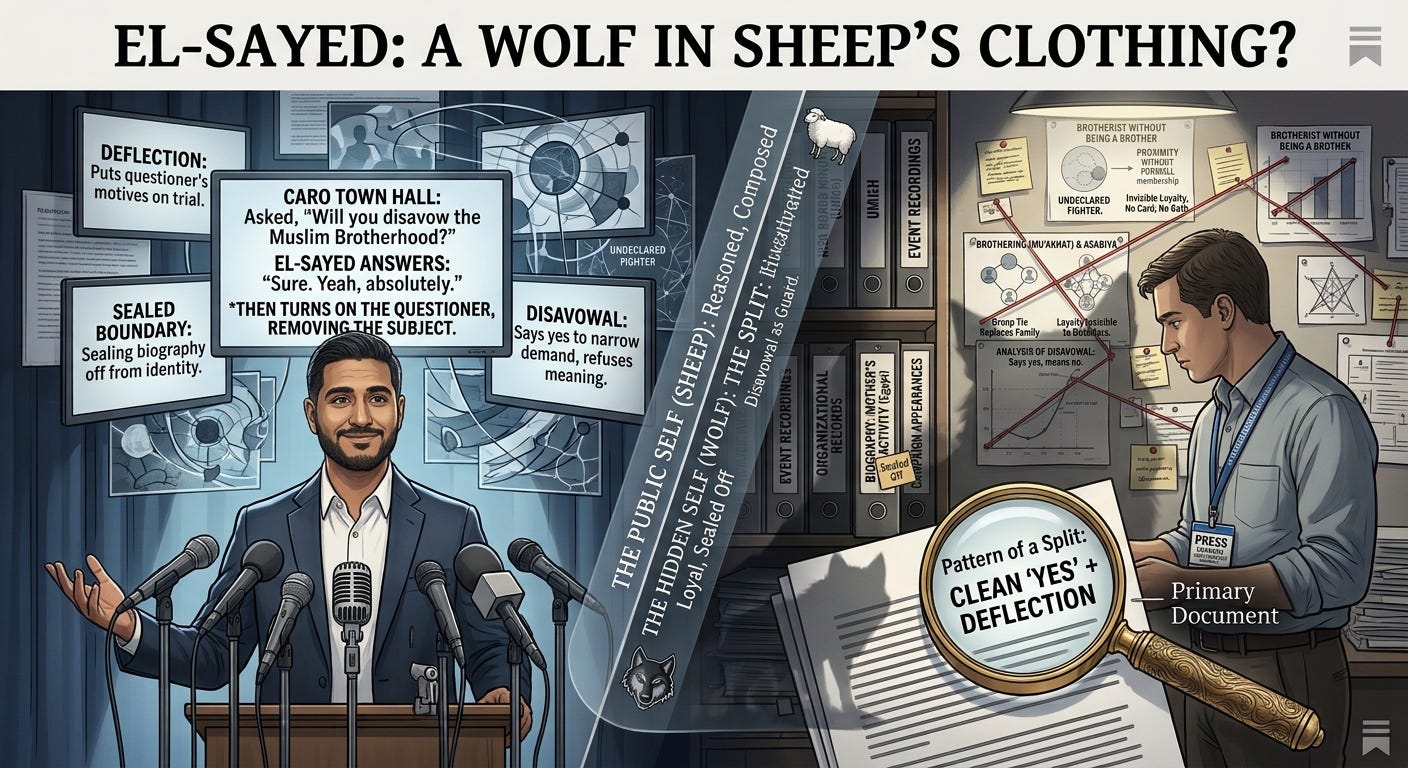
Hussein Aboubakr Mansour offers a sharper frame in his post “Brotherist Without Being a Brother.” A person may never formally join, may reject the label, and may still share the worldview and move within the institutions it shaped. Such a person is an undeclared fighter for the cause, with no card and no oath on record. How can we know what he believes in his heart? How can we tell a wolf in sheep’s clothing? This is a well-known strategy in jihadi terrorism.
Psychoanalytically, the underground jihadi lives by a split. He keeps two selves apart: a public self, composed and reasonable, who is the sheep, and a hidden self that carries the loyalty, who is the wolf. Neither may contaminate the other, so the border between them must be guarded constantly. Disavowal is the guard. It says yes to the narrow demand and refuses its meaning.
Watch the Caro town hall:

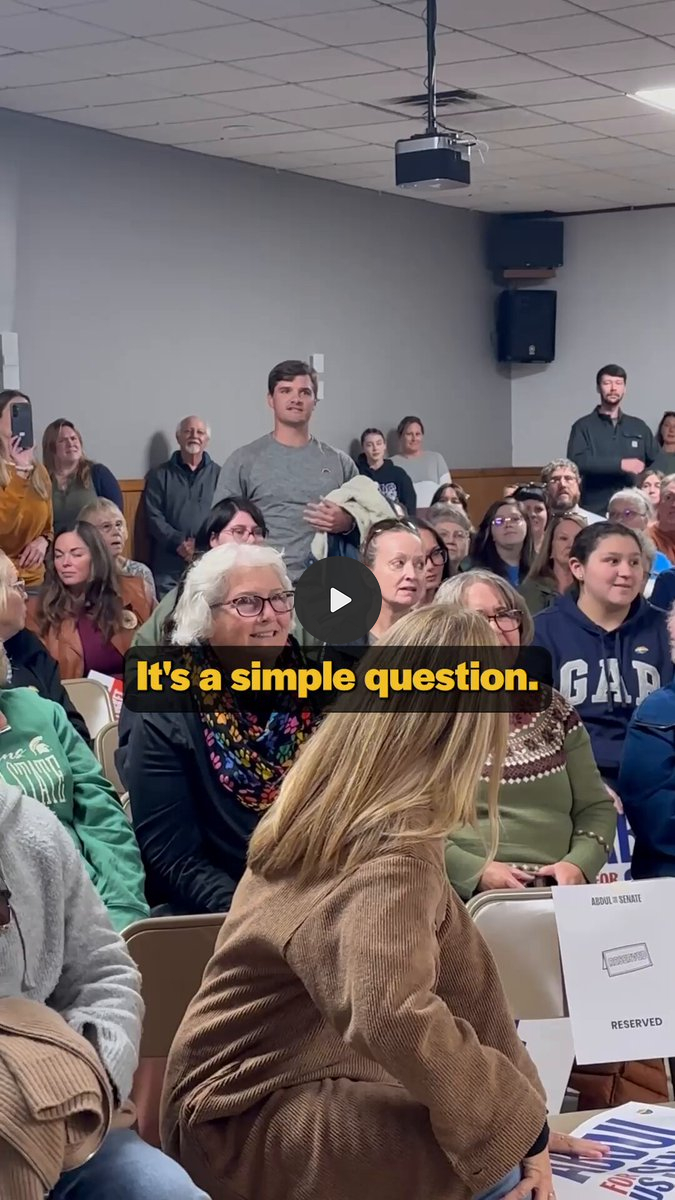
Asked, “Will you disavow the Muslim Brotherhood?” El-Sayed answers at once: “Sure, yeah, absolutely.” Then he turns on the questioner, asking why he is asking and what he assumes about his loyalties. He is upright and in command, with a trace of a smile. He never says what he rejects about the Brotherhood. The questioner’s motives go on trial instead. A real prejudice may lie behind the question, and the questioner admits to suspecting divided loyalties. But the exchange also removes the subject the question began with.
It is also very Western of us to expect a direct answer. Arabic has a saying, al-labib min al-isharah yafham, the intelligent man understands from a hint. Classical Arabic rhetoric even names the habit of meeting a questioner with something other than what he asked: uslub al-hakim, the wise response, in which the speaker sets the question aside and answers another, signaling what the questioner ought to have asked. For a listener who expects “yes” to mean yes, El-Sayed’s reply is a deflection. For a speaker formed in the other register, it is simply how a pointed question is met, and the hint is left for the listener to read. Either way, the voter cannot treat the “yes” as the end of the matter.
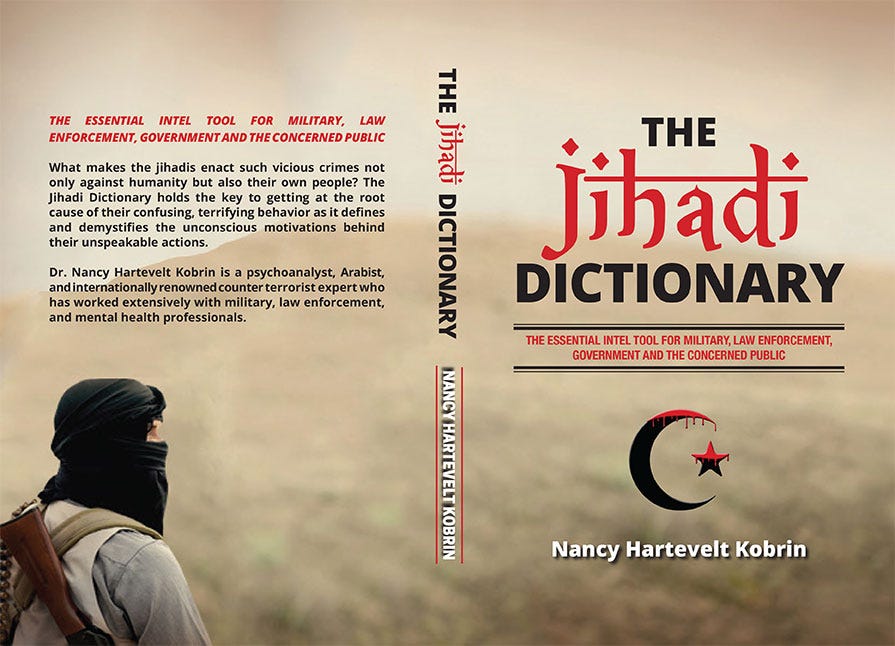
The word “Brotherist” points to something I address in my The Jihadi Dictionary: brothering, mu’akhat, the Islamic practice by which two unrelated men become brothers. Brothering is also tied to the Arab idea of asabiya, group solidarity and loyalty. The brother tie replaces the family tie and demands a loyalty invisible to outsiders. A man formed by that kind of bond could belong without ever being listed as a member, and could keep his loyalty hidden for years.
Then there is the mother. El-Sayed’s half-sister has written that their mother was active in the Brotherhood as a young woman in Egypt. His parents divorced when he was three, and his father and stepmother raised him. He says he never discussed the subject with her. This may be an ordinary result of separation. It may also be one more boundary, with biography sealed off from political identity. The interview cannot tell us which.
I do not claim that El-Sayed is a hidden jihadi but. . . Presence in a room is not assent, and sharp criticism of Israel is not proof of allegiance. Emerson’s series also reports that he has said “Hamas is wrong.” What I claim is narrower. A clean “yes” followed by deflection is the pattern of a split, and voters are entitled to ask what is on the other side of it. These are interpretive possibilities, not clinical findings.
The questions are these. What did you believe then? What do you believe now? Which parts of this inheritance do you accept, and which do you reject? What does “disavow” mean when you will not name what you disavow?
A clean “yes” can close a moment. It cannot explain a life.
Sources:
Steven Emerson, six-part investigation of Abdul El-Sayed
Hussein Aboubakr Mansour, “Brotherist Without Being a Brother”
Caro town hall exchange, posted by Abdul El-Sayed on X, October 17-18, 2026:
PolitiFact, “Mike Rogers said Abdul El-Sayed didn’t disavow the Muslim Brotherhood. Video shows he did,” October 19, 2026: https://politifact.com/factchecks/2026/oct/19/mike-rogers/el-sayed-muslim-brotherhood-michigan-senate/
Washington Post, “El-Sayed Again Denies Ties to Muslim Brotherhood,” October 15, 2026: https://www.washingtonpost.com/politics/2026/10/15/el-sayed-again-denies-ties-muslim-brotherhood/
Encyclopedia of Arabic Rhetoric, “Wise Response” (uslub al-hakim): https://al-balagha.com/wiki/WISE:_Wise_Response
Nancy Hartevelt Kobrin, The Jihadi Dictionary, p. 43
Nancy Hartevelt Kobrin, PhD, is a Tel Aviv–based psychoanalyst and counterterrorism scholar.
https://www.amazon.com/Nancy-Kobrin/e/B002RF9D5Y