

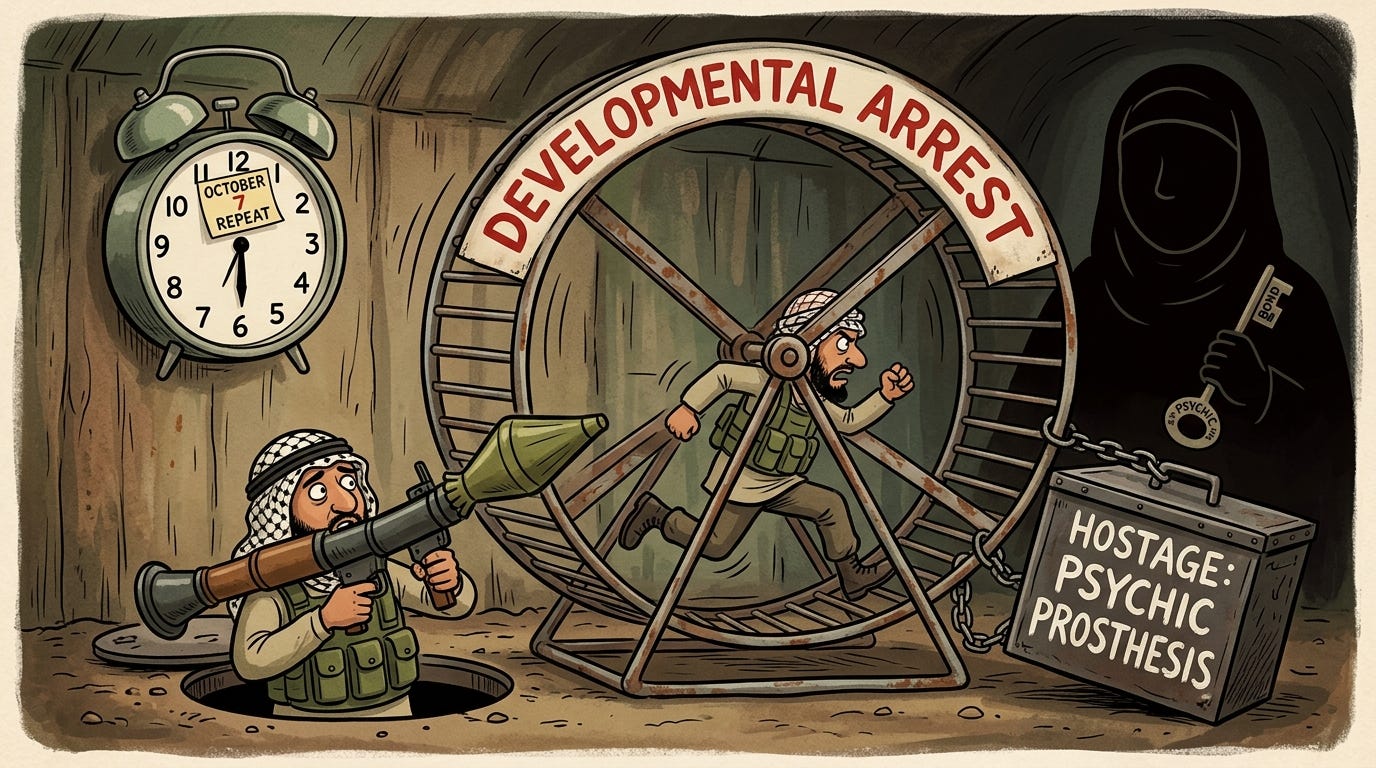
Political science, international relations, and most terrorism studies operate almost entirely at the level of stated ideology, strategy, and observable behavior — the visible ten percent of the iceberg. Psychoanalysis has long understood that the vast majority of mental life, by most estimates some ninety-five percent, operates unconsciously. A field that confines itself to ideology is, by definition, working with a fraction of the picture. This is not a rhetorical flourish; it is why analysts keep being surprised when “rational” incentives fail to produce rational outcomes, and why the accusation of genocide keeps landing on the one party the evidence least supports.
Take the recurring puzzle of why Hamas will not disarm. Framed strategically, the weapons are an asset — leverage, deterrence, a bargaining chip to be traded when the price is right. But viewed developmentally, the refusal to disarm reads differently. Arms-bearing, and the identity built around it, function as a developmental prosthesis: a substitute for a self that was never permitted to individuate. The weapon does the psychic work that a securely separated self would otherwise do on its own.
The same dynamic is visible in hostage-taking. A purely strategic actor treats a hostage as fungible currency — interchangeable, tradeable the moment the exchange value is right. What the record shows instead is something closer to fusion: retention past the point of rational advantage, refusal of otherwise favorable terms, a compulsion to keep the object physically close rather than release it. This is not an actor simply stuck in an undifferentiated state. It is, more precisely, an actor endlessly attempting separation and endlessly failing — Groundhog Day rather than stasis. Each cycle of violence, each collapsed negotiation, is not evidence of strategic learning but of the same developmental attempt at separation replaying, because the internal conditions that would let it complete were never established in infancy.
The roots of this failure lie in traumatic bonding: the infant, especially the male infant, misused as a narcissistic object rather than related to as a separate person, denied the ordinary developmental permission to individuate. Without that separation, the cognitive architecture individuation normally produces — reality-testing, tolerance for ambivalence, theory of mind, the capacity to imagine another person’s interior life — fails to develop. The result is a reverse world in which good is bad and bad is good. That reversal is not produced by ideology. It is produced by a psychic structure already in place from the developmental failure — and ideology only arrives afterward, to give that structure two things: a specific target to attach to, and a socially respectable justification for acting on it.
In shame-honor cultures, and Arab Muslim culture in particular, this dynamic is compounded by an unconscious taboo against separating from the mother — an unseverable bond, in the psychiatrist Sami Timimi’s own phrase, though Timimi himself did not draw out the full implication of what he was describing. The mother and her body remain the organizing psychic reality, producing a psychosexual confusion that outlives childhood. The bodily mutilation and beheading seen in Hamas violence are not senseless excess; they are concrete, unelaborated repetitions of an injury that was never permitted symbolic expression — an unconscious attack on the maternal body, the same dynamic clinicians recognize in serial killing.
This is why the most organized perpetrators can look, on the surface, entirely normal. Yahya Sinwar is an instructive case: patient, strategic, capable of playing a genuinely long game. But the organized presentation is what clinicians call an as-if personality — a convincing performance of a normal self, assembled on top of an underlying arrest rather than replacing it. The performance and the arrest coexist; the performance does not resolve the arrest, it only conceals it. Even the most disciplined predator can show the crack in the veneer, and when it shows, it shows in exactly the concrete, bodily register the performance was built to conceal. Indeed I authored an essay entitled The Violent Brutality of Growing Up in a Shame Honor Culture. It’s not a fun place.
Mosab Hassan Yousef, the “Green Prince,” son of a Hamas founder, put it more plainly than any theorist: the greatest enemy in his culture is shame. He would know.
The unseparated mother, and the unfinished self
I have made this argument at the level of the perpetrator before, and I want to draw the threads together here rather than leave them scattered across separate pieces. In “Sheikha Moza Still Lives,” I argued that Emir Tamim of Qatar has never undergone separation-individuation from his mother, Sheikha Moza bint Nasser, because that rupture is taboo in his culture — so her Judaeophobia remains embedded in his own psyche rather than functioning as a policy he could simply update with better information. Qatar’s billions in anti-Israel media funding, its harboring of Hamas leadership, its bankrolling of the very campus infrastructure that produces the “genocidaire” vocabulary — none of it is best explained as cold strategic calculation. It is the enactment, at state scale, of a son who never separated from his mother’s hatred because he was never permitted to separate from her at all.
In “The Unseen Years of Fatten Elkomy & Her Infant Son Abdul El-Sayed,” I traced the same mechanism through a very different figure: an American public official whose own mother worked for years at a Hamas-linked, Treasury-designated terror-financing organization during his adolescence, itself a second vulnerability window layered atop the foundational unseen years — birth to age three — when, as Vamik Volkan’s work on the need for an enemy makes clear, the psyche’s targets for hatred are already being fixed in place. El-Sayed does not argue for a ceasefire. He reaches for “genocide” the way a heat-seeking missile reaches for its target, because the object was assigned before he had words for it.
And in “Israeli = Jew = Zionist = Genocidaire,” I traced the word itself through its stages — how a nationality becomes a religion becomes an ideology becomes an accusation of the century’s defining atrocity, each step erasing a little more of the actual person underneath, until the Jew disappears entirely into a label built to be killed. Zohran Mamdani’s rhetoric belongs on that same ladder. Different biography, different continent, same word, arrived at by the same route: not analysis of what Israel has done, but discharge of what the speaker cannot locate or resolve in himself.
The fourth word
Which brings us to where these three pieces converge. Israeli. Jew. Zionist. Genocidaire. Each accusation an escalation of the last, and each one running in the opposite direction from the evidence. There is a reason the charge lands on Israel with such force and such repetition — from Al Thani’s Qatar, from Mamdani, from El-Sayed — even as the facts point elsewhere. It is not merely political convenience, though it is certainly that too. It is projection in the clinical sense: the unbearable content is relocated onto the object best suited to carry it, and the object chosen is invariably the one who was actually harmed. This is the reverse world described above, applied to language rather than to bodies. The word “genocidaire” does not describe Israel’s conduct. It describes something the speaker cannot bear to find in himself — or trace back to his mother, or locate in the movement he serves — and so relocates onto Israel instead.
This is not incidental to the developmental argument; it is the same argument, applied to rhetoric instead of violence. A psyche that never developed theory of mind i.e. walk in the other’s shoes, cannot accurately imagine what an adversary actually intends. It can only take feelings and impulses it cannot bear to recognize as its own self, and place them onto the adversary instead, and then experience that placement as if it were simply an observed fact about the adversary — not as something it has done, but as something it has seen. Zionism as Nazism, self-defense as extermination, the hostage-taker’s own weapon reframed as the victim’s crime: each is the identical operation, performed with a word instead of a knife. The accusation is not analysis. It is confession, spoken in the second person, by a son, a mother’s son, an unseparated son — three of them, on three different continents, using the same word because none of them ever finished the work of becoming a separate person. And it takes a separate person, one who can distinguish their own mind from another’s, to see a genuine act of genocide clearly enough to name it correctly.
And it is worth noting what did not happen once the shooting started on October 7: not one hostage was helped to freedom by the Gazan population around them — a silence with no equivalent among the Righteous Among the Nations who risked everything to hide a single Jewish family under a regime far more lethally enforced than anything in Gaza.
Dr. Kobrin is a counterterrorism expert and psychoanalyst holding a PhD in Islamic literature. Her most recent A Soldier’s Guide to Hamas’s Genocidal Psychosis: The Unconscious in Psychological Warfare -- Beyond Ideology, Before Words. Atzmaut Press 2025. She is currently working on her seventh book 1977—Between Empire and Covenant: The Jewish Bond, The Refuseniks and The Bukharan Jews. See her full body of work at her Amazon author page: https://www.amazon.com/stores/author/B002RF9D5Y