

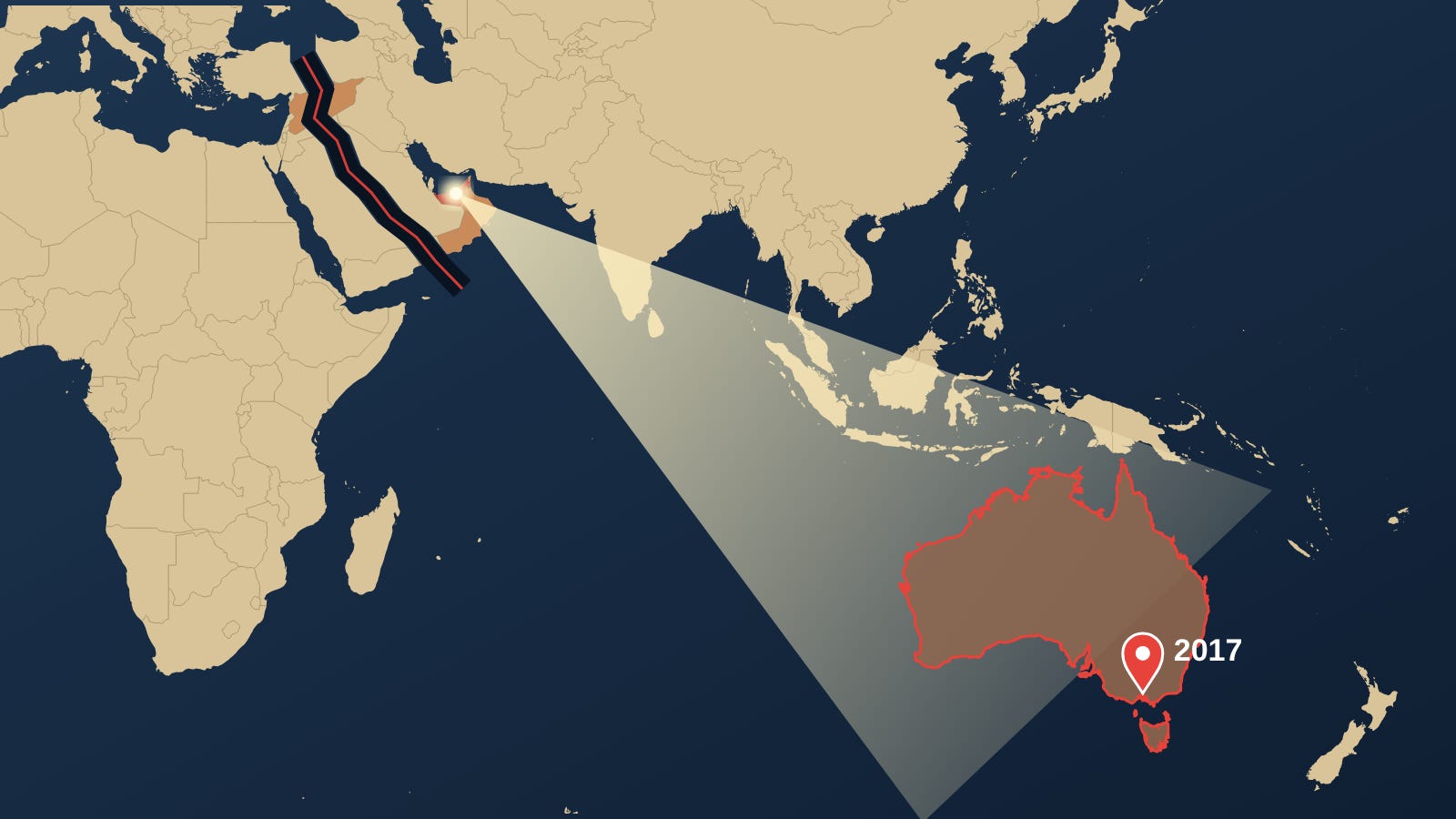
On October 9, the UAE’s Attorney General, Hamad Saif Al Shamsi, released the findings of the investigation into Hamam al-Hammami, the Omani copilot who tried to crash a Flydubai plane full of Israelis into Ben Gurion Airport on September 30. The statement was detailed and, by Gulf standards, unusually frank. Al-Hammami, 29, confessed. He was inspired by September 11. He trained in boxing with a private coach. He used two earlier flights to Israel to study the route and the target. He claims he acted alone. And, according to the Attorney General, “signs of his drift towards extremism and terrorism first emerged in 2017,” while he was studying in Australia.
The headlines took it from there: radicalized in Australia. For a country still living with the Bondi Beach massacre, when an ISIS-inspired gunman killed fifteen people at a Hanukkah celebration last December, Australia makes a convenient address. It is easy to believe.
Read the Attorney General’s words again. Signs first emerged. A sign is not an origin. It is what breaks the surface. In my work I call this the Volcanic Iceberg: the visible five percent—the reading, the videos, the boxing lessons—rides on a ninety-five percent no one sees, a seething mass of rage that was building long before it showed itself. Melbourne in 2017 is where the tip of the iceberg appeared. It is not where the volcano formed.
Consider what the official story leaves out. Al-Hammami was born in the UAE to an Omani father and a Syrian mother. He was about fourteen when Syria, his mother’s country, collapsed into civil war in 2011. In January 2012, Abu Mohammad al-Jolani founded the Nusra Front, al-Qaeda’s branch in Syria. The man who led it now rules Damascus as Ahmed al-Sharaa, welcomed in Gulf capitals. Al-Hammami spent his adolescence watching his mother’s homeland torn apart by jihadi war, at the very age when a boy tries to separate from his mother for the second time (the first being around age three) and looks for a cause, a group and a father to follow. What did his mother lose in those years? Whom did she mourn? What did her son hear at the dinner table? We hear nothing about it. Not one word.
There is also what happened inside the Gulf. Before Flydubai, al-Hammami flew for Oman Air for about seven years, until February 2025. Between Oman Air and Flydubai, he flew for Royal Air Maroc from June 2025 to January 2026. Reporting says he was removed from flight training over his extremist views and reassigned to another position. If that is true, then the signs were seen at home, in the Gulf, long after Melbourne, and he was hired anyway. Placing the beginning in Australia moves the problem seven thousand miles away from the Gulf’s own airlines, from Syria and from al-Sharaa, and above all from the family.
This is a familiar move. Each time a jihadi strikes, the search begins for the place where he was “radicalized,” as if extremism were a virus caught on a trip abroad. The mosque, the website, the university, the foreign city. Each of these matters. But each is the second chapter. The first chapter is written in the unseen years from zero to three, in the bond with the mother, which terrorism later recycles into a bond with death and with the enemy. A young man does not walk into Melbourne as a blank page. He brings his mother’s grief, his father’s silence and his country’s wars with him. The ideology he finds there gives his rage a name, a target and convenient packaging. It does not create a rage which exceeds murder itself.
There is a deeper reason the Emirates reach for Australia. Simon Sebag Montefiore’s book The Cauldron: The Making of the Modern Middle East tells the story of a Middle East that has grown less diverse and less tolerant since 1979, the year of the Iranian Revolution and of the Mahdist seizure of the Grand Mosque in Mecca, while holding on to the older, open tradition of Islamic dynasties that practiced convivencia. It is tempting to read this as two Islams, a good one and a bad one, the open Islam of the Abraham Accords and the apocalyptic Islam of al-Qaeda, whose South Asian branch named its magazine for Ghazwa-e-Hind, the prophesied battle of the end of days. But that is a trap. It is splitting, the most primitive defense of the mind, and we should not fall into it. The question is not which Islam is real but how the two function together: how one can hide behind the other, and how the open face can carry away the shame of the apocalyptic one. Shame is a huge issue in Arab Muslim culture, and shame must go somewhere. Moving al-Hammami’s radicalization to Australia is how it gets rid of its shame. The Emiratis admit they did not catch him. They did not have the early childhood tools to see a rage which exceeds murder itself. But the shame of where that rage was raised is shipped abroad.
To its credit, the UAE has conceded that it did not detect al-Hammami’s radicalization and that Flydubai found he met its professional and security criteria. That admission matters, and the Emiratis deserve credit for not sweeping the attack under the rug. As Roi Kais, Kan News’s Arab affairs correspondent, reported, Emirati sources close to the government say the message is that the UAE is “a state of justice and law,” and that the copilot’s punishment will be “very significant,” ranging from life in prison to death. The reputation of the Emirates’ aviation industry, one of its most important, is at stake. But the investigation is not finished, and it should not stop at the Australian border. Investigators are still checking whether anyone helped him. They should also be asking who raised him, what happened to his mother’s family in Syria, and what he carried with him long before he ever boarded a plane to Melbourne. This issue must be addressed publicly. The citizens of the UAE, like those of all other countries, should be educated about the real problem: early childhood development that went drastically wrong. Until that is done, and it means more than just removing anti-Israel hatred from textbooks, nothing, zero, will get better.
An alibi places the accused somewhere else at the moment of the crime. Australia has become al-Hammami’s alibi, and the Gulf’s. The crime did not begin in Melbourne. It began much closer to home.
Sources
ABC News (Australia), “Investigators say flydubai co-pilot’s ‘drift towards terrorism’ started in Australia,” October 10, 2026. https://www.abc.net.au/news/2026-10-10/flydubai-investigation-copilot-drift-to-extremism/107250928
Al Jazeera, “Flydubai co-pilot plotted ‘suicide attack’ on Israel, UAE says,” October 9, 2026. https://www.aljazeera.com/news/2026/10/9/flydubai-co-pilot-plotted-suicide-attack-on-israel-uae-says
Al Jazeera, “Who is the mystery co-pilot behind the Flydubai attack?” October 3, 2026. https://www.aljazeera.com/news/2026/10/3/who-is-the-mystery-co-pilot-behind-the-flydubai-attack
Roi Kais, Kan News, October 9, 2026, on the UAE Attorney General’s statement.
Okaz, “His mother is Syrian and he studied in Britain: new details about al-Humami” (Arabic), October 2026.https://www.okaz.com.sa/politics/na/2269078
Simon Sebag Montefiore, The Cauldron: The Making of the Modern Middle East (Knopf / Weidenfeld & Nicolson, 2026). https://www.hachette.co.uk/titles/simon-sebag-montefiore/the-cauldron/9781399634892/
Wikipedia, “Royal Commission on Antisemitism and Social Cohesion” (on the Bondi Beach attack of December 14, 2025).
Nancy Hartevelt Kobrin, PhD, is a Tel Aviv–based psychoanalyst and counterterrorism scholar. https://www.amazon.com/Nancy-Kobrin/e/B002RF9D5Y