

When I conducted prison interviews, I asked the prisoners whether they preferred the term jihadist or jihadi. They laughed at me and said they called themselves jihadis. That exchange taught me to begin with people’s own words for themselves.
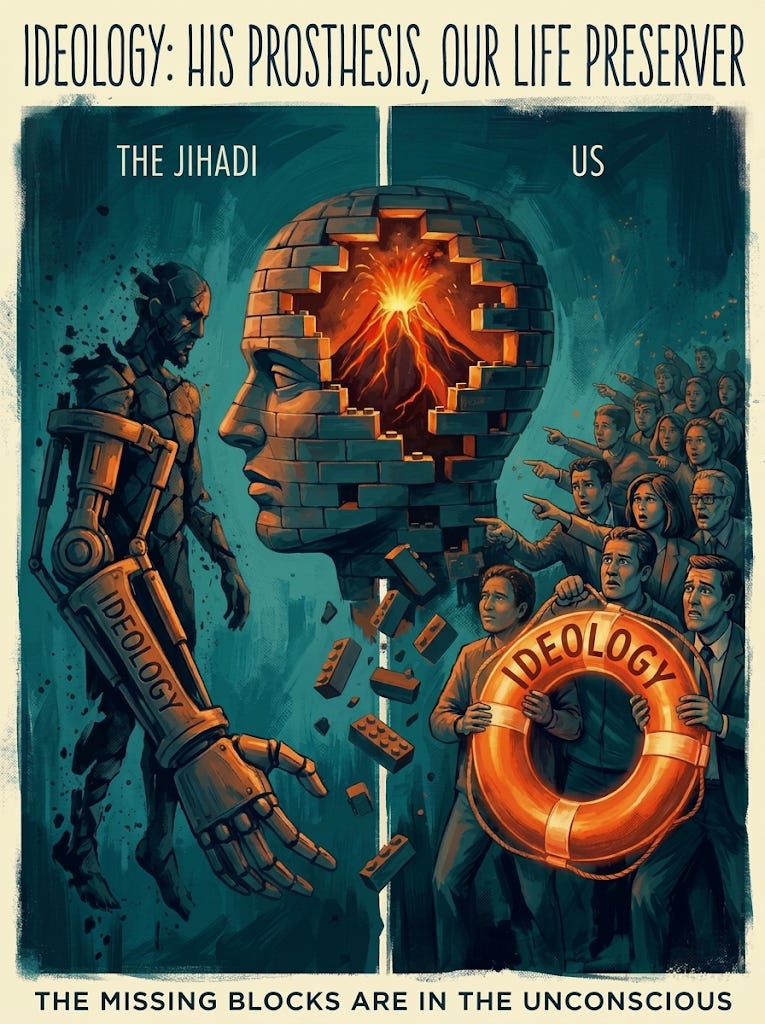
Bernard Lewis argued that to fight terrorists effectively, we need to understand the forces that drive them. I agree, and I think we have stopped too soon. We point at ideology and say, there is the problem. It is visible, quotable, and has a name and a bookshelf. We can ban it, debunk it, and rewrite the textbooks that carry it. That work matters. But ideology has become our life preserver, the thing we grab on to because we are terrified and we can see it, name it, and hold on to it. It is not a missing Lego block. It is the block everyone can see, so we stop looking for the ones that are missing and fundamental to the problem.
Changing textbooks is topical. It treats the surface. Cognitive scientists have a rule of thumb that about 95 percent of thinking is unconscious, and psychoanalysis tells us what fills that unconscious. That is where the problem is coming from. If we look only at what the jihadi says he believes, we miss what drives him to believe it because even he does not have the self-awareness to understand why he has an obsession with the Jews and a rage that exceeds murder itself for the genocide of the Jewish people.
Ideology is the envelope, the wrapping paper for the package of unmet psychological needs. These are needs that Maslow’s Pyramid of Basic Needs completely missed. Ideology also has a hidden developmental function. It organizes a fractured sense of self, turns shame into certainty, replaces helplessness with purpose, and offers belonging, status, and moral worth. It does more than explain the world. It helps the person bear what he cannot bear. Humiliation becomes proof of a chosen struggle, and the person who was powerless becomes the avenger.
Two different people cling to ideology, for different reasons. The jihadi clings to it as a psychic prosthesis, an artificial limb that holds up a self that never developed securely. We cling to it as a life preserver. His behavior is so murderous and terrifying that we need something we can point to and say, behold, here is the problem to solve. His ideology props up his mind. Our focus on his ideology keeps us afloat, because it lets us believe the problem can be solved without looking inside him.
My psychoanalytic developmental approach asks what is inside the package and looks for its visual signs: the need for dignity after humiliation, belonging after rejection, agency after powerlessness. Shaming practices in shame-honor families and cultures leave these needs unmet. The extreme shaming fosters a reading of the Quran in black and white terms, the Mecca verses against the Medina verses, which promotes psychological splitting into the binary world that Isaiah 5:20 articulates for the obsessively predatory jihadis: “Woe unto them who call evil good and good evil.” Ideology then gives the injury a story, names an enemy, and makes violence seem justified, even obligatory.
Why the Jew? The ideology answers part of it. The Hamas charter names the Jew as the enemy and calls for his killing, and it draws on the hadith of the stones and trees, in which even nature joins the hunt. But ideology only gives the hatred an address. It does not explain the intensity. A person raised in a shame-honor culture carries humiliation he cannot bear to feel. The ideology tells him where to put it: the Jew becomes the one who holds the shame, the one who must be destroyed so the shame disappears. That is why the hatred is so total, and why it cannot be negotiated away.
October 7 showed us this world. The terrorists did not hide it. They painted their inner life in blood across the Gaza envelope, in its gory details. They filmed themselves with GoPro cameras and phoned their mothers and families to boast of the killing. Every image and every call tells us what lives inside them. This is psychoanalytic visual intelligence: reading what the perpetrators themselves put in front of us. What we see there is a psychotic world, with bodies treated as objects to be torn apart and the genocidal charter acting as its script. They told us who they are. The question is whether we are willing to read it.
The missing Lego blocks are the steps connecting early experience to action:
shaming practices → unmet psychological needs → a search for dignity, belonging, and agency → ideology’s hidden developmental function → a moral story that directs the injury outward → action
This is a psychoanalytic developmental account, not a claim that every jihadi has the same childhood, family, or motive. Nor is ideology decorative. Its psychological function and its political content work together: it meets inner needs while teaching the person whom to hate and what to do. If we fight only the ideas, we are treating the symptom and clinging to the life preserver. Ideology is what we can see. The jihadi who needs it, is the one we have yet to understand.
Sources:
Lakoff, George, and Mark Johnson. Philosophy in the Flesh. Basic Books, 1999.
Lewis, Bernard. The Crisis of Islam. Modern Library, 2003.
Kobrin, Nancy Hartevelt. The Banality of Suicide Terrorism.
Hamas Covenant (1988), Article 7, on the hadith of the stones and trees. Avalon Project, Yale Law School.
Nancy Hartevelt Kobrin, PhD, is a Tel Aviv–based psychoanalyst and counterterrorism scholar.
https://www.amazon.com/Nancy-Kobrin/e/B002RF9D5Y
We know that to change psychological dynamics set up by developmental deprivation/ shame/ unmet needs may take years of psychotherapy/ psychoanalysis. Hamas jihadis will never receive this and so there is no hope they will change. Israel kills terrorists. The world is outraged that so many are being killed. But the killing would appear to confirm that Israel upholds this idea: jihad is cannot change so must be eliminated. I have come to accept this but am nonetheless left feeling somewhat discomfited each time I read about the targeted killings, and photos of smiling young men who are named accompany the notification