On Wednesday, in a motion asking a federal court in Washington to keep the search warrant for her home sealed, the U.S. Attorney’s office referred to the congresswoman as “Ilhan Nur Said Elmi, a/k/a Ilhan Abdullahi Omar.” Minnesota voters know her by the second name. The government is using the first.
A Somali name is a chain: your own name, then your father’s, then his father’s. “Ilhan Nur Said Elmi” means Ilhan, child of Nur Said Elmi. According to the New York Post, her late father, known publicly as Nur Omar Mohamed, also went by Nur Said Elmi, and a 1997 British marriage certificate for Leila Nur Said, thought to be Omar’s sister, lists her father as Nur Said Elmi, a military officer from Somalia. The man Omar married in 2009 is Ahmed Nur Said Elmi. Names repeat across clans, and none of this is proof. No charges have been filed, and she denies that Elmi is her brother. But the government has now put in writing the name that ties her to her father’s line.
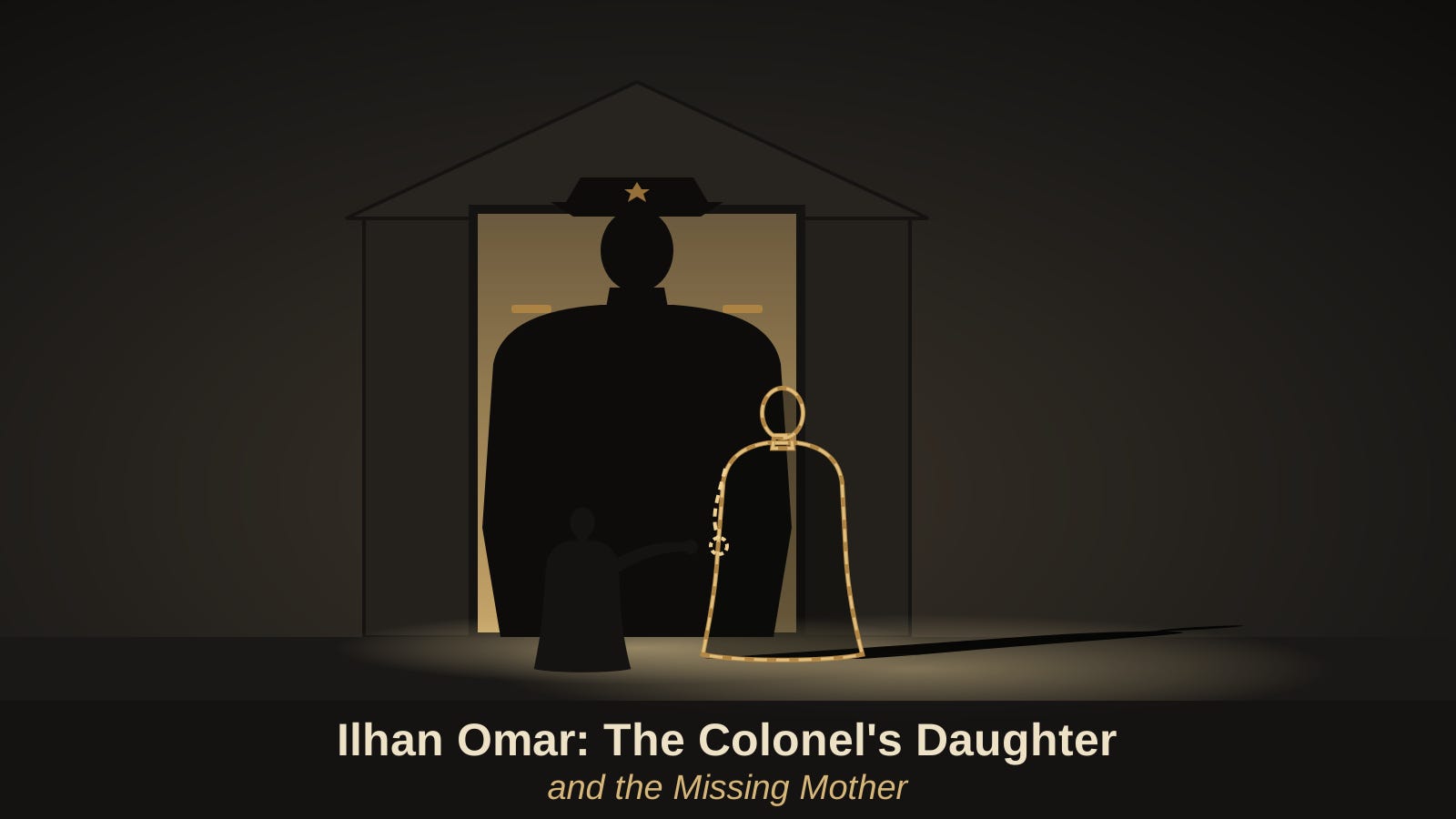
So who was the father? In her memoir Omar calls him an educator. Her own community’s newspaper, the Sahan Journal, remembered him at his death in 2020 as a Soviet-trained colonel in Siad Barre’s army who commanded a regiment in the 1977–78 war against Ethiopia and served until the regime fell in 1991. By clan he was Majeerteen, a sub-clan of the Darod, the same clan family as Barre, who was Marehan Darod. After Majeerteen officers led a failed coup against Barre in 1978, he kept his commission and served on. Barre’s reprisals left about 2,000 Majeerteen dead, men of his own clan. Psychoanalysis has a name for staying loyal to the one who destroys your own: identification with the aggressor, as Anna Freud described it. That is the house the daughter grew up in. Those years include the Isaaq genocide of 1987–1989, when that army bombed Hargeisa and Burao to rubble and killed tens of thousands of civilians. A 2001 report commissioned by the United Nations concluded that the genocide was “conceived, planned and perpetrated by the Somali Government.” No document I have seen places him personally at the killings. But he was an officer of the army that carried them out, loyal to the regime, according to the historian Mohamed Haji Ingiriis, until the end. American law bars from refugee protection anyone who assisted in the persecution of others. A colonel who served that regime to its last day should never have been admitted to the United States as a refugee without a hard look at what he did. On October 24, Saeed Ibrahim, founder of the Somaliland Chronicle, went on Newsmax to question her family’s refugee history. For the survivors’ own community, this is not a partisan question.
The father is half the story. The other half is the mother, who is almost absent from the record. In her memoir Omar writes that her mother, a Benadiri woman from a coastal minority outside the large clan families, died when Omar was two. She gives no name, no cause of death and almost no memories. A second mother figure was lost on the way out: her aunt Fos, who fled with the family, died of malaria in the Kenyan refugee camp. Omar herself describes the trauma she carried for years afterward. Among Somali women of her generation, genital cutting was nearly universal; UNICEF puts it at about 98 percent. I do not know what happened to Omar’s mother, and I am not diagnosing Omar. But I note that in 2019, when a Muslim activist asked her to speak out against female genital mutilation, she called the question “appalling.”
Early mother loss is a trauma in its own right. The infant builds a self out of the attachment to the mother: her face, her voice, her holding. Separation, as Margaret Mahler described it, needs a mother to separate from. When she disappears before that work is done, the child does not separate. She clings to whatever remains. In a clan culture, what remains is the father’s house. A secure mind can say plainly who its family is. A mind organized around an early loss holds those facts loosely, and they shift.
That is the confusion we keep seeing. A birth year that changed. A father with more than one name. And, asked directly by Chris Hayes whether she is related to her former husband, the answer “Not to my knowledge.” Most people know who their brothers are. The answer is careful, but it is also confused, as if knowledge of her own family belonged somewhere else: to the elders, to the paperwork, to the father.
The Torah places the beginning of the moral life in a departure. “Therefore shall a man leave his father and his mother, and shall cleave unto his wife” (Genesis 2:24). From this verse the Talmud derives the prohibition of incest for all nations. Abraham’s first command is the same: “Get thee out of thy country, and from thy kindred, and from thy father’s house” (Genesis 12:1). Omar lost her mother before she could leave her. She has never left her father.
We in the West badly underestimate what the clan means. Where the self has not separated from the group, loyalty runs to kin, not to rules. Jobs, contracts and favors travel along family and clan lines, connections count for more than competence, and hiring a stranger over a cousin is a betrayal. In the clan’s eyes this is not corruption. It is duty. But it cannot produce a meritocracy, because merit belongs to the individual, and the individual is exactly what the clan does not allow.
On Friday, she posted a 27-second video of herself strolling by a Minnesota lake with her husband, set to a Somali hip-hop track. To English speakers it looks serene. In a certified translation commissioned by the Washington Free Beacon, the lyrics say: “Yes, you will suffer and cry in seething. … We are the ones who rule this land.” Calm for Americans, revenge for the clan, and only the clan hears the threat. The boast is the other face of shame: the more she is exposed, the louder she boasts.
Her father died six years ago, yet he stands at the center of the investigation. Prosecutors are reportedly considering naming him as an unindicted co-conspirator. The papers in question were filed by him, in her name, when she was a child, and her defense keeps the responsibility with him. The colonel is still the head of the house, and she still speaks from inside it.
What is missing from all of this is her mother. She appears in no court filing and barely in the public story of her daughter’s life. Yet she is the one Omar needed most and had least. Abdul El-Sayed, the Michigan Senate candidate, was about three when his parents divorced and custody passed to his father’s side, away from his mother, Fatten Elkomy. Two politicians, two missing mothers, and the same reflex: when a question touches the family, the answer belongs to the clan. A daughter who loses her mother before she can leave her stays with the father. She carries his name, keeps to his account, and answers for him rather than for herself. The government has now named her as Ilhan Nur Said Elmi, her father’s child. The question no court can answer is whose child she might have become if her mother had lived.
Sources
Genesis 2:24 and 12:1 (King James Version); Babylonian Talmud, Sanhedrin 57b–58a.
Anna Freud, The Ego and the Mechanisms of Defence (1936).
Margaret S. Mahler, Fred Pine and Anni Bergman, The Psychological Birth of the Human Infant (1975).
Ilhan Omar with Rebecca Paley, This Is What America Looks Like: My Journey from Refugee to Congresswoman (New York: Dey Street Books, 2020).
New York Post, “All the clues Ilhan Omar had sham marriage to brother,” October 23, 2026 (on the U.S. Attorney’s motion, the 1997 UK marriage certificate, and her father’s names). https://nypost.com
Sahan Journal, “’He was loved by everyone’: The Somali community remembers Nur Omar Mohamed, who died of COVID-19,” June 2020. https://sahanjournal.com/remembering-minnesotans-lost-to-covid-19/he-was-loved-by-everyone-the-somali-community-remembers-nur-omar-mohamed-who-died-of-covid-19/
National Legal and Policy Center, “Who Was Ilhan Omar’s Father?” (on the 2001 UN-commissioned report, the refugee persecutor bar, and the historian Mohamed Haji Ingiriis). https://nlpc.org/government-integrity-project/who-was-ilhan-omars-father/
Western Journal, “Expert: Ilhan Omar’s Dad Was Never Refugee, Was Actually Commander in Military That Killed 200k People.” https://www.westernjournal.com/expert-ilhan-omars-dad-never-refugee-actually-commander-military-killed-200k-people/
Newsmax, interview with Saeed Ibrahim, founder and editor of the Somaliland Chronicle, October 24, 2026.


Associated Press, “Ilhan Omar describes life as a fearless fighter in new memoir” (on her mother’s death). https://kutv.com/news/entertainment/ilhan-omar-describes-life-as-a-fearless-fighter-in-new-memoir
UNICEF, Female Genital Mutilation/Cutting: Somalia prevalence data. https://data.unicef.org/topic/child-protection/female-genital-mutilation/
CBS Minnesota, “Rep. Ilhan Omar ‘disgusted’ at female genital mutilation question,” July 2019. https://www.cbsnews.com/minnesota/news/rep-ilhan-omar-disgusted-at-female-genital-mutilation-question
Nancy Hartevelt Kobrin, “The Unseen Years of Fatten Elkomy & Her Infant Son Abdul El-Sayed (Zero to Age 3),” August 2026. https://nancyharteveltkobrin.substack.com
Andrew Kerr, “’You Will Suffer and Cry’: Ilhan Omar Taunts Trump With Venomous Somali Hip-Hop Diss Track,” Washington Free Beacon, October 24, 2026. https://freebeacon.com
Rabbi Yair Hoffman, “Rep. Ilhan Omar – A Halachic Analysis,” VINnews, October 23, 2026 (on her “not to my knowledge” reply to Chris Hayes). https://vinnews.com
New York Post, on prosecutors’ conspiracy theory and Omar’s late father as possible unindicted co-conspirator, as summarized by the Huckabee Post, October 20, 2026. https://huckabeepost.substack.com
Nancy Hartevelt Kobrin, PhD, is a Tel Aviv–based psychoanalyst and counterterrorism scholar.
https://www.amazon.com/Nancy-Kobrin/e/B002RF9D5Y