

Seth Mandel’s excellent piece for Commentary, “How ‘Israeli’ Came to Mean ‘Jewish’ in the American Press,” names something I have watched from a very different vantage for over four decades: the mechanism by which a society decides a people cannot belong. Mandel dissects how New York Magazine’s food coverage recast Jewish chefs as permanent outsiders, unable to claim even a plate of hummus without being accused of theft. The word “Israeli” does the work that “Jew” once did openly — it marks a person as foreign, illegitimate, unwelcome at the table of the nations. The dish changes. The exclusion does not.
Noor Dahri, a Pakistani-born Muslim security researcher, makes the sharper point in his essay “Can a Muslim Be a Zionist?” (noordahri.com/can-a-muslim-be-a-zionist): the Quran itself instructs the Children of Israel to enter and reside in the Holy Land — “O my people, enter the Holy Land which Allah has assigned to you” (5:21) — and Dahri notes that classical commentators as early as al-Tabari read this as a perpetual covenant, not a temporary one. The equation the press now performs — Israeli means Jew means Zionist means illegitimate — has no Quranic warrant. It is invented in Manhattan, Michigan and Doha, not Mecca.
I recognize this echo from a very different battlefield. My work on jihadi psychology begins in the “unseen years,” ages zero to three, when a child’s earliest attachments teach him and her who counts as human and who does not. Ideology arrives later and dresses what the body already learned. And the mother’s own hatred has origins in those same unseen years. In Muslim honor-shame cultures, the infant girl is handed a forked message from birth: in one breath she is the jewel of the family, her body — specifically her vagina — the seat of the clan’s honor; in the other breath she is the unconscious target of chronic bullying, sexual abuse, and in the worst cases, murder disguised as honor. When she grows up and has children of her own too young, her unresolved rage and anxiety project onto the male baby. He becomes her narcissistic object, a life extended from hers rather than a life of his own. The unconscious arithmetic is exact: the son who later murders Jews still calls his mother afterward. Ideology gave him a vocabulary. She gave him the wound.
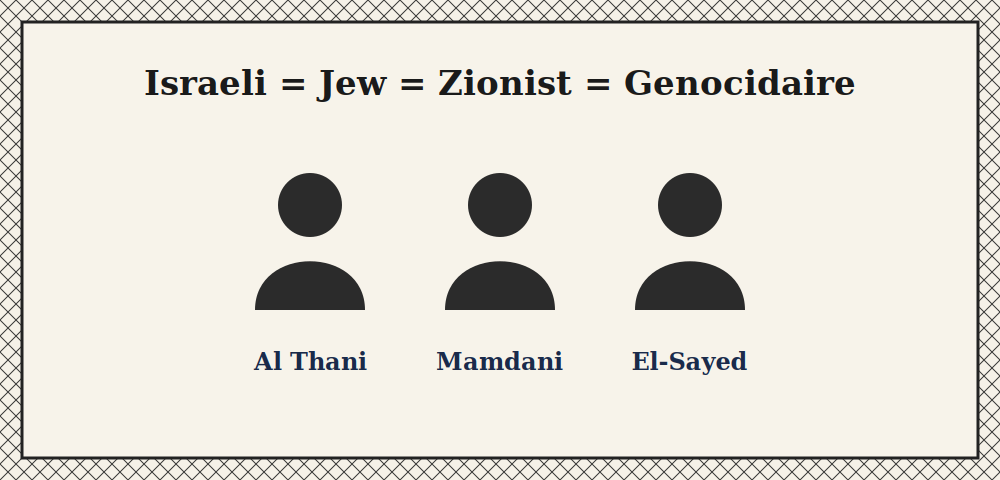
Three forces now carry that same permission machinery into American public life. Qatar, through the Al Thani family’s patronage of media and universities, has spent two decades laundering hostility to Israel into respectable discourse — money as emissary. Zohran Mamdani, now mayor of the city with the largest Jewish population outside Israel, built his career on the premise that Zionism itself is the crime. Abdul El-Sayed, seeking office in Michigan, draws from the same well: Israeli becomes shorthand for oppressor, and the Jew standing beside the dhimmi inherits the label whether he asked for it or not.
None of these men needs to say “Jew.” Mandel shows that the press has already done that translation work for them. A magazine profile, a mayor’s office, a Gulf-funded lecture circuit — different registers, one grammar. The child who never separates from a mother’s hatred grows up to become a movement. The society that lets “Israeli” absorb “Jew” grows up to become a permission machinery. Mandel has named the sentence. I would only add: watch who is teaching it, and how early the lesson begins.
The fourth link in this chain is the word “genocide” itself. Al Thani’s funded media, Mamdani’s platform, and El-Sayed’s own words all reach for it as the closing move — Israeli, Jew, Zionist, genocidaire, one substitution after another until the original victims of the term’s coinage are made to wear it. When El-Sayed was asked about his own rhetoric, his answer was “Hurt people hurt people.” That line is false, and it is worth saying plainly why. Not all hurt people hurt people. Most do not. The ones who do are the ones who never metabolized the rage, who let it calcify into a grievance that needs a target — like the accusation that Jews are committing genocide, a word coined to name the Holocaust itself, now turned back against its own survivors’ children. A physician, of all people, should know the difference between a wound and a decision. Reaching for “hurt people hurt people” the moment Jews, Israelis and Zionists are the victims is not compassion. It is a ready-made excuse for the attacker, dressed up as psychological insight. ElSayed, Mamdani and Al Thani show that they have none.
Nancy Hartevelt Kobrin, PhD, is a psychoanalyst and counterterrorism scholar specializing in the psychology of terrorism and jihadi violence. Her most recent book is A Soldier’s Guide to Hamas’s Genocidal Psychosis—The Unconscious in Psychological Warfare: Beyond Ideology, Before Words. Atzmaut Press, 2025.
https://www.amazon.com/stores/Nancy-Kobrin/author/B002RF9D5Y