

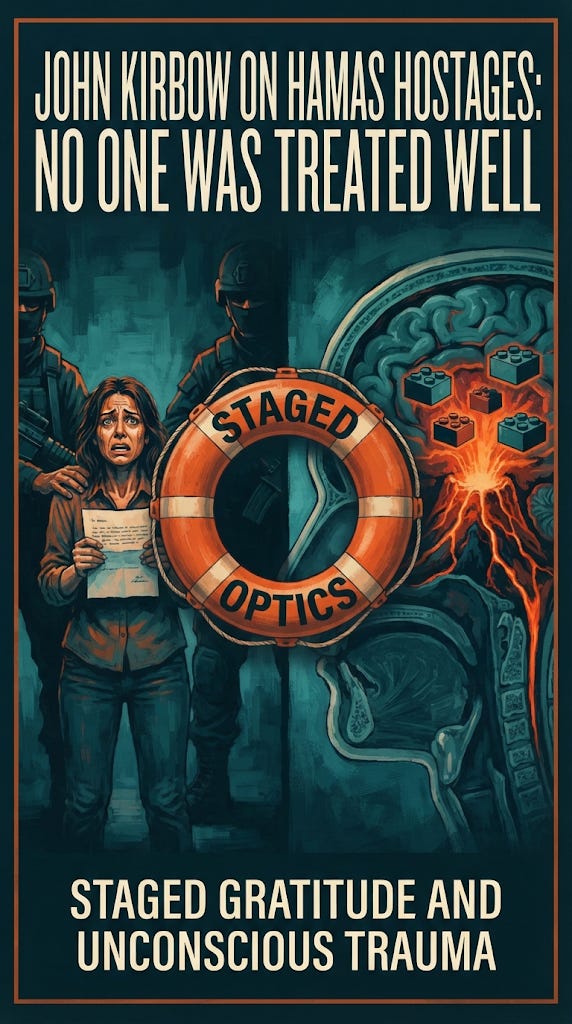
On November 2, Small Wars Journal published John Kirbow’s essay on how Hamas exploited hostages to manipulate Western audiences. I read it with a particular interest. I am a graduate of the Army’s Human Terrain program, as he is, and I hold my US Army ID tags. I also faced enormous discrimination there as a Jew, and I describe the abuse in the epilogue of my book, A Soldier’s Guide to Hamas’s Genocidal Psychosis: The Unconscious in Psychological Warfare—Beyond Ideology, Before Words, which Mr. Kirbow is welcome to read. I did war games at Fort Irwin, and I was in the main tent on November 5, 2009, watching the Fort Hood massacre come in on CNN. Later Nidal Hasan’s defense lawyer, John Galligan, who had read my first book, The Banality of Suicide Terrorism: The Naked Truth about the Psychology of Islamic Suicide Bombing, asked me to be an expert witness at the trial. I declined. I was working for the Army and did not want my work used that way.
Kirbow’s core point is sound. A hostage who thanks her captors on camera is not evidence of kindness. Danielle Aloni’s letter was coerced, and she has said so. He is right that frightened captives can cling to whoever controls them, and that captors know how to use this.
But his essay builds a hypothetical in which a hostage really was treated humanely, then explains it away as optics. The premise is the problem. No hostage was treated well. They were seized, hidden underground, starved and threatened, and kept alive at the captors’ discretion. Some were murdered. Israeli forensic findings show that Ariel and Kfir Bibas, aged four and under one, were murdered in captivity in November 2023, and that Shiri, their mother, was not killed by an airstrike as Hamas claimed. She was murdered as well. In August 2024 six hostages were found shot in a Rafah tunnel: Hersh Goldberg-Polin, Eden Yerushalmi, Ori Danino, Alex Lobanov, Carmel Gat and Almog Sarusi. Kirbow mentions none of this young tragic deaths.
He also treats the hostages’ bonding as a trained technique. It is that, but it is also something deeper. Under total helplessness the mind regresses to the earliest dependence, on the one who holds the power of life and death. He quotes a source calling this “traumatic infantilism.” That is the right term, and he does not follow it to where it leads: the captor becomes the all-powerful parent, and gratitude for being kept alive is staged easily because it is felt in part. This is the kind of unconscious dynamic I call Psychoanalytic Visual Intelligence. A viewer trained to see it recognizes a frightened person who is smiling for her life.
His point about the audience matters too. The crowds who read the footage as proof of Hamas’s humanity were taking in the staging without seeing the helplessness behind it. And the claim that ordinary Gazans were bystanders does not survive the testimony. Released hostages describe civilians who took part in their abduction and captivity, and Eli Sharabi told the UN Security Council that in 491 days no one in Gaza helped him.
Hamas’s crimes against families are also the subject of my own work. The term kinocide was coined after October 7th, and I wrote about it in “The Psychology of Kinocide: Why Do Terrorists Target Families and Women?” in the Jerusalem Post on May 18, 2025. My written statement, “Holding Hamas Collectively Responsible for Kinocide and the Weaponization of Sexual Violence,” was submitted to the United Nations Human Rights Council by Fazal ur Rehman Afridi through the Tumuku Development and Cultural Union (TACUDU), holding Hamas accountable for the massacre (UN Doc. A/HRC/60/NGO/146, August 4, 2025).
Kirbow’s toolkit comes from the training room, and it explains a great deal. But most of what drives a captor, a hostage and an audience is unconscious, and tactics alone cannot reach it. Had he known to use psychoanalysis, he would have seen that the smile on camera, the letter of thanks and the crowd’s eager belief all come from the same place: the oldest terrors and wishes of a mind under threat. Psychoanalysis has much to offer in understanding the depth of terrorism, because most of our thinking is unconscious.
Sources:
https://ynetnews.com/article/rkqxp9w91l
https://ynetnews.com/article/sksmuehcyl
https://www.jns.org/israel-news/bodies-of-six-hostages-located-in-southern-gaza
https://www.christianpost.com/news/israeli-hostage-shares-his-experience-with-un-security-council.html
https://freebeacon.com/national-security/gazan-civilians-involved-in-every-stage-of-hamas-hostage-scheme-released-israelis-reveal/
https://www.jpost.com/opinion/article-854402
https://docs.un.org/en/A/HRC/60/NGO/146
Nancy Hartevelt Kobrin, PhD, is a Tel Aviv–based psychoanalyst holding a doctorate in Islamic literature as well, counterterrorism scholar and a graduate of the Human Terrain Program in Leavenworth KS
https://www.amazon.com/Nancy-Kobrin/e/B002RF9D5Y