

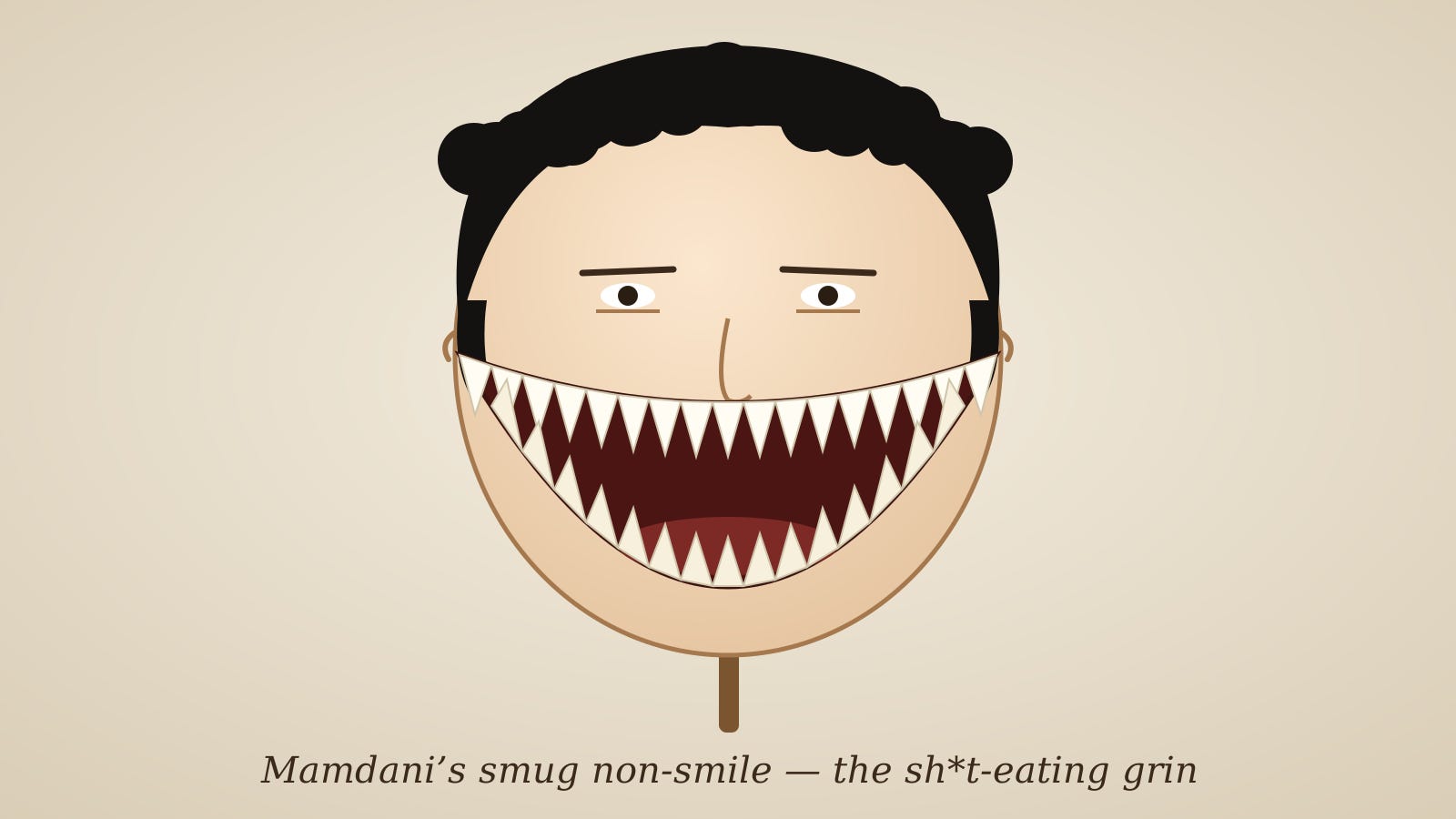
New Yorkers have a phrase for the expression Mayor Zohran Mamdani so often wears when he says something cruel: a sh*t-eating grin. It is crude, but ordinary people reach for it because they sense something real. The smile does not match the words. As a psychoanalyst who has spent decades reading the faces of perpetrators and those who excuse them, I want to explain why that mismatch unsettles us, and why it matters.
Clinicians call it incongruent affect: an emotional expression that does not fit what is being said. A man who accuses the Jewish state of genocide on the anniversary of the worst massacre of Jews since the Holocaust should not look pleased. A man who welcomes the city’s retreat from Israel Bonds, a fifty-year expression of trust, should not look pleased. When the face and the words part ways, the face tells us something the words do not.
The research gives us language for this. Paul Ekman, who spent his career studying the human face, distinguished felt smiles from false ones. A felt smile engages the muscles around the eyes; a social smile lives mostly in the mouth. Ekman also named something he called duping delight: the small, leaking pleasure a person takes in getting away with something, which surfaces as a smile at exactly the wrong moment.
More recent work goes further. Psychologists now distinguish smiles by what they do. Some reward, some reassure, and some dominate. The dominance smile signals superiority, and in one experiment, people shown such smiles responded with rising stress hormones. A smile, in other words, can be an act of aggression. It does harm while looking pleasant, and it leaves the person receiving it feeling that something is wrong without being able to say what.
Others have seen it too. In August, Israel’s Consul-General in New York, Ofir Akunis, called Mamdani “an antisemite hiding behind a fake smile.” Last year a Jerusalem Post columnist described his politics as antisemitism sold with a smile. On September 11, cameras appeared to catch him laughing with Rep. Alexandria Ocasio-Cortez during the reading of the victims’ names, moments after the broadcast showed a young man sobbing. Defenders said it was only a greeting, and perhaps it was. But the image traveled because it confirmed what so many had already sensed.
The most revealing moment came when the smile disappeared. On October 7, Mamdani attended a vigil in Union Square. Protesters shouted “Traitor!” at him. The New York Times described him as stone-faced but visibly emotional. The grin was gone.
That is the key to reading it. The smile appears when he is on the attack. It vanishes the moment he is the one under attack. A smile that is present only while attacking is not warmth. It is armor, and it is a weapon. It allows hostility to be delivered in a pleasant package, so that anyone who objects looks humorless, oversensitive, or paranoid.
I want to be careful here. No one can read a mind from a face, and research shows that most of us are poor at detecting deception from expressions alone. I am not claiming to know what Mamdani feels. I am pointing to a pattern that anyone can see: a smile that consistently fails to match the gravity of his words, and that disappears only when he himself comes under attack.
What We Must Do
Do not let the smile soften what he said. A pleasant face makes harsh words seem milder, and the listener begins to wonder whether he heard correctly. He did. Take the words at their full weight.
Name the incongruence calmly when it appears. Do not answer it with rage, which only lets the smiling Mamdani play the reasonable one. Answer it with precision: here is what he said, here is how he looked when he said it, and the two do not belong together.
And trust what you sense. When ordinary New Yorkers call it a sh*t-eating grin, they are not being crude for its own sake. They are registering, in plain language, what the research confirms: some smiles are not smiles at all.
Sources: Paul Ekman and Wallace Friesen, “Felt, False, and Miserable Smiles,” Journal of Nonverbal Behavior (1982); Paul Ekman, Telling Lies (1985); Magdalena Rychlowska et al., “Functional Smiles: Tools for Love, Sympathy, and War,” Psychological Science (2017); Jared Martin et al., Scientific Reports (2018); Charles Bond and Bella DePaulo, Personality and Social Psychology Review (2006); VINnews, August 2, 2026; Fox News, September 11, 2026; New York Times, as quoted by Hot Air, October 15, 2026.
Nancy Hartevelt Kobrin, PhD, is a Tel Aviv–based psychoanalyst and counterterrorism scholar.
https://www.amazon.com/Nancy-Kobrin/e/B002RF9D5Y

Thank you Sadhana. Much appreciated.
You are so right!