

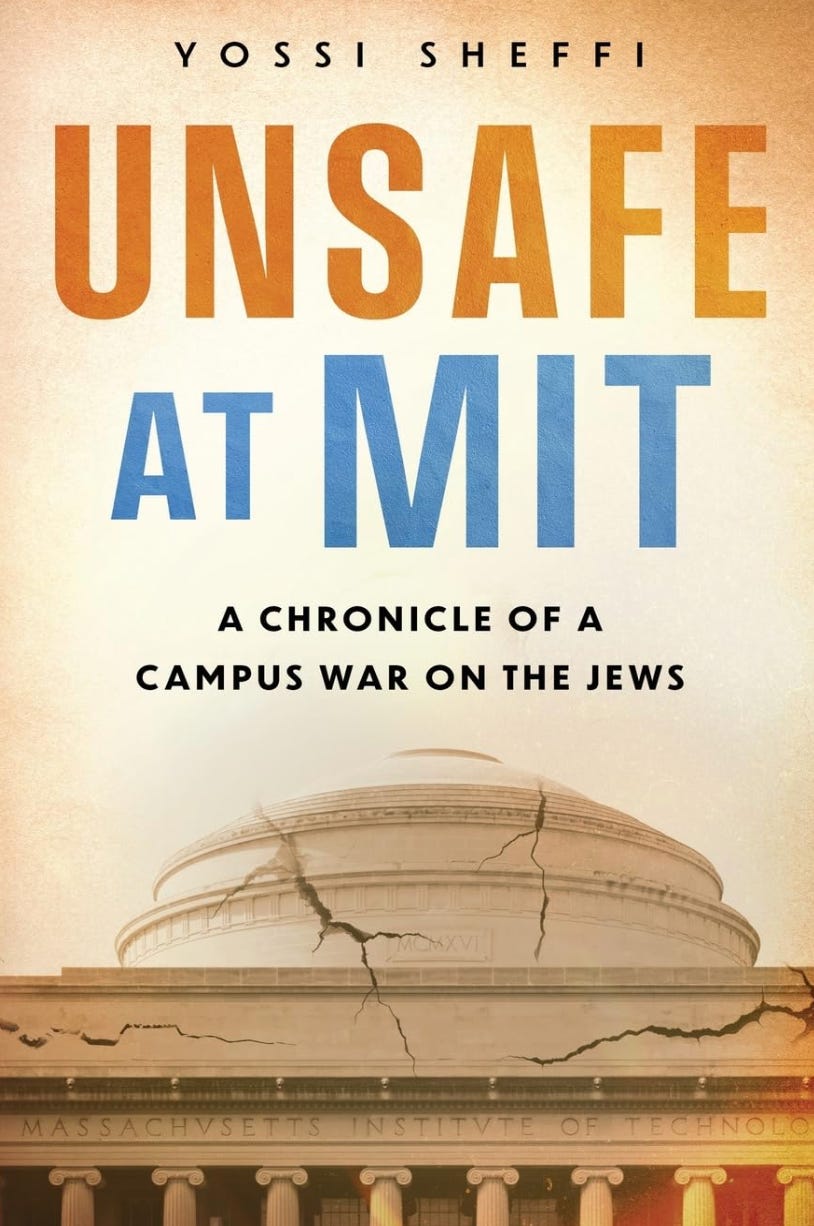
A grandmother's reading of Unsafe at MIT: A Chronicle of a Campus War on the Jews, by Yossi Sheffi Transoft Inc., 280 pgs.
This spring my grandson was accepted to the Technion, as an external student out of New York, to study mechanical engineering. I am an Israeli American. I will not pretend the pride was uncomplicated. It came with a private, unspoken arithmetic: which university would have protected him, and which would have handed him a hostage poster to defend with his own two hands. Reading Yossi Sheffi’s new book, I found myself running that arithmetic again, this time for MIT.
I have some standing to run it. In 1989 I filed a lawsuit against a university department for sex discrimination. There was no smoking gun. There never is. What there was instead was a pattern any Jewish woman (and I was the only one) in that department could describe and no single memo could prove: a promotion withheld here, a committee seat denied there, a colleague’s sudden coolness that had no paper trail and needed none, because everyone in the room already understood the terms. The case went to the Eighth Circuit twice. I petitioned for certiorari. And somewhere in the arguments the university’s lawyers made in their own defense — the appeals to academic freedom, to faculty self-governance, to the impossibility of proving intent — I watched the early scaffolding go up for what would later be called, with considerable self-satisfaction, a progressive university culture. Nobody in 1989 would have told me antisemitism was in that room too. It was. It simply hadn’t yet found its vocabulary.
As a scholar of Islam, my doctorate and a degree in Jewish Studies as well and also a psychoanalyst who works in terrorism, antisemitism has always been there below the radar under the surface. To me Sheffi’s book is a cautionary tale that must continue to be told.
Antisemitism found a great deal of vocabulary later, when I trained for deployment to Afghanistan under the Human Terrain Program. I write about what I encountered there — and what it taught me about the unconscious life of hatred in institutions that believe themselves rational — in the epilogue to my own book, A Soldier’s Guide to Hamas’s Genocidal Psychosis—The Unconscious in Psychological Warfare: Beyond Ideology, Before Words. The lesson was the same lesson the 1989 case taught me, restated in a harder key: antisemitism rarely announces itself. It borrows the reigning grievance of its decade — merit then, decolonization now — and wears it as a decent coat.
This is the frame I brought to Sheffi’s book, and it is, I think, the right one.
What the book is
Sheffi is a 51-year MIT faculty member, an Israeli who flew for the Israeli Air Force in the Six-Day and Yom Kippur wars, and by his own account not a natural pamphleteer — his prior work is in supply chain logistics, not polemic. He wrote this because MIT, unlike Harvard or Columbia, never produced its own reckoning. “For MIT,” he told the New York Times, “this book is the report.” That is the book’s real genre: not quite journalism, not quite memoir, but an oral history assembled by a witness who is also a participant, built from some forty interviews with students and faculty, laid alongside emails, footage, and the administration’s own paper trail.
Its strength is exactly where an oral history’s strength should be: in the particulars. The eight-hour Lobby 7 blockade with its differential deadline — one side complies and is thanked for it, the other does not and is not disciplined. The encampment scheduling that bumps a permitted Israeli students’ event five separate times while the tents beside it stand untouched. A DEI officer who, shown screenshots of threats, advises the threatened student to leave the group chat rather than acting on the threat. A named professor who edits footage to make his own target look like the aggressor, and is rewarded with more teaching freedom rather than less. None of these, singly, is a smoking gun. Together they are the pattern I recognized from 1989 — a machinery of official neutrality that, in practice, only ever presses on one side.
What a fair reader should also know
Sheffi is not a disinterested narrator, and he does not claim to be. He is inside the story he is telling — footnoted, in one case, recounting his own treatment by MIT leadership. Readers should also know the book has already drawn a serious, if bitter, published answer: MIT linguistics professor Michel DeGraff, one of the very antagonists who appears inside its pages, wrote a long rebuttal in the MIT Faculty Newsletter accusing Sheffi of exactly the selective moral framing Sheffi accuses others of — a close reading of Sheffi’s own verbs, in fact, arguing that his prose grants Israel only the grammar of a victim and Hamas only the grammar of an agent. This is tu quoque, the oldest deflection in rhetoric: answer an accusation by turning it back on the accuser rather than by answering it. More precisely, it is what psychologist Jennifer Freyd named DARVO — Deny, Attack, Reverse Victim and Offender. DeGraff does not contest Sheffi’s account of what Hamas did on October 7, or what followed at MIT. He instead performs a close reading of Sheffi’s syntax — who is subject, who is object, who acts and who merely suffers — and concludes from grammar alone that Sheffi is the true offender. That move, treating sentence structure itself as evidence of moral guilt, is the house method of a particular contemporary school of discourse analysis, the same one that reads power into every pronoun and calls it liberation. It is a fashionable method on campuses like his. It is not a refutation. Parsing who a sentence blames is not the same as answering for who a massacre murdered. This is the characteristic move: not to deny the accusation, but to redirect the room’s attention onto the accuser’s language until the original act disappears from view.
Whatever one makes of DeGraff’s argument, its existence matters for how this book should be read: not as settled history, but as one combatant’s testimony in a fight that is still, as I write this, entirely unresolved on Sheffi’s own campus. A rigorous reader will also want to hold the book’s most serious individual claims — the doxxing that went unpunished, a professor’s quoted remark that a student must “crawl” to pass, a DEI officer’s private outreach to protesters rather than to their targets — as testimony attributed to named witnesses, not as facts independently established by the footnotes.
The pattern beneath the pattern
What moved me most in this book was not any single incident but its shape, because I had seen the shape before. An institution built its entire self-defense around the word neutral, and neutrality, examined closely enough, turned out to be a defense against having to choose — which is itself a choice, made over and over, always in the same direction. The President of MIT threatens suspension and then withdraws it. She promises consequences and delivers none. A DUSP lecturer tells Jewish students to crawl under a human chain and faces no inquiry. This is not incoherence. An institution that fears a lawsuit from one side more than it fears the exodus of another has already decided who it is willing to lose. I recognized the pattern because it was the same pattern my own university’s lawyers used against me in 1989, dressed then in the language of academic self-governance rather than DEI, but doing precisely the same work: converting cowardice into a principle.
Sheffi’s own father left Vienna in 1937 for exactly this reason, against his family’s pleas — because he read the sign before the people who loved him could bring themselves to read it. That is the true center of this book, more than any single encampment or hearing: the argument that Jewish safety, intellectual or physical, cannot be subcontracted to an institution that has not yet decided to defend its own stated values. His father built something new rather than wait for Vienna’s institutions to become brave. Sheffi’s message to the next generation, delivered eighty years later from inside the institution rather than outside it, is the same one.
I think of my grandson, who will begin at the Technion having chosen, in effect, to skip this particular argument — to study mechanical engineering somewhere it does not need to be made twice a semester. I am glad of it, and I am also aware that this is itself a form of the pattern: a young Jewish engineer choosing an institution by its willingness to defend him, the same calculation his great-great-grandfather’s generation made when they chose a boat instead of a university. Sheffi would say, I think, that both choices are correct. Some of us organize, and stay, and fight for the university’s own stated principles from inside it, as he has done. Some of us build the thing we need elsewhere. Both are what his father understood, watching a European institution surrender without ever admitting to itself that it had.
Unsafe at MIT will not persuade anyone who has already decided the last three years were, on the whole, a matter of protected speech and understandable grief. It was written for the record, not for them. What it does, and does with real documentary patience, is put names, dates, and quoted remarks under a pattern that a great many of us — in a lawsuit, in a war zone, in a lecture hall forty years apart from one another — have already learned to recognize without needing a single smoking gun to prove it. MIT scapegoated its own Jews — what a “busha” (Heb. shame).
Buy the book, support the effort! Available at amazon.com https://www.amazon.com/dp/B0H4S4VG2T?utm_source=chatgpt.com
Nancy Hartevelt Kobrin, PhD
is a psychoanalyst (PTSD expert) holding a doctorate in Islamic literature and former military contractor.
Her most recent book is A Soldier’s Guide to Hamas’s Genocidal Psychosis—The Unconscious in Psychological Warfare: Beyond Ideology, Before Words, Atzmaut Press, 2025. https://www.amazon.com/dp/B0G7KGWLJH
Her forthcoming book is Between Empire and Covenant—Signs of the Jewish Bond: Lotman, the Refuseniks and the Bukharan Jews, 1977 Atzmaut Press, 2026.
nancykobrin.org and nancyharteveltkobrin.substack