Chapter Fifteen opens with a count. King Abdul Aziz sired forty-five sons, and their offspring now number at least three hundred sons, grandsons and great-grandsons, and an equal number of princesses. The extended family reaches an estimated fifteen thousand. Yet House calls the Al Saud “a shrinking ruling family,” because the future of the monarchy now rests in the hands of one man, Mohammed bin Salman.
Notice how the family counts. House’s scorecard lists the sons by mother, with birth year and office, like trophies. The princesses are counted but not named. “Wedding washing” returns here: so many children and so many marriages make marriage a joke and a power play. It is very manipulative and very confusing for the children. With poor object constancy, how can they integrate who is related to whom? Where is the stability with everyone pitted against each other. This is the classic herd mentality.
The chapter title echoes the American sitcom “All in the Family,” where Archie Bunker ruled a quarreling household. On television the family fights and stays at the table. Here it fights for the throne. Family cohesion is a joke in a family this large, and the history shows it. Abdul Aziz was so conscious of cohesion that on his deathbed he told his two eldest sons, Saud and Faisal, to “join hands across my body and swear you will work together when I am gone.” Saud was deposed into exile in Greece. Only three of fourteen successions have been uncontested. The historian Joseph Kéchichian says the eleven contested ones included “assassination, civil war, and, in a few cases, bloodless revolution.” A family this large does not hold together. It splits, and one branch takes the rest. House writes that MBS and his father have sidelined relatives by incarcerating them and confiscating their wealth, and that some, including the king’s only surviving full brother, Prince Ahmed, are under house arrest.
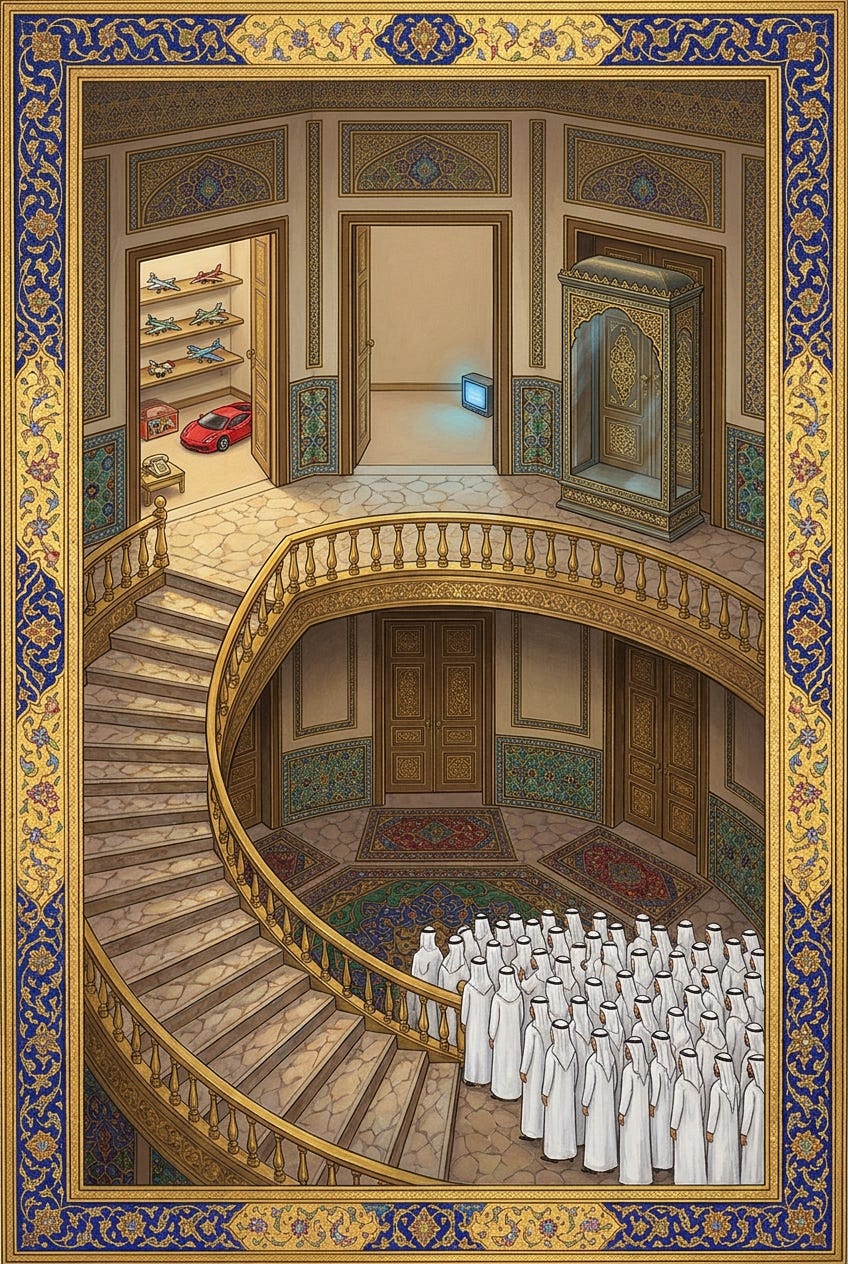
Then the bedrooms. Prince Khalid, thirty-six and now minister of defense, shows House his childhood room at Shati Palace in Jeddah. Toy fighter planes and photos of young Khalid in military uniforms fill the shelves. A toy red plastic Lamborghini sits near the bed, and under it an old landline telephone. At the bottom of the shelves are a Neo Geo game and old movies he watched with his brothers on a VCR he has kept since childhood. A man who commands an army keeps the room as it was.
Around the circular stairway is MBS’s bedroom: large, nondescript, subdued beige. About the only clue that MBS lived there is a Neo Geo machine on the bookshelf. Their brother Turki’s bedroom completes the three childhood rooms upstairs. Three rooms kept like museums, and these men seem stuck in their childhoods. Khalid’s room is full of the boy he was. MBS’s room has almost no one in it, which I read as fitting a man who hides his own family.
Khalid says MBS “always has his Apple TV with him in his room even when he travels. At the end of the day he puts on Apple TV and falls asleep.” I hear a lullaby. It may be a transitional object in Winnicott’s sense: the thing carried everywhere so the child can fall asleep without the mother. The man who runs the kingdom may still need to be soothed to sleep.
As a teenager, Khalid says, MBS began inviting thirty to forty young princes and friends to the desert each weekend “to relax and bond.” I read this as early control. He chose the place and the guests, and the younger princes gathered around him because they know how their “khubz” is buttered.
Their father divided his time between two families. That is enough to give a young fledgling crown prince whiplash trying to follow his father. When he was with Fahda and her six boys, they ate together and discussed books on Friday nights, books their father assigned. MBS, only three years older than Khalid, became “something of a second father to his younger brothers.” Becoming a second father to his brothers in part is a way of working through his absent father. In high school he sat Khalid down and asked sternly, “What are you going to do with your life?” When a father is divided, an older brother takes his place and asks the question a father should ask. This reminds me of the earlier post where MBS’s car breaks down and he calls the towing service. The narrator of this anecdote bragged about how self-sufficient MBS was when in fact he missed the point that MBS didn’t have a father who taught him how to change a tire, just in case.
House reports that MBS’s cleverness is often compared to Mu’awiyah’s, famous as one of history’s great manipulators. When Mu’awiyah’s forces were losing to Ali’s, they hoisted pages of the Quran on their lances and urged both armies to let Allah decide. Fighting stopped, arbitration followed, and Mu’awiyah’s delegate simply declared him caliph. I see a kind of fusion: the sacred book and the weapon become one object, and the holy text wins what the battlefield could not. This is the same succession quarrel, Ali against Mu’awiyah, that I described as the unmourned inheritance of the Sunni-Shia feud. Mu’awiyah then passed rule to his son Yazid, whom the sources call dissolute, the first hereditary succession in Islam. Yazid’s forces killed Husayn, the Prophet’s grandson, at Karbala, the founding trauma of the Shia.
Allegedly MBS is a good listener. The source is Prince Khalid, whom House describes as comfortable around his brother but “very deferential.” Listening is what an analyst does, and an analyst does not hold the room.
The shrinking family is a political fact. It is also a floor of childhood bedrooms that nobody has left. The kingdom’s future rests with this brother who had to become the father. This father is currently not to be seen, and neither is the brothers’ mother, and the others are still waiting in their rooms. And the females are hardly counted. Welcome to the Royal Saudi soap opera of All in the Family.
Sources: House, Karen Elliott. The Man Who Would Be King, Chapter 15. Winnicott, D. W. “Transitional Objects and Transitional Phenomena.” International Journal of Psychoanalysis 34 (1953): 89–97.
Nancy Hartevelt Kobrin, PhD, is a Tel Aviv–based psychoanalyst and counterterrorism scholar. https://www.amazon.com/Nancy-Kobrin/e/B002RF9D5Y