Chapter Seven of Karen Elliott House’s The Man Who Would Be King, “Castles in the Sand,” tours the gigaprojects: Neom at $500 billion, the 105-mile Line, the Trojena ski village, Sindalah, Qiddiya and the Mukaab. My psychoanalytic associations, in light of developmental psychology, go to grandiosity and to what grandiosity covers.
The Ski Slope: Not the First
House writes that Trojena “will offer the Middle East’s first outdoor snow skiing.” It will not be the first. Mount Hermon opened to the public on December 27, 1971. Three years after the Shoah we were building Israel, and through all the wars Tel Aviv has changed completely, on land that was sand dunes. The mentality is a bit Arab: the bare minimum, making do with the temporary and never improving it, and it still persists. But we built from need, one step at a time, with people living in what we built.
Neom: Manic Defense
Klein described the manic defense as omnipotence, triumph and contempt, which keep out the pain of dependence and loss. Neom looks like that to me. The grandiosity is getting the better of him. House herself reaches for Shelley’s “Ozymandias” and calls the result a “pharaonic image.” MBS admits he does not know how it will turn out: “I can promise you that there’s going to be something new and creative but what it is, I don’t know.” In my Jerusalem Post op-ed I wrote that Neom is a bid for attunement between mother and son, and that it now looks like a balloon that burst mid-ascent. In 2023, House notes, the ski village, the glow-in-the-dark sand, the artificial moon and the Line “none yet existed.”
The WPA: What Planning Looks Like
I think of the Works Progress Administration during the Depression. Things were planned methodically, around real needs and real workers. Neom was drawn from the Crown Prince’s imagination. At Al Bada, Neom’s largest town, 3,000 people live. The one new structure House sees is housing for 350 workers, apart from a royal palace and an airport used mostly for private VIP flights.
The Money: Greed and Corruption
An angry Saudi prince told House in 2011 that “cartels, collusion, and corruption are making the rich richer.” Eighty percent of government projects exceed their budgets. The Bin Laden Group built eighteen of the fifty-nine towers of the failed financial district. A nursery for Red Sea hotels holds ancient Spanish olive trees that cost about $530,000 each. The Howeitat tribesmen were forcibly removed to make way for Neom. House credits the Ritz crackdown with more transparency. Grandiosity and greed work well together. The underlying unmet psychological need for both grandiosity is wanting to be seen and responded to not as an object but as a real baby, and greed when the feeling of emptiness is pervasive.
Houston: An Association
When House quotes a Houston-based designer, Roger Soto, I think of Ariel Sellouk z”l, a young Jewish man killed in Houston in August 2003 by Mohammed Ali Alayed, a Saudi former friend who had become more religious. Alayed pleaded guilty and received sixty years. Prosecutors did not bring a hate-crime charge. The kingdom now courts Jewish and Israeli tourists. My question is what is under the welcome. You see, the problem remains: has the citizenry really been prepared to welcome people who are not like them? In Saudi Arabia people have to be the “same” and conform, even though MBS has loosened up such conformity. Again it reminds me of the complaint in this chapter that there was nothing to do growing up, “a work camp.” The deadness, though, comes from the unseen years. MBS is Fahda’s first-born son, but not the first-born among the many half-brothers of his father’s multiple wives. A first-born son who is also his mother’s honor carries a built-in pressure to perform. A baby who must perform is not seen as a real baby, and that is a mismatch in maternal attunement.
The Builder Who Is Not Invited
House asks Jerry Speyer of Tishman Speyer whether the Line is possible. He says it is “eminently doable if you have the money and the courage,” and earlier called Neom “a gutsy thing to do.” His firm is not involved in the Line or any of the other projects. This is admiration from outside the circle, praise without a seat at the table. It repeats the mistress pattern from Chapter Six: useful, admired and kept at a distance.
Mount Sinai: The Supremacist Attitude
At Neom, evangelical Christians are encouraged to visit Jebel Lawz, which many of them believe is the real Mount Sinai. House says mainstream scholars dispute this. In 2009, when she asked to visit it, a Saudi diplomat told her in a near whisper, “We don’t want Christians going there.” Amaala makes a virtue of the alcohol ban by marketing itself as a wellness destination. The kingdom wants the visitors’ money and the sacred geography, and it does not want the visitors. Ozymandias is Ramses II, and Sinai is where Moses received the commandments, so Pharaoh and Moses meet in the same chapter.
Castles in the Sand
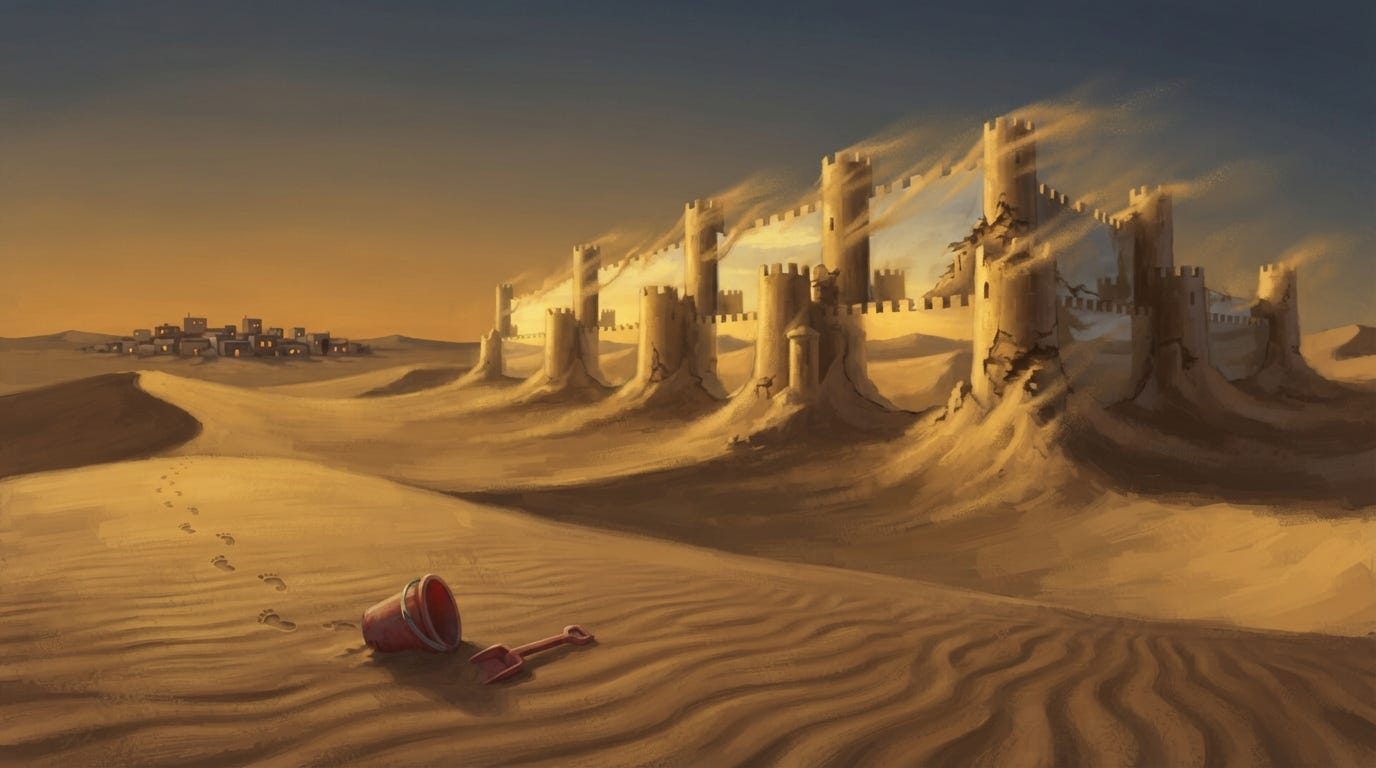
House writes that the projects “help mask the daily drudgery requiring decades to truly transform the Saudi economy off dependence on oil revenue,” and that MBS “has jailed the elite and courted the young.” A young Saudi told her in 2009: “Saudi Arabia is a work camp.” Real change is slow and unglamorous. Tel Aviv was also built on sand, but people were living in it before it was finished.
Sources
House, Karen Elliott. The Man Who Would Be King (Harper, 2025), Chapter Seven, “Castles in the Sand,” from p. 101.
Kobrin, Nancy Hartevelt. “Where is Mohammed bin Salman’s mother? And why does it matter for Israel?” Jerusalem Post, February 2, 2026. https://www.jpost.com/opinion/article-885321
NoCamels. “Mount Hermon: 50 Years” (December 2021). https://nocamels.com/2021/12/mount-hermon-50-years-israel/
“Murder of Ariel Sellouk.” Wikipedia. https://en.wikipedia.org/wiki/Murder_of_Ariel_Sellouk
Klein, Melanie. “A Contribution to the Psychogenesis of Manic-Depressive States” (1935).
Kobrin, Nancy Hartevelt. The Jihadi Dictionary.
Nancy Hartevelt Kobrin, PhD, is a Tel Aviv–based psychoanalyst and counterterrorism scholar.
https://www.amazon.com/Nancy-Kobrin/e/B002RF9D5Y