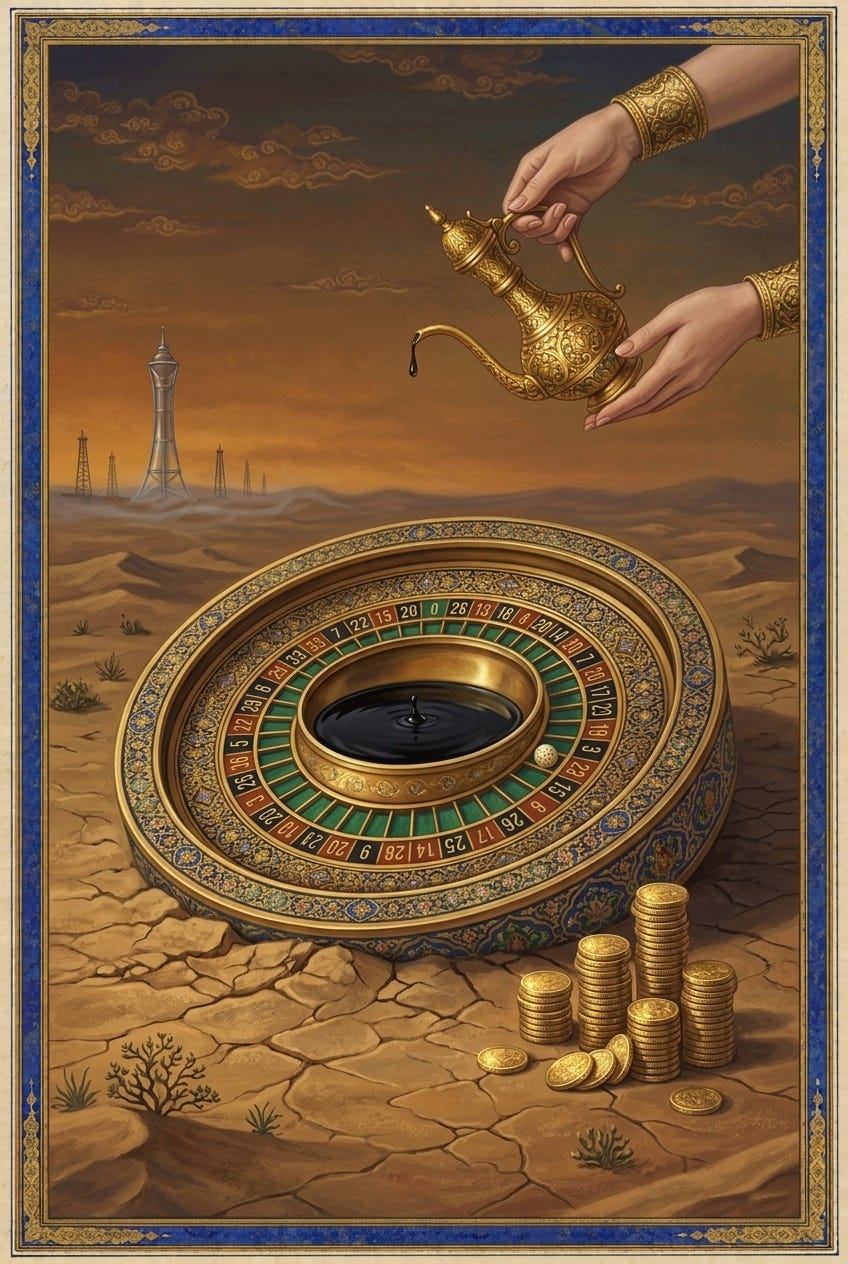
Chapter Fourteen opens with a gambling metaphor: plotting the future of the Saudi economy is “like playing roulette on a long-spinning wheel.” House lists the unknowns. When will demand for Saudi oil run out? Will the gigaprojects pay? Can education be reformed? Her own answer is that firm answers are elusive.
The three pillars are the energy minister’s: energy security, growth for the billions in poverty, and climate change. Pillars like these are the language of reality. Underneath them I hear something else.
Oil has supplied about 75 percent of fiscal revenue and 40 percent of GDP. Saudis consume more oil per capita than any nation on earth. That is a maternal supply: it arrives without effort and it never says no. Breast feeding on demand. A nation fed this way can confuse an unmet psychological need with a question about energy. The need is to be fed. The answer is more supply, then a hedge on supply, then another supply: solar, nuclear, hydrogen, “all of the above.” House quotes MBS: “I am in a hurry.” Hurry is how an infant demands the breast, and it is also how a gambler plays.
The projects show the gap between wish and reality. The Line was to be 105 miles long and house 1.5 million people. It is now 1.5 miles and 300,000. The mother’s supply is real, but the fantasy built on it has outgrown it. Or has reality set in?
Then there is the heat. Roughly 125 days a year now pass 95 degrees Fahrenheit, rising to 180 by 2050, and half the water comes from desalination. House calls heat and water shortage the biggest climate threat. A country that cools and waters itself by burning the thing that heats it is caught in a loop it cannot leave. Abu Nuwas put it in one line of verse that Arabic speakers use as a proverb: داوني بالتي كانت هي الداء (dawini bi-llati kanat hiya ad-da’), “Cure me with the very thing that was the disease.”
Alcohol is a revealing detail. Diplomats in Riyadh have been allowed to buy it since January 2024. At the Sindalah resort alcohol was served, and a Saudi friend photographed a hotel basement with empty shelves and a sign reading “Liquor Storage.” House says that, to date, “the wish is father to the thought.” Empty shelves with a label on them are a wish waiting for supply.
House reports that those close to MBS say he is determined to avoid Western culture, which he considers decadent because America has lost its focus on family and values. I read this as defensive. A man who hides his own mother and family can hardly lecture anyone about family. Why should he be the only one in the light? This shows a lack of insight: his behavior is out of sync with a mature relation to desire and fulfillment. It is splitting again. The West is decadent and the kingdom is pure. Yet the Saudi Arabia he is building offers dancing, movies and fine dining, but will not openly approve gay marriage or LGBTQ+ rights. Traditional family remains the core. Pleasure is allowed, but the family stays closed. Under the flashy veneer of entertainment, the claim that it is unlike the West does not hold. In some ways it is even more shallow and superficial, because it is built on the backs of foreign laborers whom Saudis look down on. House reports that foreign workers total nearly 13 million, almost three times the 3.9 million Saudi employees.
I met this attitude in the UAE. I wanted to do outreach to the Pakistani communities there, who have been in the country since the nineteenth century. I had found an Urdu edition of Schindler’s List and wanted to work on Holocaust education. The Ministry of Culture wanted no contact. The message was that one does not work with the disenfranchised minorities, who are large in number but have no rights, or limited rights.
The foreign investor meets the same closed door. House notes that Saudi Arabia’s legal system is based on sharia, rarely understood by foreigners, and that this is one complication for investment. I would go further. Sharia divides people into Muslim and non-Muslim, and the foreigner falls on the wrong side of that division. The category is stark in its classical form. A recent Israeli study of Hamas military-wing Shariah texts describes a ruling that defines the Muslim as ma’sum al-dam, protected from harm, and the non-Muslim as mubah al-dam, one whose blood may be shed. Saudi courts do not apply that ruling, but the division it expresses comes from the same tradition. A legal system that treats the outsider as the other is discriminatory, and no investor can feel secure inside it. The same split that tells the foreigner he does not belong tells him his rights are not equal.
It is ironic that House chooses the roulette wheel. Gambling, الميسر (maysir), is haram, and the Quran forbids it in the same verse as wine. A kingdom that forbids the wheel is staking its future on one, just as it quietly stocks the liquor basement.
The real question is whether a nation raised on a supply it never earned can be weaned. A gambler keeps playing because the next spin might bring back the mother who never said no. Weaning begins only when a country can bear the thought that the supply will end, and says so honestly. The wheel is still turning, and MBS has not yet said it.
Sources: House, Karen Elliott. The Man Who Would Be King, Chapter 14. Milstein, Michael. “The Shariah Basis for the Activities of Hamas’ Military Wing.” Meir Amit Intelligence and Terrorism Information Center, November 19, 2026. Arab News, ACWA Power’s Al-Shuaibah solar project begins commercial operations: https://www.arabnews.pk/node/2579132/business-economy. Zawya, Neom green hydrogen project: https://www.zawya.com/projects/utilities/neom-green-hydrogen-project-work-on-schedule-first-ammonia-production-in-2027-loq8joah
Nancy Hartevelt Kobrin, PhD, is a Tel Aviv–based psychoanalyst and counterterrorism scholar. https://www.amazon.com/Nancy-Kobrin/e/B002RF9D5Y