Chapter Nine of Karen Elliott House’s The Man Who Would Be King, “Six Flags over Saudi Arabia,” begins: “Fun has come to Saudi Arabia, a remarkable change from the sober and somber Saudi society that MBS inherited.” The subtitle of the book is “An Unprecedented Biography.” This chapter tours something unprecedented: a state that has decided to make its people happy in order to keep them from terrorism. That is the key to why it is so manic.
Fun as Counterterrorism: Why the State Is So Manic
The General Entertainment Authority was founded in 2016, and religious officials immediately called it the “General Evil Authority.” Its first director told House: “When you go to entertainment you are smiling, you accept others. When you sit home bored, you may go out with bad people.” House writes that entertainment had two primary goals: “to distract young Saudis from contemplating terrorism and to create new sources of revenue for the kingdom.”
Note the verb: distract. The kingdom does not claim to understand why a young man turns to terror. It only wants him looking elsewhere. That is what the manic defense does with a terror it cannot face: it fills every hour with triumph, noise and the biggest, tallest and fastest of everything, so that the persecutory anxiety never gets a quiet moment to speak. The state is manic because it is terrified, and what it is terrified of is its own sons.
As a counterterrorism scholar I know where that terror comes from. The jihadi is not made in a boring evening. He is made in the unseen years, from birth to age three, in the first relationship, long before a roller coaster or a Fashion Week could reach him. A ride cannot answer a mother-and-infant problem. So the distraction must keep growing, bigger and louder, and the mania has no stopping point.
Bread and Circuses
At the end of Chapter Eight, House calls the playfulness of Qiddiya and the new sports competitions “a modern equivalent of first-century Rome’s ‘bread and circuses.’” The amusements distract young Saudis from a reform that requires “totally transforming its inferior education system and its work ethic.” And she asks: “Will bread and circuses then suffice?”
If my Grandma Rosie z”l, of limited education, had read this chapter, she would have said: oy veh ze mir. The effort to have fun and be happy is overkill. It is again manic, and tragic.
The Smile as an Order
The photos of the smiling Crown Prince are everywhere in Riyadh, and House says they “seem to be inspiring his populace to smile too.” Oh really? It feels like the Wizard of Oz. At Qiddiya, MBS challenged the planners to find one theme to connect entertainment, sports and culture. They came back with “Freedom, Joyfulness.” His response: “That’s it.” Qiddiya’s managing director explains: “We want to provide in everything a dollop of playfulness, escapism that the rest of the world isn’t having.” And: “We want to show the world Saudis are friendly, hospitable.”
The name Qiddiya, according to one Saudi explanation, comes from Darb Abā al-Qadd, a caravan road over the Tuwaiq Mountains so rough and narrow that the leather straps tying the camel saddles often snapped. The city of joy is named for a place where things gave way under strain.
A smile is a gesture that cannot be ordered, and an order makes it something else. Winnicott’s false self (1960) is the compliant self, the one that performs what the environment wants while the true self stays hidden. A smile on command is a facade. And play, for Winnicott, is what a child does when she is safe enough to be spontaneous. A ministry cannot decree it.
In an earlier post, “Mohammed bin Salman’s Fake Moon,” I wrote about the Falcon Boy who grew up playing games, with soccer and videogames instead of movies or music. Now the Falcon Boy is building the playground for everyone, and it is again a fantasy world under his control.
The Manic Defense Has a Mascot
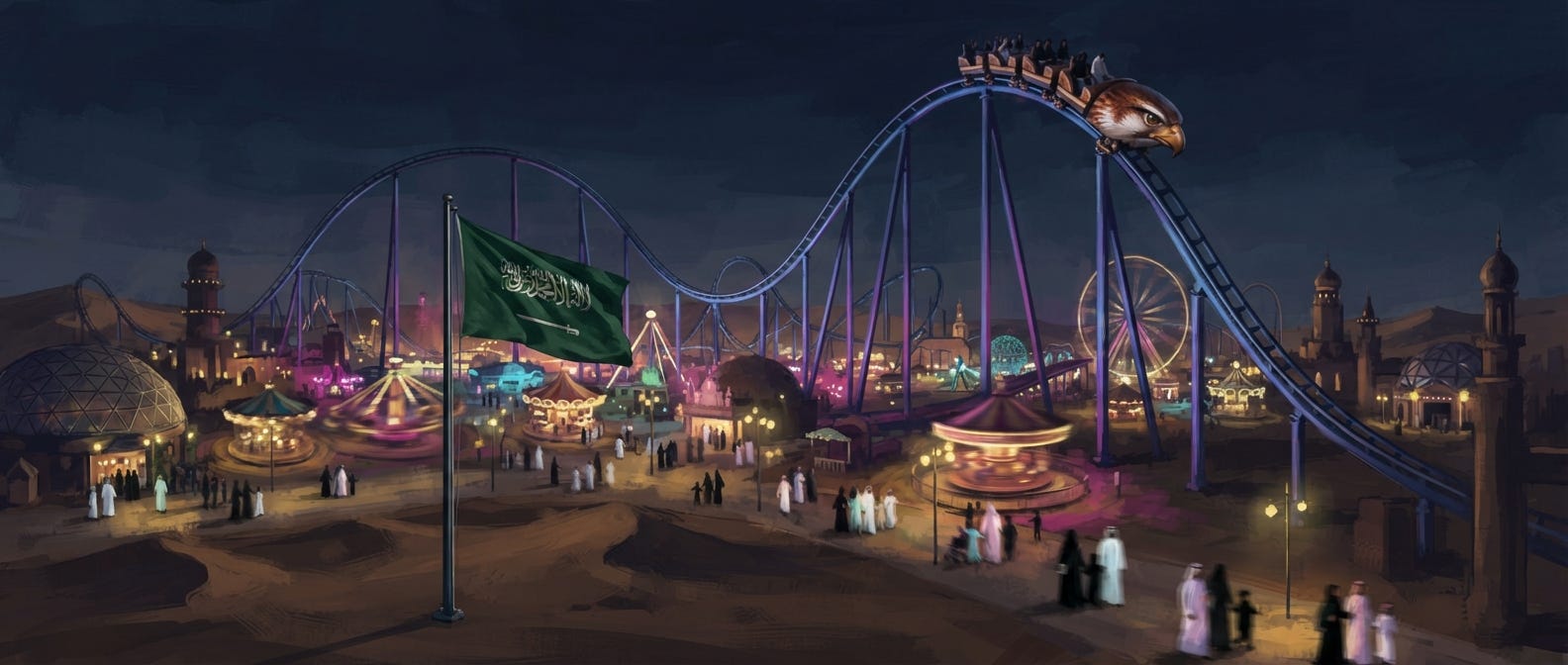
Klein described the manic defense as control, triumph and contempt. House reports that the Qiddiya roller coaster will be the longest, tallest and fastest in the world: “As always here, it’s big, bigger, best.” The Six Flags park finally opened on December 31, 2025, years behind schedule, with Falcons Flight rollercoaster. Its front car is sculpted as a falcon’s head. In “Fake Moon” I compared MBS to a falcon on a leash. The Drop Tower lifts a rider 160 feet, and House’s companion was stuck at the top for two hours, dangling. That is exactly what the manic defense does: it keeps a society suspended above a fall.
Boulevard of the World
Boulevard World, patterned on Disney’s Epcot Center, lets a visitor tour the world’s capitals and sample the cuisine, and House admits it is “all a bit garish but Saudis don’t seem to mind.” The Muslim countries it includes are the picturesque and tourist-friendly ones (for some): Morocco, Egypt, Turkey and Iran. On the list I found, Afghanistan and Pakistan are absent, and so is Israel. It is supposed to be fun. And yet earlier in this very book we learned that the Saudi prince says Saudis prefer not to work. Here a nation that does not like to work is working very hard at looking happy.
House notes that all this visible fun was created by “an invisible exploitation: the labor of millions of underpaid, overworked migrants,” in eighty days, on three shifts, with passports seized. Fun for the citizens, hidden labor for the others: the same splitting I described in Chapter Six, applied to a theme park.
What the Children Learn
At Boulevard World, Saudi women paint children’s faces to look like cats. Less than a decade ago, House writes, creating a likeness of a living being was forbidden because only God creates life and man must not imitate God, a rule that comes from the hadith, not the Quran. Yet the women painting these faces don’t appear to fear hellfire.
In Saudi schools, English is the second language, and since 2019, after MBS’s visit to China, Chinese has been introduced as a third. A country that is teaching its children Chinese for the economy and giving them rides to keep them from terrorism has still not reached the mother and infant in the first three years, where the problem begins.
Six Flags and One Sword
The chapter’s title is a pun. The original, Six Flags Over Texas, opened in Arlington in 1961 and was named for the six flags that have flown over Texas: Spain, France, Mexico, the Republic of Texas, the Confederacy and the United States.
The flag that flies over the Saudi park is not a fun flag. It is green, with the shahada, “There is no God but Allah and Muhammad is the Messenger of Allah,” above an unsheathed white sword. Under the flag law it may never be flown at half-mast, and it may not be used as a trademark in commercial advertising. The emblem of the state is a creed and a sword, and the park beneath it sells joy.
That is splitting at the level of the nation. One half of the state is playful, smiling and open to the world. The other half is a sacred sword that cannot be lowered. As I have written about beheading, the sword is not an innocent emblem in this part of the world. A society that was told for decades that pleasure was dirty has now been told that pleasure is a duty. Both are commands, and neither is freedom.
Sources: Karen Elliott House, The Man Who Would Be King (Harper, 2025), Chapter Nine, “Six Flags over Saudi Arabia,” and the closing pages of Chapter Eight; Kobrin, “Mohammed bin Salman’s Fake Moon: The Falcon Boy Who Grew Up Playing Games,” https://nancyharteveltkobrin.substack.com/p/mohammed-bin-salmans-fake-moon-the; Boulevard World, https://wikiwand.com/en/articles/Boulevard_World; Saudipedia, Chinese Language Education in Saudi Arabia, https://saudipedia.com/en/chinese-language-education-in-saudi-arabia; Sada News, “توضيح معنى اسم مشروع القدية الترفيهي,” April 29, 2018, https://slaati.com/2018/04/29/p1077882.html; Six Flags Qiddiya City opening, Coaster101, Jan 2, 2026, https://www.coaster101.com/2026/01/02/six-flags-qiddiya-city-grand-opening/; Saudipedia, Law of the Flag of Saudi Arabia, https://saudipedia.com/en/article/1560/government-and-politics/systems/law-of-the-flag-of-saudi-arabia; History.com, Six Flags Over Texas opening, https://www.history.com/this-day-in-history/august-1/texans-head-for-the-thrills-at-six-flags; Aniconism in Islam, https://en.wikipedia.org/wiki/Aniconism_in_Islam; Klein, “A Contribution to the Psychogenesis of Manic-Depressive States” (1935); Winnicott, “Ego Distortion in Terms of True and False Self” (1960); Kobrin, The Jihadi Dictionary.
Nancy Hartevelt Kobrin, PhD, is a Tel Aviv–based psychoanalyst and counterterrorism scholar.
https://www.amazon.com/Nancy-Kobrin/e/B002RF9D5Y