

Chapter Five of Karen Elliott House’s The Man Who Would Be King, “Heavy Lies the Head,” opens with Jamal Khashoggi, whom House knew over a decade of meals. At their last lunch he joked about MBS’s habit of tracking his ministers on an iPad: “Key Performance Indicators are as close to accountability as we are going to get. I’d prefer democracy but at least we have KPIs.” MBS had forbidden him to write. He left for Washington, his columns grew more critical, and in October 2018 he died in the Saudi consulate in Istanbul. House’s words: “Khashoggi’s body was sawed into pieces and hauled out in suitcases.” The title echoes Shakespeare’s “Uneasy lies the head that wears a crown,” the weight of power. I also hear a second meaning, whether House intends it or not, in a chapter that opens with a man cut into pieces. My psychoanalytic associations, in light of developmental psychology, go to the body in pieces, and to what a leader can choose to retire.
In my Jihadi Dictionary I write about part object representation – that the production of body parts is what is found in serial killing revealing the loosely put together mind of the serial killer due to his problems in attachment. While I am not claiming that MBS is this, what it does point back to again is the problem of the maternal fusion i.e. not going through a stage of separation individuation from mother. Whoever took apart Khashoggi’s body probably had not gone through this stage, to put it mildly.
A Rendition Gone Wrong: Minimization
House reports that devout Saudis saw the death as treachery. Khashoggi was lured to the consulate with the promise of a paper allowing him to marry his Turkish fiancée, and “Allah does not love him who is treacherous.” Then she concludes: “Sifting through the circumstances of this murder, it’s hard not to conclude it was a rendition gone wrong.” She calls it “too stupid and inept,” “a crime and a blunder,” and “the brutal and clumsy dispatch of Jamal Khashoggi. Once was enough.” She does write that the Crown Prince “ultimately is responsible even at a distance.” But “blunder,” “clumsy” and “dispatch” are words for a mistake, and the lure, the secret trial and the forensic doctor tell another story. The 2019 UN report called it a “deliberate, premeditated execution,” and recordings made before Khashoggi entered the consulate captured a forensic doctor discussing how the body would be cut up. I do not need to settle who gave the order to say that this was not an accident.
I also remain perplexed, because House reports that MBS suspected Khashoggi of being a member of the Muslim Brotherhood, and that Khashoggi was close to Osama bin Laden. These are not flattering affiliations, and one can see how they angered MBS. Khashoggi knew bin Laden as a journalist in the late 1980s, later pleaded with him in Sudan to stop, and condemned the 9/11 attacks. Even so, suspicion about a man’s affiliations is not a reason to cut him into pieces.
House names the man believed to have orchestrated it: Saud al-Qahtani, nominally the Crown Prince’s media adviser, in fact his right-hand man, charged with enforcing the zero-tolerance campaign against critics. In Arabic there is a word for the one who carries out the sword’s work, the sayyaf (سيّاف), the executioner. That is what a right-hand man is in a regime that rules by fear. Qahtani was fired in 2018 and banned from the U.S., and a Saudi court cleared him in 2021. In June 2023 he was seen at a social gathering at his uncle’s home.
House also sets the killing beside Peter the Great, Napoleon, Putin, Obama’s drone strike on Anwar Awlaki and Trump’s killing of Qasem Soleimani: “Even U.S. presidents murder citizens they see as a threat.” That is tu quoque, an argument that someone else does it too. There is a difference, and it matters. A democracy can be made to answer. Awlaki’s killing was argued over in courts, in Congress and in the press. In Saudi Arabia, eleven men went on secret trial, and the man believed to have orchestrated it walked free.
The Body in Pieces: Part Object
House reports the dismemberment and does not ask what it means. A psychoanalyst has to. In The Jihadi Dictionary, a part object is the representation of an unintegrated experience of the mother’s body. The baby cannot see the forest for the trees: it experiences a breast, a hand, a face, and never the whole mother. A child who stays fused to her in this way, even as the years pass, is never separate enough to see her whole, and so never learns to see a whole person. Melanie Klein called what such a mind perceives a part object, the opposite of a whole person who can be recognized. In my work on beheading, the head taken off is the mother’s head displaced, and the body parts stand in for a secure, whole maternal image that was never there. To saw a man into pieces is to make him a set of part objects. It is the most extreme form of what I wrote about last time: the fear of deadness that comes from not being recognized as an individual with one’s own sense of being. Khashoggi was a large, smiling man who spoke with a candor most Saudis do not allow themselves, and who made mild fun of the leader. In a shame-honor culture, I think, mockery from someone who sees you clearly must be answered. A whole person who looks back is turned into parts that cannot.
Saudis called MBS “Mr. Everything,” because he runs the economy, defense and Aramco. After October 2018, House writes, he stood for “Mr. Bone Saw” to his critics. From everything to bone saw: the omnipotent figure, the one who does it all, became in the world’s eyes the one who cuts a person into pieces.
The Sword He Must Retire: Choice
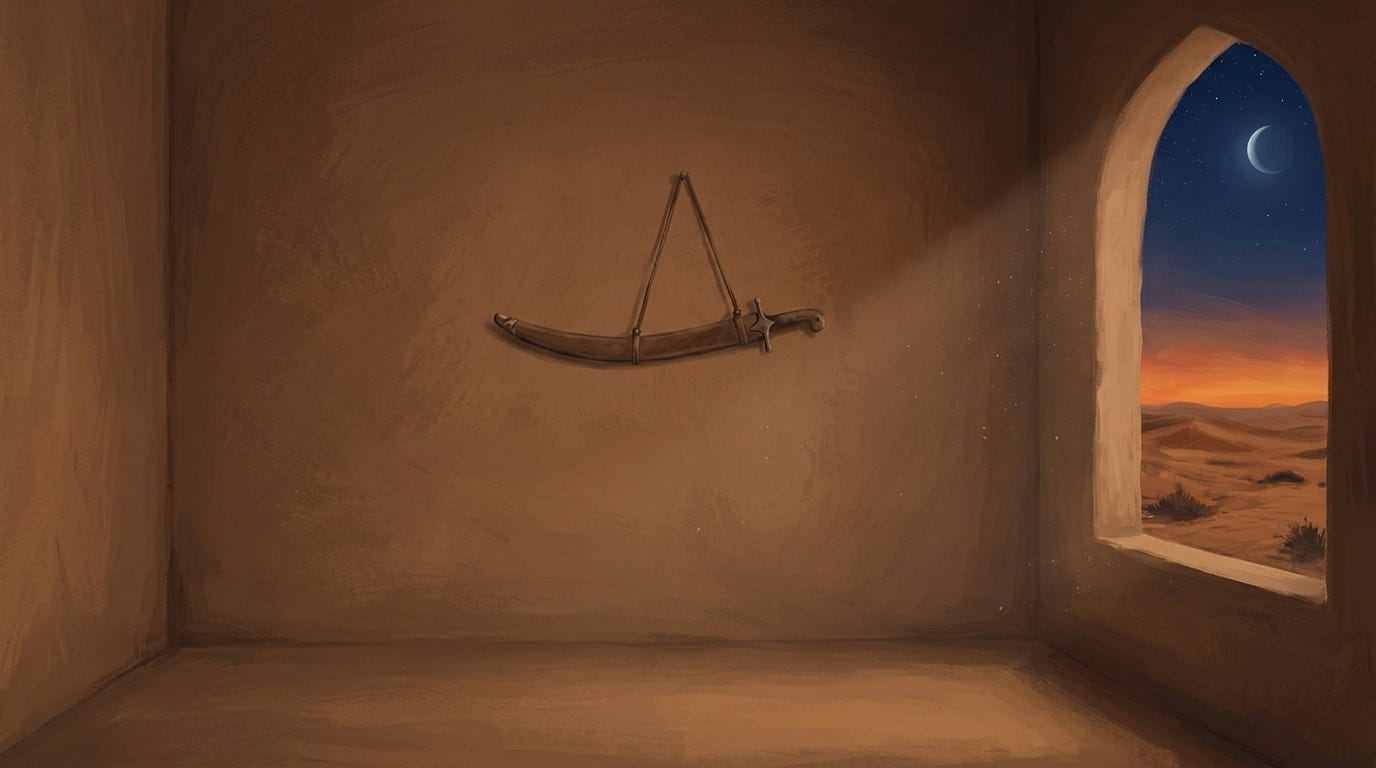
The Saudi flag carries the shahada above a sword, the saif, and the kingdom still executes by beheading with a sword. A leader who is modernizing a country cannot keep that. The point is not the flag. It is the act, which keeps people in a regressed, terrified state where the body is the message. MBS has shown what he can do by decree. He said he wanted to see women running in the streets, and women ran. If he can mandate that, he can mandate the retirement of the beheading sword and of the sayyaf. He can choose not to keep his people frightened.
Learning: Reflection
House has also found change. Covid ended head-of-state travel, the scandal faded, GDP and women’s employment rose, and she quotes Einstein: “Learning is experience. Everything else is just information.” Saudis close to him say “He learned the need for systems of governance, not whim,” and “He has learned to sit, think, reflect, and then react.” A foreign official says: “He’s learned it’s not smart to tick off everybody at one time.” That is less whiplash, and it is a real capacity, because reflection is what a child gains when its world becomes steady enough to think in. But at home the regime still locks up critics, and “once was enough” is not a standard. Heavy lies the head: the burden Shakespeare meant, and the head in my work on beheading. A head that can learn can also retire the sword.
Sources
House, Karen Elliott. The Man Who Would Be King (Harper, 2025), Chapter Five, “Heavy Lies the Head,” beginning p. 69.
Shakespeare, William. Henry IV, Part 2, Act 3, Scene 1.
Callamard, Agnès. Annex to the Report of the UN Special Rapporteur on extrajudicial, summary or arbitrary executions: Investigation into the unlawful death of Mr. Jamal Khashoggi (2019).
Klein, Melanie. “Notes on Some Schizoid Mechanisms” (1946).
Kobrin, Nancy Hartevelt. The Jihadi Dictionary.
Nancy Hartevelt Kobrin, PhD, is a Tel Aviv–based psychoanalyst and counterterrorism scholar.
https://www.amazon.com/Nancy-Kobrin/e/B002RF9D5Y