This is the third in a short series as I read Karen Elliott House’s biography The Man Who Would Be King and associate to it psychoanalytically. If later reading changes my mind, I will say so.
The boy. House reports that MBS is the firstborn of six sons by his father’s third wife, and the sixth son overall, a rank that normally carries little role (p. 16). His father, then governor of Riyadh, vacationed with his first wife and family at a palace in Marbella and visited MBS’s mother and her boys at a hotel in Barcelona (p. 18). This must be psychosexually provocative to wonder what his father does with the first wife and that family and then with his mother and his siblings? Being kept in the dark?
House writes that his father spent little time with him as a boy. Jamal Khashoggi mused that it must have been hard for MBS to get his father’s attention. MBS himself says he was not his father’s favorite and names four siblings who rated higher (p. 18). A tutor recalled that he was allowed to do as he pleased (p. 18). So he had no boundaries. His mother pushed her sons to excel and not be seen as “also-rans” (p. 16). This is an equestrian expression in horse racing meaning a horse that finishes but just one among many. Think not only Arabian horses but the family on the order of a herd in size. . . At six she gave him a Neo Geo (p. 17). He was also a shy, insecure boy who could not perform in a third-grade play as we learned yesterday (p. 16). Then all of a sudden he is described by House as having become filled with leadership and bravado (p. 17). How did this happen so fast? A leopard cannot change its spots overnight.
The mother. We should not be hard on her. It is very difficult to grow up in a shame-honor culture as a female without equal rights. Her quest to push her sons was to guarantee, as best she could, his future, her own and the family’s. She was exercising power through her “honor.” Producing a firstborn son was her first taste of honor, and it made her Umm Mohammed, the mother of Mohammed. House notes that she descends from the Ajman tribe, famous for its persistent opposition to Abdul Aziz (p. 15). That should not be written off by characterizing her tribe as rebels. It was tribal war. She carried that history into a household where she was one wife among several, and pushing her son not to be an “also-ran” was her way of securing his place in a house that ranked everyone.
The companion. When MBS was seventeen, his father lost his two eldest sons within a year, and the young prince offered constant companionship (p. 21). I ask, as a question and not a claim, whether he stepped into the place of the dead sons, and whether anyone mourned. With the two eldest gone, he also moved up the line of his father’s sons, so the family’s loss was in a way his gain, which is the setup for unmourned survivor guilt. Was he unknowingly a belated replacement child? Generally replacement children are born after the death of the sibling. They are fraught with misgivings and never feeling that they had been seen as their own true self more on the order of a fictitious character in the family tale.
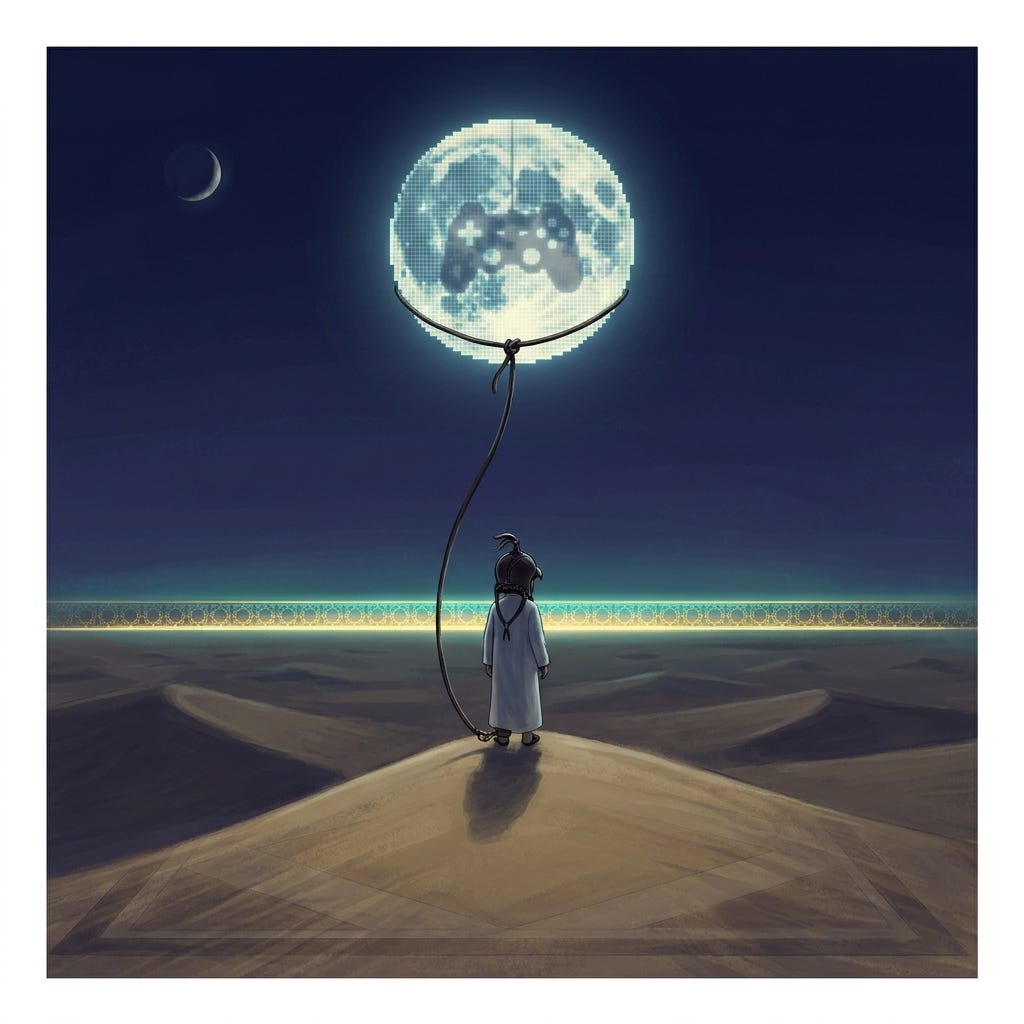
Play and fantasy. House describes a childhood with no movies or music, only soccer and videogames (p. 17). The Neo Geo console still sits in his childhood bedroom. Could it be his equivalent of a teddy bear? To this day he still connects with it every morning playing a videogame for half an hour (p. 17). Perhaps trying to reconnect with his lost inner child? His favorite, Final Fantasy XVI, is about the heir to a fictitious throne who discovers he is the “True King” (p. 19). This immediately took me back to the discussion of Judar and the treasure hunt. A close associate says the games led him to believe that anything possible in a game is possible in life. House calls Vision 2030 “full of his grandiose, videogame futurisms” (p. 19). Winnicott distinguished playing from fantasying. Playing needs a mother reliably there to hold the space, and reality pushes back. Fantasying is a closed world where nothing resists. I think of Sherry Turkle’s work on simulation, which I will read next. The title of her new book is Artificial Intimacy and strikes a chord to my ear here.
The moon. In Islam the new crescent marks sacred time. Ramadan begins and ends with its sighting. Neom is to have a fake moon to light the night sky (p. 20). The moon is also the image of a constant object that wanes and always returns. A moon that he builds, and that never wanes, is a mother who never leaves, held by control. This is my interpretation.
The falcon. I once saw a hooded falcon in the Amman Airport while I was changing planes to go and lecture in Colombo, Sri Lanka. I had read Arabic poetry about falcons and I was so momentarily captivated to actually see one with its falconer. The Arabic hunting poem, the tardiyya, from Abu Nuwas to Ibn al-Mu’tazz, describes the trained hawk and falcon in loving detail. Psychoanalytically this is a special kind of maternal attachment – the owner and falcon are a fused dyad. House writes that MBS’s speed and focus mimic a prize falcon (p. 22), and a friend says the falcon owner knows the best falcon in his group (p. 21). A falcon is a predator that kills, and in falconry it is hooded and tethered to the handler’s glove. The falcon tears its prey apart making body parts and eating them. King Abdullah told MBS’s father to “keep your son on a short leash” (p. 24). A predator on a leash, with the father as the falconer.
The hunted. In this childhood there is one woman, the mother. Reports from October 2026 describe the precautions MBS takes as he moves between fortified palaces with bunkers. An INSS analysis written in the middle of the war with Iran and its proxies, including the Houthis, concludes: “He remains strong enough to rule the kingdom, but not strong enough to ensure its security.” The boy who wanted a world with no resistance is inside a game he cannot pause, kept behind walls, under watch, as he was once watched by his mother through a surveillance camera.
It must be hard for us to understand the “shifting winds” of the Arabian desert. But his moves may be more predictable than they look, because the trigger is the same each time. Each time House shows him feeling passed over or made to look like a failure, he escalates. He was incensed when he was passed over for a promotion: “It was upsetting that everyone got promoted except me; made me look like a failure” (p. 22). This is shame speaking, the narcissistic wound that stings. The judge who refused him land allegedly received a bullet in an envelope, an early form of the intimidation he later practiced with the Ritz-Carlton lockup (p. 24). A man who lacks a constant inner object may read a public slight as an abandonment. So watch for humiliation, offer him ways to save face, as he himself did when he settled a quarrel between his father and King Abdullah (p. 24), and be a steady, consistent partner. Constancy from the outside can steady a leader who never had enough of it inside. That is how to make the unpredictable more predictable.
Sources:
House, Karen Elliott. The Man Who Would Be King (Harper, 2025), pp. 11-25.
Winnicott, D. W. Playing and Reality (1971).
Cain, Albert C. and Barbara S. Cain. “On Replacing a Child,” Journal of the American Academy of Child Psychiatry (1964).
Turkle, Sherry. Artificial Intimacy: Who We Become When We Talk to Machines (2026).
Ibn al-Mu’tazz. In Deadly Embrace: Hunting Poems, trans. James E. Montgomery (Library of Arabic Literature, 2023).
Guzansky, Yoel. “When Threats Converge: Saudi Stability Revisited,” INSS Insight No. 2214, November 11, 2026.
Hubbard, Ben. MBS: The Rise to Power of Mohammed bin Salman (2020), the tutor passage.
Nancy Hartevelt Kobrin, PhD, is a Tel Aviv–based psychoanalyst and counterterrorism scholar.
https://www.amazon.com/Nancy-Kobrin/e/B002RF9D5Y