

I started thinking about MBS again because of the ongoing war in the Kingdom. I hope to post short pieces concerning how we might understand his leadership.
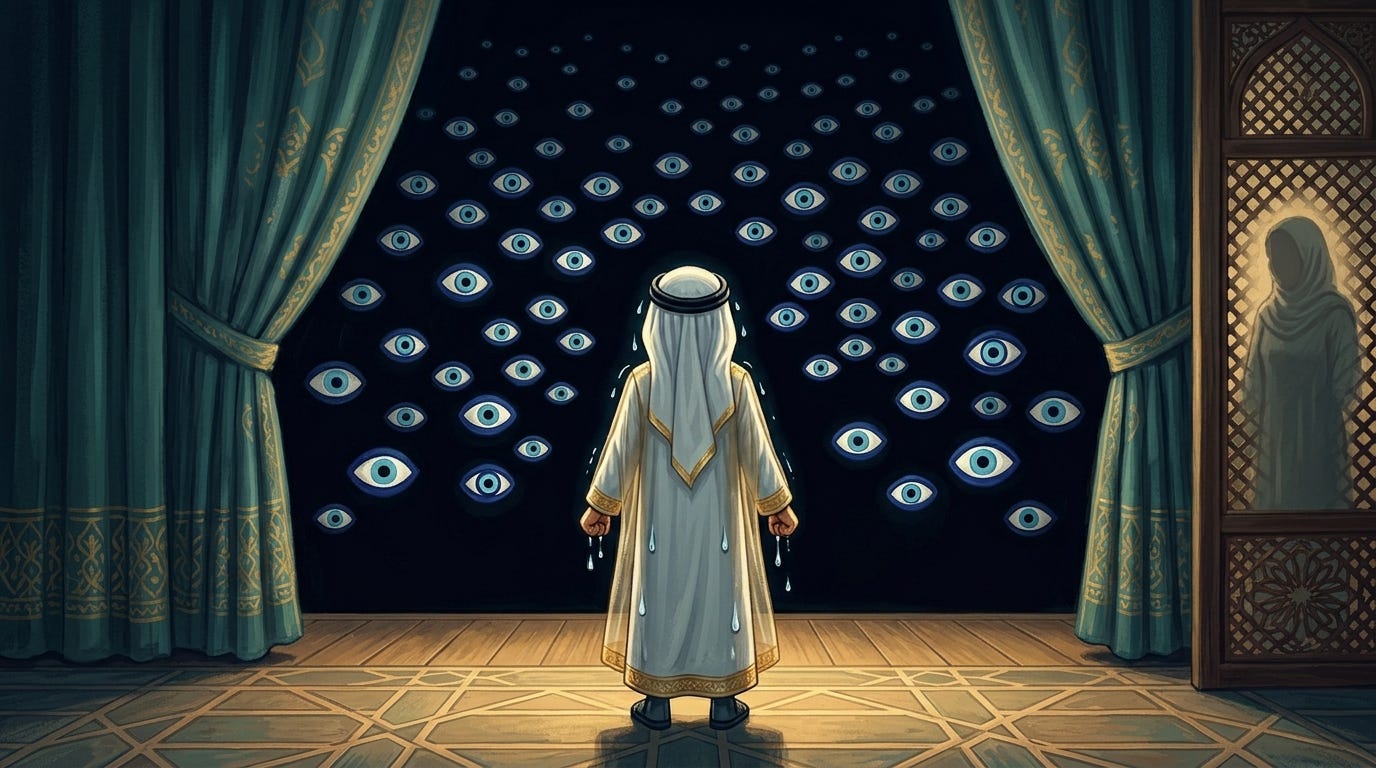
When Mohammed bin Salman was in third grade, he rehearsed for a school play. On the day, with his father there to support him, he refused to go on stage. His father pleaded and he would not move. Karen Elliott House reports the scene from his own recollection and reads it as early proof of his determination to follow his instincts.
When I read that, it reminds me of stage fright and panic attacks. I cannot say that is what happened, and I do not diagnose from a distance. But I notice what stage fright may be covering. Both parents wanted a performance. A boy asked to perform for his mother and father becomes their narcissistic object, shown for them and not for himself. His refusal says, in a child’s way, that he wants to be seen in his own right, with his own needs. It also says that being looked at frightens him, because the audience is the accusatory eye that he has done something wrong, i.e. shaming in another form.
In March 2018, NBC News reported that more than a dozen current and former U.S. officials believed he had kept his mother, Princess Fahda bint Falah Al Hithlain, away from his father, King Salman, for at least two years. They said she had at one point been placed under house arrest and that the king was given excuses. The Saudi embassy denied it. Ben Hubbard adds that she was then the king’s only remaining wife, that the king was fond of her, and that MBS and his aides usually said she was abroad for medical treatment. Around the time Salman became king she stopped appearing at family functions and other royals concluded that her son had locked her up. Some thought he feared she would split the family; others whispered that she used black magic on the king. Saudi officials called any inquiry highly offensive. Nothing public has confirmed or refuted the account, so I treat it as an allegation and ask only what it would mean if true.
Start with the phrase - “house arrest.” To arrest is to stop movement, and the house is the maternal container. A son who puts his mother under house arrest is controlling the psychodynamics of the whole family by controlling the woman who holds it together.
The medical excuse is the one lie nobody can argue with. A husband cannot demand his sick wife back without seeming to deny her care. It also keeps a fond old man waiting and hopeful. I call that cruelty, a quiet kind, toward a father who asked for his companion.
Westerners reach for Oedipus, but the Arabo-Muslim form is the Judar complex, as Abdelwahab Bouhdiba names it. In the Arabian Nights, Judar, a Cairo fisherman’s son, is hired by a Moroccan sorcerer to open a treasure. At the seventh and last door an apparition appears in his mother’s shape and claims him: she bore him, nursed him and reared him. She pleads her modesty and tells him he disappoints her fosterage of him. The sorcerer has ordered Judar to strip her. The first time he stops at her trousers out of pity, and the guardians beat him. The second time, warned that she is only an enchantment in her semblance, he denies her claim, strips her completely, and she becomes a body without a soul. The treasure opens.
The name itself has a maternal tie. Judar is a spelling of the Arabic Jūdhar, the calf of the wild cow. The classical dictionary Lisan al-Arab files it under the root j-dh-r, whose core meaning is root or origin: the root of a plant, the root of a number, the root of the tongue, and as a verb to uproot or cut off. So the hero carries the mother in his name, as the young one of the cow, and the root beneath it names the origin he must face at the seventh door. By the end of the tale he does cut himself loose from her claim. No source I found links the name to the plot, so this is my reading.
I read the tale this way. The fisherman’s son draws things up out of water, and the river dries when the doors open, so the treasure behind the mother reads to me as her honor and her womb. The command to violate her comes from a paternal sorcerer, an outsider, and the whole test is whether Judar can bear the mother’s reproach and refuse it. What drives it is shame, not guilt.
The Arabic word for such a figure is shabah, from the root sh-b-h, whose core meaning is likeness. A shabah is a form seen from afar whose identity you cannot be sure of, hence a phantom. If a son treats his mother as a semblance, a figure who claims him as a mother and must be refused, then there is no mother to answer to. I add the throne as my own gloss: it may be the power waiting behind the door.
The mother’s gaze in this culture is the accusing eye of a mother who used shame as a tool in raising her son, because that is how she was raised. Shame passes from mother to daughter to son across generations, as I argued in “The Violent Brutality of Growing Up in a Shame-Honor Culture Predicated on the Destruction of the mother and the Maternal Bond.” The eye he fears is one she inherited and handed on without choosing it. Hiding her cannot remove it, because by then it is inside him. That is also why the school stage matters: an audience of strangers is that eye, looking, in a kingdom where everyone is already under surveillance. Human Rights Watch and Citizen Lab have documented Saudi use of commercial spyware such as Pegasus against critics, and HRW reports the surveillance and harassment increased after he rose to power.
A second line runs through the culture. A family’s standing rests on the sexual purity of its women, and the mother’s body carries that honor. Hiding her keeps it out of view. The sources show concealment, not sexuality, so this is my interpretation.
Her origin adds a fact. Fahda is of the Ajman tribe, of the Al Hithlain family, and her ancestors include the chiefs Rakan and Dhaydan bin Hithlain. The Ajman were long-term enemies of the Al Saud. They fought Ibn Saud at Kanzan in 1915, and in 1929 Dhaydan was killed after the Ikhwan defeat at Sabilla. A son who inherited his father’s house may carry his mother’s rebel lineage inside it.
Shakespeare gives the contrast. Hamlet forces his mother to look into a glass and see herself. Lear, breaking, cries out for the mother who was never in the room. In Judar the mother’s claim is refused. The boy who would not perform for his mother and father is now the man who decides who may see her, and he never shows his own wife and children.
Then the Houthi war. Since the truce collapsed in July, Houthi missiles and drones have reached Riyadh, and an Aramco building in the capital was damaged by shrapnel this week after an attempted attack. He can arrest princes at the Ritz-Carlton, as he did in 2017, and, allegedly, his mother. The Houthis are Zaydi Shia, not his kin, and they do not respond to the family’s tools of control. Each strike that gets through reminds him that the house he sealed is not sealed.
Sources:
https://www.nbcnews.com/news/world/u-s-officials-saudi-crown-prince-has-hidden-his-mother-n847391
https://www.tpr.org/2018-03-15/saudi-crown-prince-is-hiding-his-mother-u-s-officials-say
https://en.wikipedia.org/wiki/Fahda_bint_Falah_Al_Hithlain
https://en.wikipedia.org/wiki/Battle_of_Kanzan
https://en.wikipedia.org/wiki/Dhaydan_bin_Hithlain
https://www.bookrags.com/ebooks/3440/71.html
https://www.bookrags.com/ebooks/3440/72.html
https://arabiclexicon.hawramani.com/%d8%ac%d8%b0%d8%b1/?book=10
https://foreignpolicy.com/2018/10/19/the-kingdoms-hackers-and-bots-saudi-dissident-khashoggi/
https://www.democracynow.org/2019/11/7/former_twitter_employees_charged_with_spying
https://www.aljazeera.com/news/2026/11/8/saudi-arabia-intercepts-houthi-missiles-targeting-riyadh-eastern-province
Karen Elliott House, The Man Who Would Be King, p. 17
Ben Hubbard, MBS: The Rise to Power of Mohammed bin Salman, p. 58
Abdelwahab Bouhdiba, Sexuality in Islam, p. 228
Nancy Hartevelt Kobrin, PhD, is a Tel Aviv–based psychoanalyst and counterterrorism scholar.
https://www.amazon.com/Nancy-Kobrin/e/B002RF9D5Y
#PsychoanalyticVisualIntelligence #MohammedBinSalman #SaudiArabia #JudarComplex #MaternalGaze #Shame #Psychoanalysis #MiddleEast #Houthis #CrownPrince