On October 10th a Houthi missile struck Riyadh’s airport and killed 13 people. What did Muhammad bin Salman, the crown prince and de facto ruler of Saudi Arabia, do next? He disappeared. His ministers visited the victims. His ministers offered reassurance. The man himself was nowhere to be seen. Nine days later, organizers postponed the Future Investment Initiative, the “Davos in the desert” where he usually spends a week shaking hands with presidents and bankers. The airport remains, in effect, shut.
The Economist calls this his annus horribilis and lists the failed gambles: he could not defeat the Houthis, his economic vision is stalling, and Donald Trump turned out to be no reliable friend. All true. But the magazine missed what is in plain sight, or rather what is not in sight. As a psychoanalyst I look at what a leader shows us, and just as carefully at what he hides.
Start with the women.
In 2018, U.S. officials told NBC News that MBS had kept his mother, Princess Fahda, away from his father, King Salman, for more than two years, reportedly because they feared she would oppose his rise. A son who cuts his mother off from his father in order to seize power has told us something about his inner world. The mother is not a source of comfort to be kept close. She is a threat to be put out of view.
Then there is his wife. Her name is Sara bint Mashour, a cousin he married in 2008. They have five children. In a modern nation-state, in an era of cameras everywhere, she has never been seen in public. Neither have the children. This is the same man who sold himself to the West as the great modernizer, who let women drive, who opened cinemas and concert halls.
To be fair, most Saudi royals keep their wives out of view. This is not his private quirk. But that is precisely the point. The façade changed. The foundation did not.
What holds that foundation together is shame.
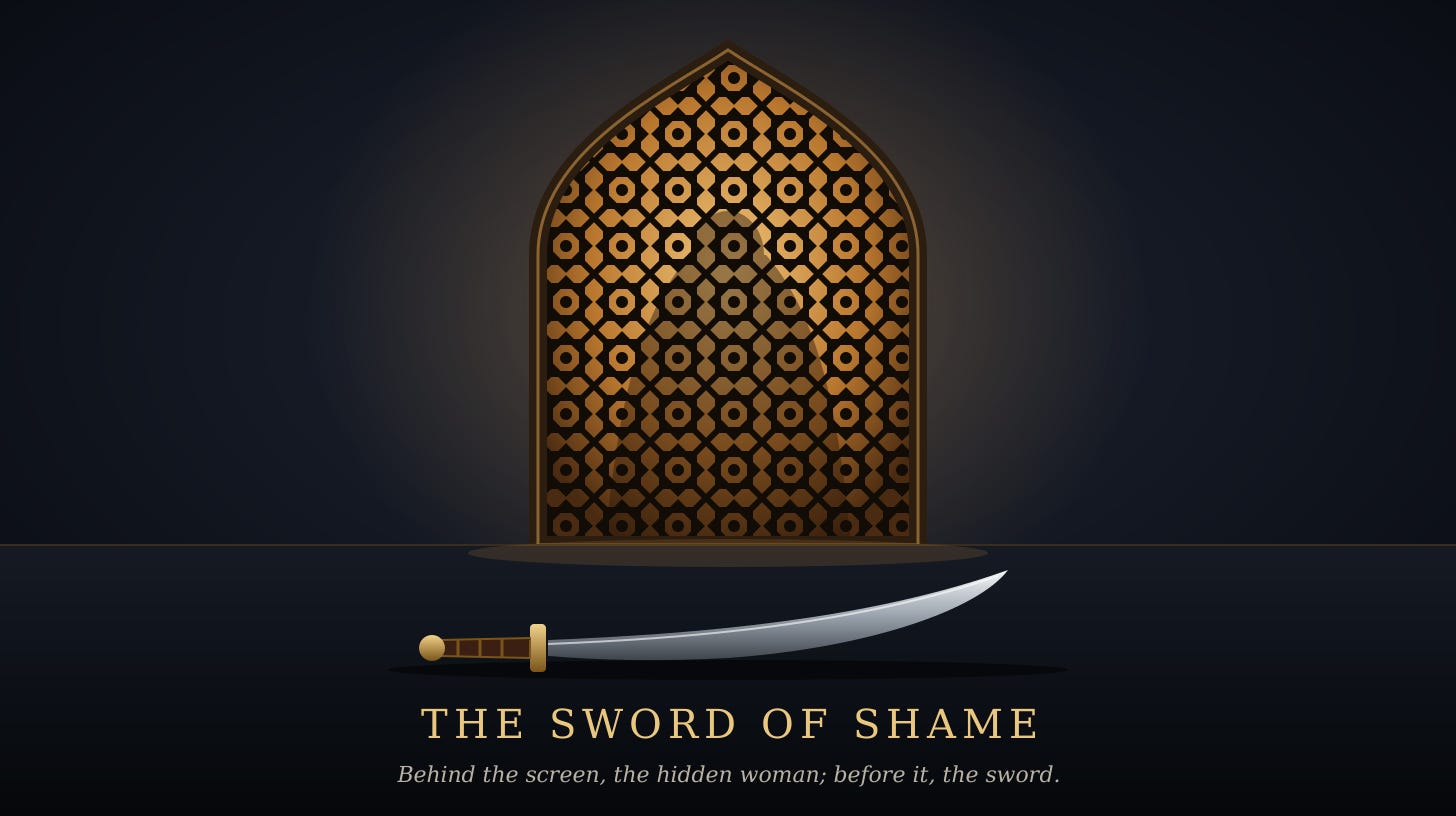
In Saudi honor culture, a woman’s visibility is treated as ‘awra, something that exposes the man. To show her is to expose himself to dishonor. Hiding her protects him. Not her. Him.
Here the distinction between guilt and shame matters. Guilt says: I did something wrong, and I must repair it. The guilty leader goes to the funerals, sits with the families, stands in the rubble. Shame says something else entirely: I am exposed, and I cannot bear to be seen. The shamed person wants the ground to swallow him. He hides.
That is what MBS did after October 10th. A ruler whose capital is hit, whose airport is closed, whose foreign guests are told by their governments to stay away, has been exposed as the protector who could not protect. And the shamed self does what it has always done with what it cannot bear. It removes it from sight. First the mother. Then the wife and the children. Now himself.
On October 14th, Saudi Arabia executed a Bangladeshi man and woman for what the Interior Ministry called “immoral acts” inside a mosque in Mecca. The act was never named. Bangladesh’s own government was not even told before they were killed. Again the same sequence: what shames is hidden, then destroyed.
Saudi Arabia carries out most of its executions by beheading with the sword. I have written for years that beheading is the concretization of “off with her head.” The head that is cut off is, unconsciously, the mother’s head, displaced onto the body of the condemned. The rage that cannot be directed at the mother, the one who must be revered and kept hidden, is carried out in public on someone else. The rage comes from a sense of emasculation. These men are not permitted to separate psychologically from their mothers. That is the unconscious cultural taboo: the son may never leave the mother inside his mind, and so he never becomes a man in his own right. The sword does what the son cannot.
And the regime does not stop at the head. It produces body parts. Jamal Khashoggi was not only killed inside the Saudi consulate in Istanbul in 2018. He was dismembered. The production of body parts is the signature of the serial killer, who cannot relate to a whole person and so reduces each victim to pieces, again and again. When a state beheads by the sword year after year and dismembers a journalist in a consulate, it is repeating the same unconscious act on a national scale. In Melanie Klein’s language, this is the world of the part object. The infant who never achieves a secure, stable, whole image of the mother lives among fragments: a breast, a face, a voice, never a whole person who can be loved and hated at the same time and still survive. Without that whole maternal image there is no security and no true separation. What remains is a terror of being swallowed or destroyed, managed by cutting things into pieces.
A ruler who hides his mother, hides his wife, hides his children, hides himself, and cuts the bodies of his enemies into parts is showing us a mind that cannot hold anything whole. The women are kept out of sight. The bodies are kept in pieces. Neither can be seen as a full human being, because a full human being would have to be faced.
There is one more layer, and I pose it as a question. His wife’s name is Sara, the name of the matriarch. Islam honors Sarah as the wife of Abraham (Ibrahim in Arabic) and the mother of Isaac. But the Arabs trace their line through the other mother, Hagar (Hajar in Arabic), the one Sarah sent away into the desert with her son Ishmael. Every pilgrim at Mecca reenacts Hagar’s frantic running between Safa and Marwa in search of water for her child. MBS is the custodian of that ritual. The mother of the rival line, the line of Isaac, of the Jews, lends her name to the woman he keeps hidden. What does a man do with what he cannot bear to look at?
Now look at his search for protectors. He courted Trump with promises of impossible investments, golf tournaments, and $2 billion placed with Jared Kushner. It did not buy loyalty. So now there is the Mecca pact, a mutual defense agreement with Pakistan and Turkey. The West reads this as strategy. I read it as a son searching for a substitute father after the first one failed him, while the mother remains locked away.
Western diplomats in Riyadh say talk of a threat to his rule is overblown. They may be right. He has crushed his rivals and centralized power like no Saudi ruler since the founder of the kingdom. But power is not the same as psychological strength. A leader who cannot show his wife, cannot show his children, and cannot show his own face when his people are killed is not secure. He is hiding.
For Israel this matters. Normalization with Saudi Arabia has been dangled for years as the great prize. But a partner governed by shame is a partner who will vanish when exposed, who will deny, who will retreat behind the curtain the moment the costs become visible. We should plan for that, not hope it away.
The Economist concludes that his test in his second decade is to change the foundations and not just the façade. I agree. But the foundation is not oil, the army, or America. The foundation is shame. Until a Saudi ruler can stand in public beside the women of his family and beside the bodies of his dead, until he can give up beheading as capital punishment, and perhaps even remove the sword of shame from the flag of Saudi Arabia, nothing will have changed. The façade is all there is.
Sources
The Economist, “Everything is going wrong for Muhammad bin Salman,” October 19, 2026.
NBC News, “U.S. officials: Saudi crown prince has hidden his mother,” March 15, 2018. https://www.nbcnews.com/news/world/u-s-officials-saudi-crown-prince-has-hidden-his-mother-n847391
Al Jazeera, “Houthi missile attack targets Saudi capital Riyadh for third day in a row,” October 12, 2026. https://www.aljazeera.com/news/2026/10/12/houthi-missile-attack-targets-saudi-capital-riyadh-for-third-day-in-a-row
Gulf News, “Saudi Arabia executes Bangladeshi man, woman for indecent acts inside Mecca mosque,” October 2026. https://gulfnews.com/world/gulf/saudi/saudi-arabia-executes-bangladeshi-man-woman-for-indecent-acts-inside-mecca-mosque-1.500711645
Prothom Alo, “Bangladesh unaware of execution of 2 nationals in Mecca, writes to Saudi Arabia seeking details,” October 2026. https://en.prothomalo.com/bangladesh/yxrw2kmcx8
Al Jazeera, “’Joints will be separated’: Grim new details of Khashoggi murder,” June 19, 2019. https://www.aljazeera.com/news/2019/06/19/joints-will-be-separated-grim-new-details-of-khashoggi-murder/
Amnesty International, “Saudi Arabia: Three more executions add to unprecedented spike in death penalty,” March 2015. https://www.amnesty.org/en/articles/news/2015/03/saudi-arabia-unprecedented-spike-in-executions/
Nancy Hartevelt Kobrin, PhD, is a Tel Aviv–based psychoanalyst and counterterrorism scholar.
https://www.amazon.com/Nancy-Kobrin/e/B002RF9D5Y