

My doctoral training was in Islamic literature, and there is an older pattern here worth naming. Under classical Islamic rule, Jews and Christians lived as dhimmis, protected subjects. Their protection was granted in exchange for the jizya, a special tax, and for visible deference to the ruling power. The dhimmi survived by anticipating the ruler’s displeasure and yielding before it was expressed.
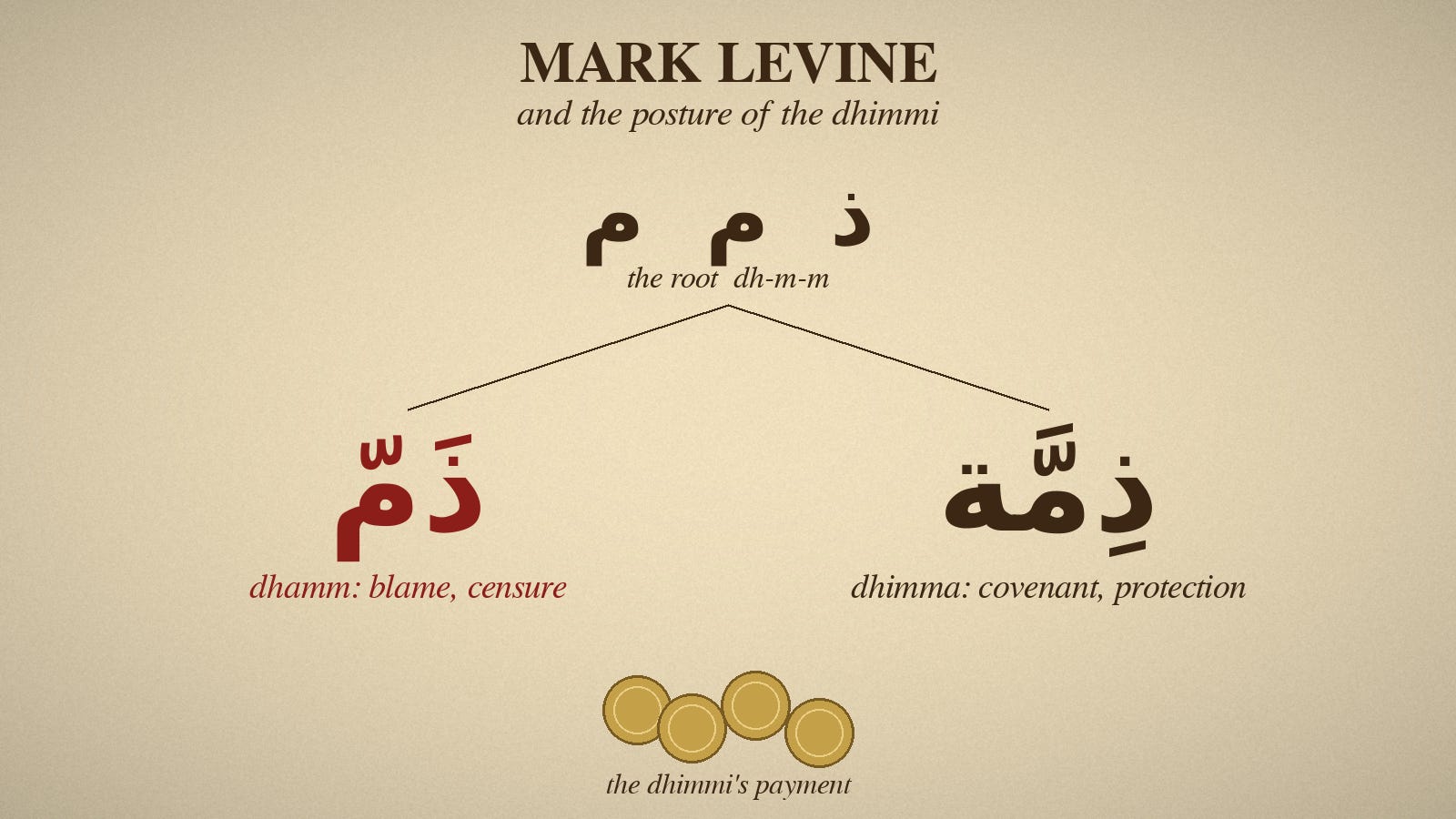
The word itself tells us more. Dhimmi comes from the Arabic root dh-m-m. From it come dhimma, covenant or protection, and dhamm, blame or censure. The same root that names the pact of protection also names reproach. The language of the institution thus builds blame into the very status of the Jew: he is protected and blamed in one breath. It is a two-for-one. The Jew is blamed, and in blaming him the ruling group purges itself of blame by shaming him. Embedded in the language of the dhimma, the mechanism runs deep in the unconscious of the culture that created it. It did not need to be taught. It was carried in the word.
The posture outlived the empires that imposed it. It describes anyone who buys safety through preemptive submission. Mark Levine paid no tax, but he offered something in the same spirit: a promise broken before anyone demanded it, delivered with a rebuke of the Jewish state, to win the approval of Mamdani and his base. That is the dhimmi’s payment.
Some will call Levine a court Jew. He is not even that. The court Jews of Europe used their access to power to intercede for their communities. Levine used his access to withdraw the city’s trust from the Jewish state.
This is why I call for a boundary rather than outrage. A dhimmi posture is not cured by shouting at the dhimmi. It ends when the community stops paying, and when we show, with our own bonds and our own children’s gifts, that we are not afraid.
Nancy Hartevelt Kobrin, PhD, is a Tel Aviv–based psychoanalyst and counterterrorism scholar.
https://www.amazon.com/Nancy-Kobrin/e/B002RF9D5Y