Setting the Record Straight
My research began earlier than 9/11 — with Hezbollah’s suicide bombings of the Israeli army headquarters in Tyre in 1982 and 1983, and the U.S. Marine barracks bombing in Beirut that same year. Those attacks first put the question of what drives a person to become a human bomb in front of me. That question was still mine when the U.S. Army, Fort Leonard Wood, contacted me after September 11, 2001 — I am still in contact with Scott Cheek, who reached out to me then — about the devalued female in Arab-Muslim culture and the suicide attack. I lectured on this at Fort Leonard Wood and at a U.S. Army Middle East studies program in Florida. It reached print in 2002, in a chapter titled “The Death Pilots of September 11th, 2001: The Ultimate Schizoid Dilemma,” which introduced the “maternal cameo” — the mother’s unconscious inscription in the very structure of Islamic violence, down to the naming of al-Qaeda itself.
This was not armchair theorizing. I trained military and law enforcement on radical Islam globally and conducted prison interviews — one senior psychoanalyst criticized me for lacking formal “case studies,” yet he had no grasp nor empathy for how dangerous that fieldwork actually is. I was also the first to lecture on the mother-infant bond in Hebrew, through MALAM (Hebr. Merkaz L’Moreshet Modi’in), to Mossad, Shin Bet, and AMAN (i.e the IDF’s intelligence units, not Jordan’s capital). I have worked for years as a citizen diplomat on normalization across the Muslim world — Pakistan, Somaliland, Somalia, Tunisia, North Africa — and served as a military contractor. I also hold a doctorate in Islamic literature. Few in psychoanalysis have taken the discipline off the couch this way, to educate on the early-childhood roots of shame-honor cultures across the Arab and non-Arab Muslim world and maternal attachment.
The thesis: the suicide bomber’s motivation is rooted in a profound terror of abandonment accompanied by extreme rage, originating in the earliest mother-child relationship, with ideology as cover. Not politics wearing a psychological mask — psychology wearing a political one.
I kept building the record. In 2003, Clio’s Psyche published my exchanges with fellow scholars — Shneidman and Lotto. By 2009, Clio’s Psyche ran a full interview profile, “Nancy Kobrin’s Journey from Psychoanalysis to Fighting Terrorism.” In March 2010, Potomac Books published my first book, The Banality of Suicide Terrorism: The Naked Truth about Islamic Suicide Bombing. The publisher’s copy made a claim I still stand behind: “Until now, no one has explained why the mother-child relationship is central to understanding Islamic suicide terrorism.” It was not a first word — it was the culmination of nine years of published, peer-engaged argument. And I did not stop there:
● 2013, Penetrating the Terrorist Psyche deepened the maternal-attachment argument.
● 2013/2014, The Maternal Drama of the Chechen Jihadi (Jason Aronson) — the first book on shaming and radicalization, via Shamil Basayev and Chechnya. A free download at www.freepsychologybooks.org 450 copies were downloaded within the first 48 hours the digital copy was made available.
● 2014, The Jihadi Dictionary, reviewed in Werner Bohleber’s Psyche (in German), engaged directly with the work of a prominent psychoanalyst and further developed my concept of death fusion.
● 2016, The Last Two Jews of Mogadishu Livingin Under Al Shabaab’s Fire further extended the framework to Somalia/al-Shabaab.
● 2018, “The Violent Brutality of Growing Up in a Shame Honor Culture” (Mentélités) extended the thesis to shame-honor child-rearing as a traumatic bonding disorder.
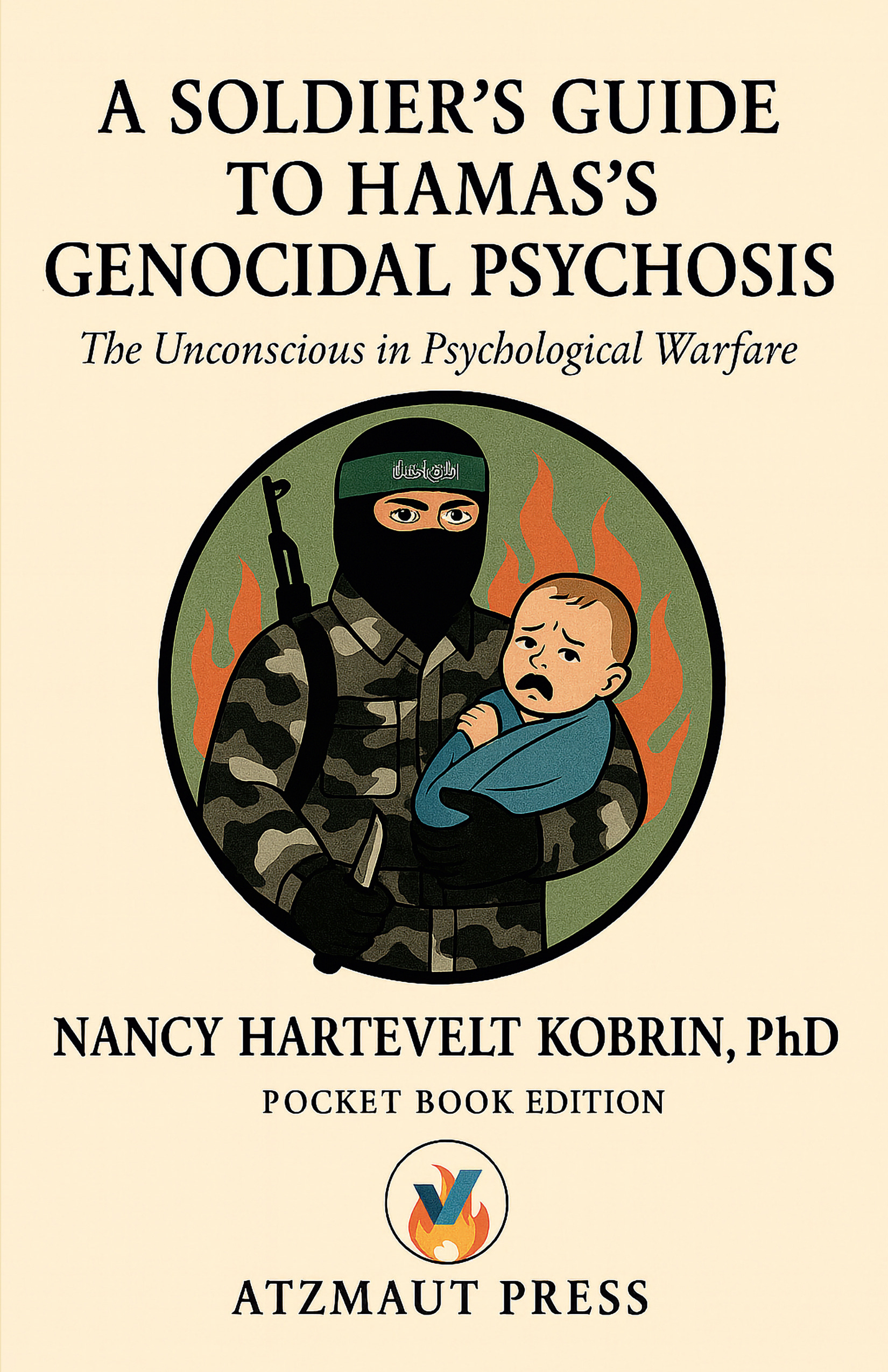
● 2025, A Soldier’s Guide to Hamas’s Genocidal Psychosis—The Unconscious in Psychological Warfare: Beyond Ideology, Before Words reveals how like the story of The Emperor’s New Clothes, Hamas and all the other jihadi groups are naked as seen by the graphic imagery they communicate.
A 2017 essay by another writer in the field engages a mother-son dynamic fifteen years after my 2002 chapter and seven after my 2010 book. But this model centers on the mother’s own disenfranchisement — her rage over her social position “deposited” in her son — not the bomber’s own developmental terror. The causal engine is her grievance, not patriarchal society; the female is blamed once again in its own shame-honor culture. And it seems as if the concept of Islamic antisemitism is missing in this theory altogether — the war on the Jews that defines radical Islam has no place in this account.
Rage is not new territory for me either. In A Soldier’s Guide to Hamas’s Genocidal Psychosis — the Unconscious in Psychological Warfare: Beyond Ideology, Before Words, I read taqiyyah and kitmān as psychological armor against dependency and shame, not just deception tactics. In the 2018 Mentalitiés essay, I argued that in hyper-shame-honor cultures, unmet psychological needs cannot be met — so rage becomes the only available language. I had been pulling this thread for years.
The mechanism needs a target, and that target is not incidental — it is required. The infant’s terror of abandonment, armored over with taqiyyah and kitmān, does not dissipate into ideology; it needs an object. Where the mother is devalued and chronically abused as a female, and the boy’s rage at her cannot be spoken without unraveling the family’s honor, that rage is displaced onto a substitute who can be hated without cost. The Jew is cast as the collective stranger — unrelated by blood, external to the honor apparatus. Antisemitism is not a political add-on to the maternal thesis; it is the mechanism’s outlet. It is why Hamas murderers on October 7th called home to their ummi bragging about having slaughtered Jews.
This is why the maternal cameo and death fusion are not confined to the bomber’s interior life — they surface in the choice of victim. A psychic architecture of dhimmitude, built on unspeakable rage at the mother, finds in the Jew a target built to specification: near enough to hate with the same intensity, far enough to hate without consequence. Hamas’s genocidal violence against Jews is not a departure from the mother-child thesis — it is the thesis, externalized and armed.
My model locates the dynamic in the bomber’s own terror of abandonment, not his mother’s social position — ideology as cover story for a psychic structure formed long before any ideology entered the picture. Both models involve a mother and a son. But they are not the same claim, they share no mechanism.
I raise this not to diminish someone else’s contribution, which I have engaged with directly, but because this other essay does not cite my work at all — not the 2010 book, not the 2002 chapter, not anything that followed. In a field where priority is rarely tracked carefully, and where women’s — especially a Jewish woman’s — early contributions are easily absorbed into later, more widely cited work without acknowledgment, it seemed worth putting the record in writing, in my own words.