

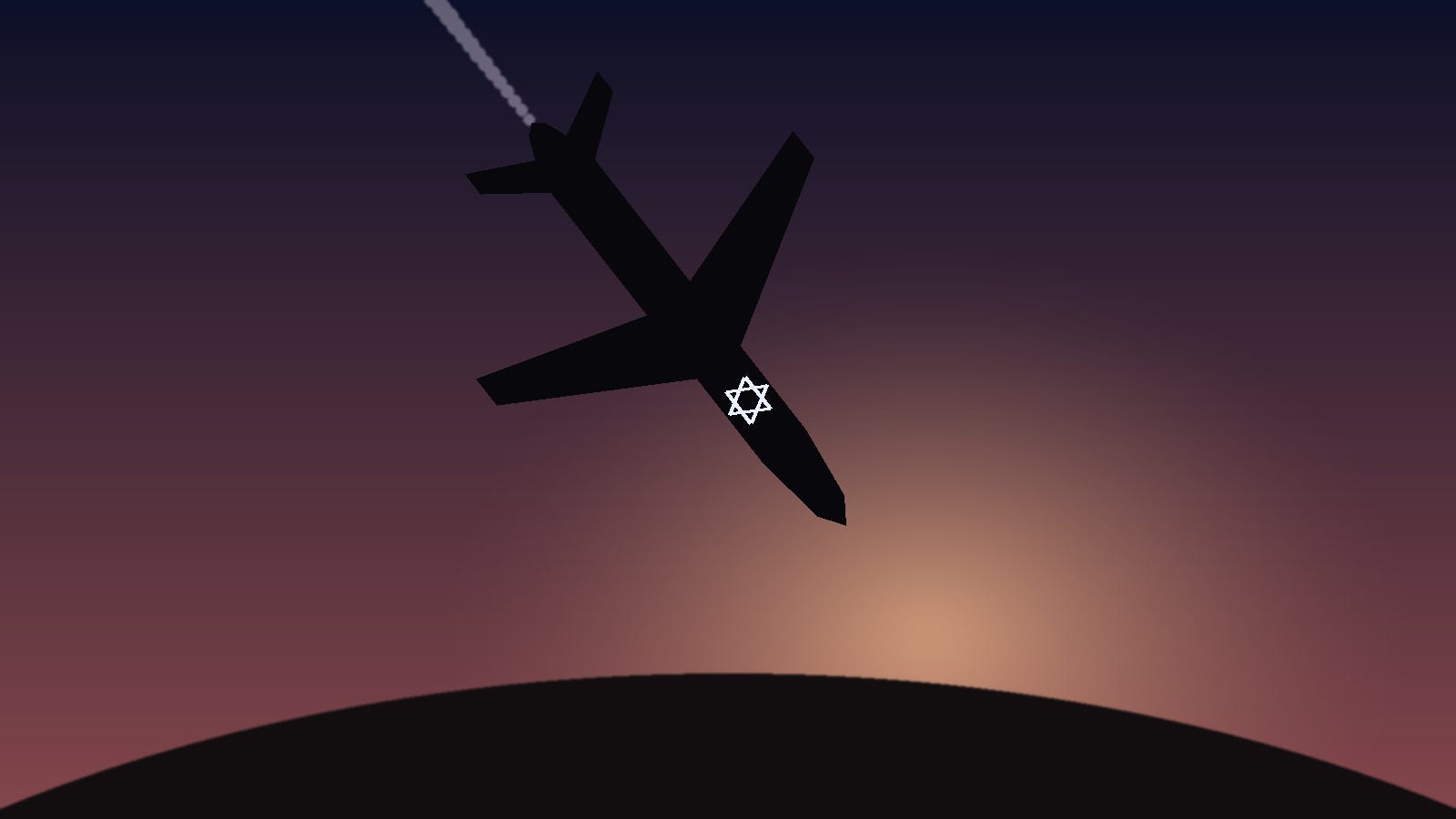
On September 30, a Flydubai jet bound for Tel Aviv with more than 170 Israelis aboard dropped some 14,000 feet in under half a minute. The co-pilot had reportedly stabbed the captain. Passengers and off-duty crew broke into the cockpit, overpowered him, and the aircraft landed in Saudi Arabia. The investigation into motive is ongoing. Still, an attempt to drive a passenger plane into the ground should be read for what it is structurally: a suicide bombing that uses an aircraft in place of an explosive belt.
Israelis have been here before. In November 2002 in Mombasa, al-Qaeda operatives bombed the Israeli-owned Paradise Hotel and, almost simultaneously, fired two shoulder-launched missiles at an Arkia charter carrying 271 people home to Tel Aviv. The missiles missed. Then and now, the target was the same: Jews in the air, on their way home.
September 11 remains the model: aircraft turned into suicide bombs. Mohamed Atta, who flew the first plane into the World Trade Center, left a will forbidding women to attend his funeral or visit his grave. The female is banished at the moment of death, just when the longing for the mother is greatest. I first wrote about this in 2002, in “The Death Pilots of September 11th, 2001: The Ultimate Schizoid Dilemma,” my chapter in Jihad and Sacred Vengeance.
Counterterrorism analysis tends to stop at the tactical and the strategic. Who planned it, who financed it, how the cockpit was breached. These questions matter, but they address only conscious thought, which neuroscientists estimate makes up about 5 percent of thinking, while some 95 percent is unconscious. I review this research in A Soldier’s Guide to Hamas’s Genocidal Psychosis. That is why AI has become so important: it can surface patterns that no analyst consciously sees. Psychoanalysis, however, provides a unique perspective on a rage that exceeds murder itself. It brings in the developmental dimension, the one people are most uncomfortable discussing: early psychological needs, and above all dependency needs.
Abraham Maslow gave us the familiar pyramid of needs. It starts with food, water and shelter, then moves up through safety, belonging and esteem to self-actualization. But the pyramid rests on a foundation it does not show. Beneath it lie unconscious psychological needs that come before any need the infant could name. These include the need to be held, to be contained, to see oneself reflected in the mother’s face, and to depend on her without being destroyed by that dependency. Melanie Klein, Winnicott, Bion, Bowlby and Kohut each described a piece of this foundation. Klein showed that from the start the infant splits the mother into an idealized good mother and a persecuting bad one, and lives with phantasies of entering her body both to possess it and to destroy it. These needs are preverbal, so they never appear on a chart built from conscious motivation. When they go unmet, the result is not simply a deficit. Dependency becomes something craved and hated at once, and the wish to be reunited with the mother can take the form of a wish to fuse with her in death.
Consider the Japanese kamikaze pilots. Their manual instructed them not to fear death, because as they approached the target the face of their mother would appear. Suicide was conceptualized as a return to the mother, a fusion with her. Others in the psychoanalytic literature have described suicide as a death fusion. At its core this is a rebirth fantasy: to die into the mother in order to be born again, cleansed of shame. The dive is not only toward the target. It is toward the maternal object.
Japan, like the jihadi world, was a shame-honor culture. The samurai code made death preferable to disgrace. Ritual suicide ended with a beheading by a trusted second. And the female was devalued even as the mother remained the hidden center of a man’s inner life. Where the woman is degraded in daily life, the longing for her becomes all the more dangerous. It cannot be acknowledged, so it is acted out through violence and death. The pattern does not belong to one religion or one people. It belongs to cultures that shame dependency and devalue the women on whom every infant depends.
This is how I came to conceptualize the suicide bomber: murder plus suicide. In the West we routinely recognize murder-suicide from domestic violence, where the perpetrator kills his partner and then himself. When I began writing about this years ago, I met tremendous resistance in counterterrorism. The field was male dominated, and it did not welcome the idea that a terrorist’s violence could be traced back to his dependency on his mother. Yet the configuration is the same. The violence collapses the boundary between self and other. Those who cannot be separated from are taken along into death.
In the Middle East, honor killing substitutes for murder-suicide. The female is gotten rid of, and the man lives on. But the dependency does not go away. On October 7th, a Hamas terrorist used a murdered Israeli’s phone to call his parents and boast to his father and mother of how many Jews he had killed. This is culturally revealing. The atrocity is offered as a gift to home. Everything is done for the mother.
We continue to underestimate how severe the cultural problems of the unseen years, from birth to age three, really are. No one keeps records of them, and the infant cannot speak of them. Yet this is where the damage begins. A mother who is devalued, shamed and isolated, and often traumatized herself, raises her child inside that degradation. The infant absorbs it before he has words: a mother who cannot hold him because no one holds her, and a dependency that is needed and despised at the same time. Policymakers look at ideology, schooling, poverty and recruitment, all of which come later. By then the template is set. What was never seen cannot be remembered. It can only be enacted, and too often it is enacted as murder and suicide together.
Here psychoanalytic visual intelligence becomes useful. Look at the image itself: an aircraft, a container full of people, plunging nose-down toward the earth. Mother earth receives. The plane enters her as a body returning to the womb. It is Klein’s phantasy of forcing one’s way into the mother’s body, carried out by means of a machine. This is the rebirth fantasy at the heart of suicide terrorism: the shamed, dependent self is destroyed so that a new, glorified self can be born as a martyr. The passengers are not bystanders to the act; they are pulled into the fusion. The act stages, in the language of the body and of machinery, what could never be put into words: an unbearable dependency, rage at the one depended upon, and the wish to merge with her and be born again, all at once.
None of this replaces the security investigation. It complements it. Background checks on aircrews, cockpit protocols, and intelligence sharing address the how. The developmental psychoanalytic dimension addresses the why. It helps us understand why a man trained to keep a plane in the air would turn it into a weapon aimed at himself and at everyone behind him. This psychoanalytic developmental dimension, together with psychoanalytic visual intelligence, must be integrated into AI in order to promote better and earlier screening of perpetrators.
The passengers who stormed the cockpit saved more than 170 lives. They should not have had to. The next man who dives toward his mother will not announce himself. If we want to stop him before he reaches the cockpit, we must learn to see what he cannot say or acknowledge.
Nancy Hartevelt Kobrin, PhD
Nancy Hartevelt Kobrin, PhD, is a Tel Aviv–based psychoanalyst and counterterrorism scholar. Her books are available at https://www.amazon.com/Nancy-Kobrin/e/B002RF9D5Y
This is where AI can save lives, as long as there is data to track. In Israel, they track kids from early on, so the IDF knows where to place them. Again the key is data.