

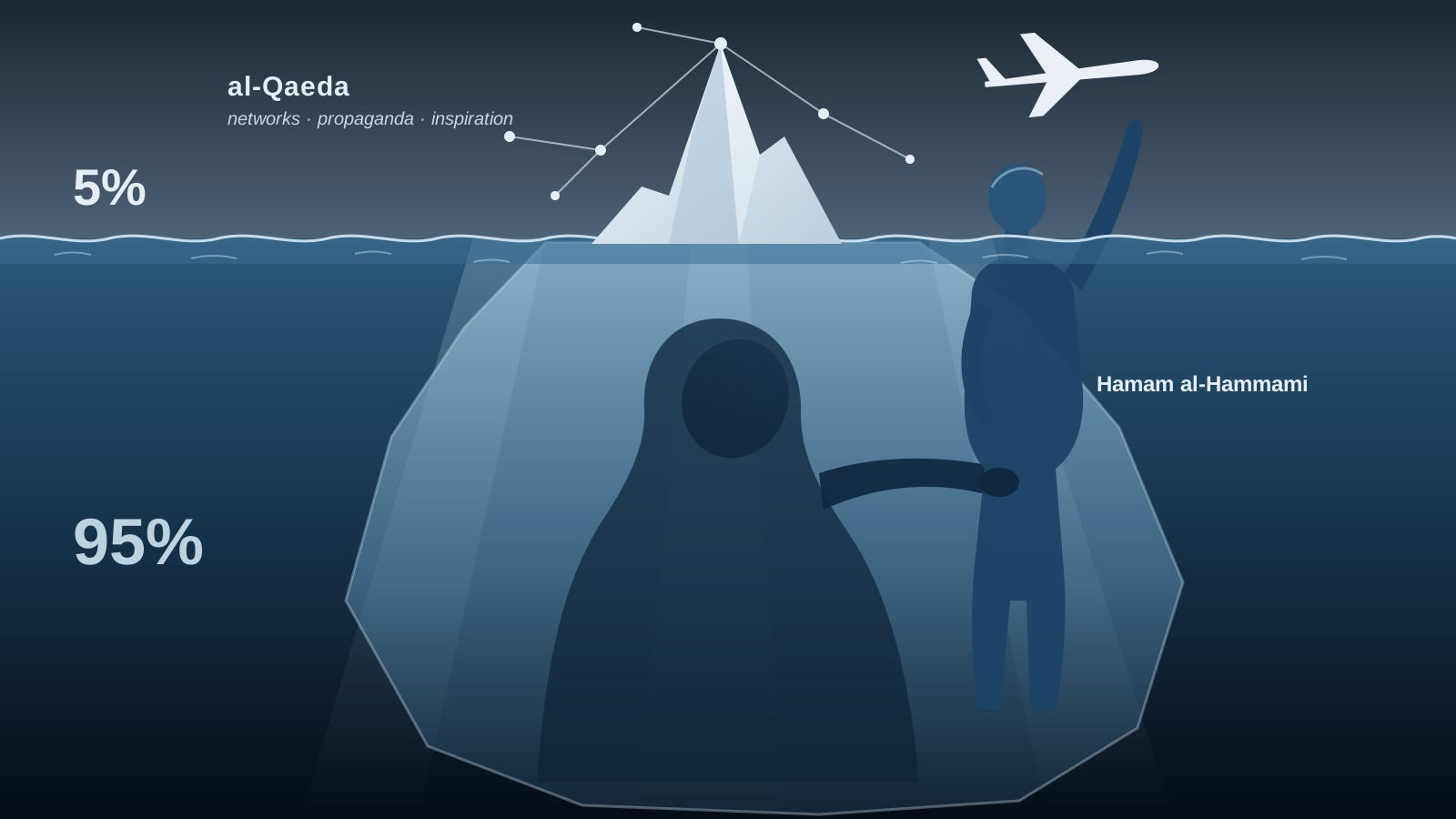
Al-Qaeda has now told us how it reads Hamam al-Hammami. The al-Qaeda-affiliated digital paper al-Bayan praised his attack on Flydubai flight FZ1073 and called for copycats, warning that planes carrying “Zionists, Americans and all the other infidels” can still be targeted, as on “September 11th and 30th.” With that pairing, al-Qaeda wrote him into the 9/11 lineage. The posts he left behind, the faces of Zawahiri and al-Balawi, were a message. Al-Qaeda received it and answered.
Israel’s experts have answered too. In the Jerusalem Post, Yoram Schweitzer of INSS explains al-Hammami through networks and inspiration: al-Qaeda Central’s propaganda, social media, associates who may have shared his views or guided him. He doubts he was a true lone wolf and adds that to plan such an attack, “you don’t have to be a genius.” In Israel Hayom, Zaki Shalom and Kobi Michael call it a failure of imagination and turn to incitement in the Palestinian Authority, Egypt and Jordan. They write that we must read the enemy through his own psychological framework. In Future of Jewish, Jonathan Sacerdoti tells the story of the flight in vivid detail and declares, “The ideology has a name.” None of them asks who the man was.
Networks explain how an idea travels. Incitement explains what fills the air. Neither explains why this man, out of the millions who see the same posts and breathe the same air, picked up the axe. That question is not about networks. It is about a mind.
Here is what we now know of the mind’s history. He was born in the UAE to an Omani father and a Syrian mother. By security sources’ inference, not yet documented, he may have spent part of the years 2011 to 2017 in Syria, from about age 14, at the start of the civil war, in his mother’s country, where Omani authorities believe he was radicalized. In 2024 extremist material was found in his possession and he was taken off flight duty. According to his reported confession, he researched which airlines flew to Tel Aviv, applied to several of them, and took the flydubai job with Israel already in mind. By his own account to investigators, he first planned the attack for July and called it off at the last moment because a friend was among the crew. One human bond stopped him once. He reportedly put off another opportunity after a crisis of confidence. Doubt stopped him another time.
On the day itself, he asked to pray in the cockpit. Captain Smit Machchhar looked away out of respect, and was struck from behind with the crash axe. The captain’s courtesy, turning his eyes away, was the opening. It is this essay’s question in miniature: what happens in the moment we look away.
Adolescence is the second great push to separate from the mother. If he spent those years in Syria, he did it on her ground, likely among her family, as her country tore itself apart. Whose household took him in? Who were the men there? No one has asked, and the experts are not asking.
Then there is Jolani. In 2013 Abu Mohammad al-Jolani, then leader of the Nusra Front, al-Qaeda’s branch in Syria, pledged allegiance to Ayman al-Zawahiri, the ideological father whose face al-Hammami chose for his posts. Today Jolani is Ahmed al-Sharaa, who governs Syria and is received in Gulf capitals in a suit. The war years in which al-Hammami may have been radicalized are the years Jolani’s movement was recruiting young men in that country. If anyone can say where a Syrian mother’s family lived and where her teenage son stayed, it is the government in Damascus. The ideological father al-Hammami chose belongs to the history of the man who now rules his mother’s homeland.
Why don’t the experts ask who he was? Networks can be mapped, counted and cut. A mind cannot. To ask who he was is to go where security analysis is not trained to go: into the nursery, the mother, the unseen years, and the shame. There is also a fear closer to home. To understand a perpetrator from the inside is to find that his terrors are human terrors, the same terror of abandonment and helplessness that every infant knows and every adult has buried. It is safer to keep him outside, as an ideology, a node in a network, a product of incitement, than to recognize anything of ourselves in him. Some fear that understanding him means excusing him. It does not. It means seeing him before he acts. Whenever the explanation stops at the network, it stops just short of the place the analyst would rather not look. That is the blind spot, and it persists because looking would require us to feel, for a moment, what he felt. Our maternal wi-fi picks up his terror before we can think, and we defend against it by turning him back into a category. Not everyone defends against it. In the days after Flydubai, it was reported that two United pilots had refused to leave a colleague alone in the cockpit because they did not trust him, while his union reportedly blocked the airline from removing him.
This is the konseptzia writ large. On October 7th, Israel’s konseptzia was the belief that Hamas calculated as we do. The deeper konseptzia is the belief that terrorism can be understood by working only with the 5 percent of the mind that is conscious: ideology, networks, incitement, stated motives. As long as counterterrorism confines itself to that 5 percent, there will be more attacks, and each surprise will force a harsher shift in thinking than the last. The bond that matters forms below the waterline, in the unseen years from birth to age three, and again in adolescence, when a boy either separates from his mother or does not. Al-Qaeda knows how to read that kind of young man. It is time we learned to read him first.
Sources: Al-Bayan, as reported by The Jerusalem Post, “’Alive and kicking’: Al-Qaeda still holds sway in Arabian Peninsula, Israeli expert tells ‘Post’” (Oct. 5, 2026); Zaki Shalom and Kobi Michael, “Why does terrorism keep catching Israel by surprise?” Israel Hayom (Oct. 6, 2026); Jonathan Sacerdoti, “The terrifying details of the flydubai hijacking are emerging,” Future of Jewish (Oct. 7, 2026); NDTV, “Born in UAE, Then ‘Mysterious’ Syria Chapter: Details of flydubai Copilot” (Oct. 3, 2026); Times of Israel, “Flydubai terrorist said to tell investigators he intended to crash plane into Ben Gurion Airport” (Oct. 4, 2026); CNN, “Terrorist images found on Flydubai suspect’s social media” (Oct. 2, 2026); VINnews, citing Libby Blanca Alon, “Update: United Suspends Pilot Ibrahim Mossallam From Flight Duties Amid Renewed Review” (Oct. 6, 2026).
Nancy Hartevelt Kobrin, PhD, is a Tel Aviv–based psychoanalyst and counterterrorism scholar. https://www.amazon.com/Nancy-Kobrin/e/B002RF9D5Y