

There is a moment every year, on the tenth of Muharram, when some Shia men take a blade to their own foreheads and strike. Blood runs down their faces in public, in processions, in front of children who are sometimes cut too. Western cameras find this scene almost every Ashura, and Western viewers recoil, and then look away, having filed it under “extreme religious practice” — exotic, disturbing, foreign. Few ask what the word itself is doing.
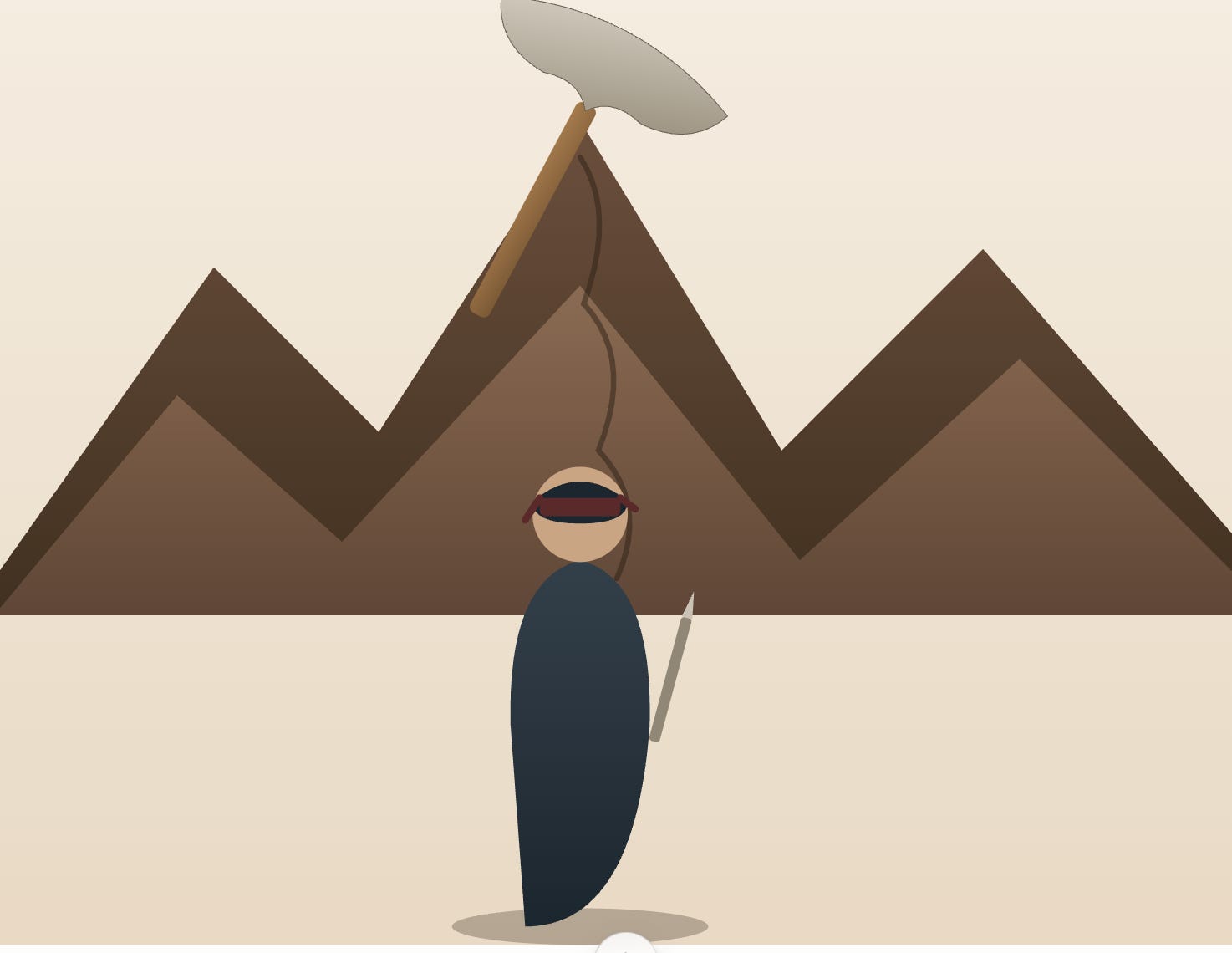
Tatbir comes from the Arabic root ط-ب-ر, tied to the Persian tabar — an axe. To strike the forehead in tatbir is, linguistically, to bring an axe-word to the body. The gesture and the name agree: something hard is meant to break something open.
The foreheads of children are cut too. A child who is cut carries a double wound: the physical injury itself, and the earlier, wordless knowledge that this will happen to him — that his own body is not fully his to protect, that pain of this kind is simply what comes with belonging to this community. And the child who only watches, who has not yet been cut but knows his turn is coming, carries something almost as heavy: the anticipatory dread of an inevitability he cannot refuse. There but for the grace of God go I, every boy standing in that crowd must think, knowing it is not really an escape at all — only a postponement. A society that inducts its children into pain this early, and calls the induction devotion, is a society quietly training its next generation in the acceptance of violence as a normal cost of belonging. That training does not stay contained within Ashura. It becomes a template.
I have been thinking about this alongside a very different mountain. Iran’s Natanz-adjacent nuclear facility — tunneled at least 100 meters deep into rock the West cannot easily reach — has become known in recent reporting as Pickaxe Mountain — Kūh-e Kolang Gaz Lā. Israeli intelligence believes Iran moved thousands of uranium-enrichment centrifuges into tunnels within the mountain last fall, following the twelve-day war in June — an acceleration of a nuclear program both the U.S. and Israel had believed effectively dead and buried. The Persian word there is not tabar but kolang, pickaxe rather than axe — a different tool, a different root, no etymological kinship to tatbir at all. And yet the two names sit oddly close together in the mind: one a word for opening a body, the other a word for opening a mountain, both naming the same basic human gesture — the blow that breaks resistant matter to expose what is hidden inside it.
I don’t think this is coincidence in any provable sense. I think it’s something closer to what psychoanalysis calls character armor — Reich’s term for the rigid, defensive structure a person builds around vulnerability, a structure that must eventually be struck, cracked, or bled through if what is inside is ever to be reached. Tatbir enacts that striking on the body, deliberately, ritually, as devotion. A mountain built to hide uranium enacts something structurally similar on the level of a state: armor built so dense that only the heaviest strike can break it open.
What Westerners miss, watching the bleeding foreheads on Ashura and recoiling, is that this is not simply “extreme” in the sense of aberrant. It is a culture’s own theory, encoded in ritual, of what it takes to reach the truth of a wound — that some things do not yield to gentle disclosure, only to the axe. The same logic, I suspect without needing tatbir’s theology, animates a state that buries its most dangerous project under a mountain named for the tool required to break in. Both are saying, in their own registers: what matters here is armored, and only force will open it.
That logic is no longer theoretical. As I write this, American forces are, for the tenth consecutive night, striking targets across Iran. Pickaxe Mountain itself has so far escaped attack — U.S. intelligence reportedly shows “no activity” there at present — but President Trump has broken his public silence on the site: “Pickaxe is a possible target for a nice big fat shot right near the front door. We’re going to take out Pickaxe Mountain. Tell the Iranians to be ready,” he said last week, adding that the U.S. would “probably give Pickaxe a shot relatively soon.” An Israeli military official involved in recent targeting decisions has reportedly expressed frustration that strikes so far have insufficiently prioritized the site. The character armor is not a metaphor I am importing from outside. It is the strategic reality on the ground: an adversary calculating, quite literally, how many meters of rock stand between the world and what is hidden beneath it, and whether any weapon can close that distance.
I do not know what is inside that mountain. Neither, fully, does anyone outside Iran’s own command structure — that is the entire design of the armor, tatbir’s logic scaled up to the level of a nation: build the shell dense enough, and the question of what it protects becomes almost beside the point. The world is left striking at rock, hoping the blow lands somewhere that matters.
What the bleeding foreheads on Ashura and the tunnels beneath Natanz share is not politics. It is a conviction, older than any of this week’s headlines, that some truths will not surrender themselves. They have to be broken open. I did not choose to be writing this during a week when that conviction is being tested with real munitions, against real rock, over a possession that could kill millions. But I am, and I do not think that timing is incidental to why the words would not let me alone.
Source: Amit Segal, “It’s Noon in Israel: Iran’s Nuclear Program: Buried but Not Dead,” July 21, 2026.