

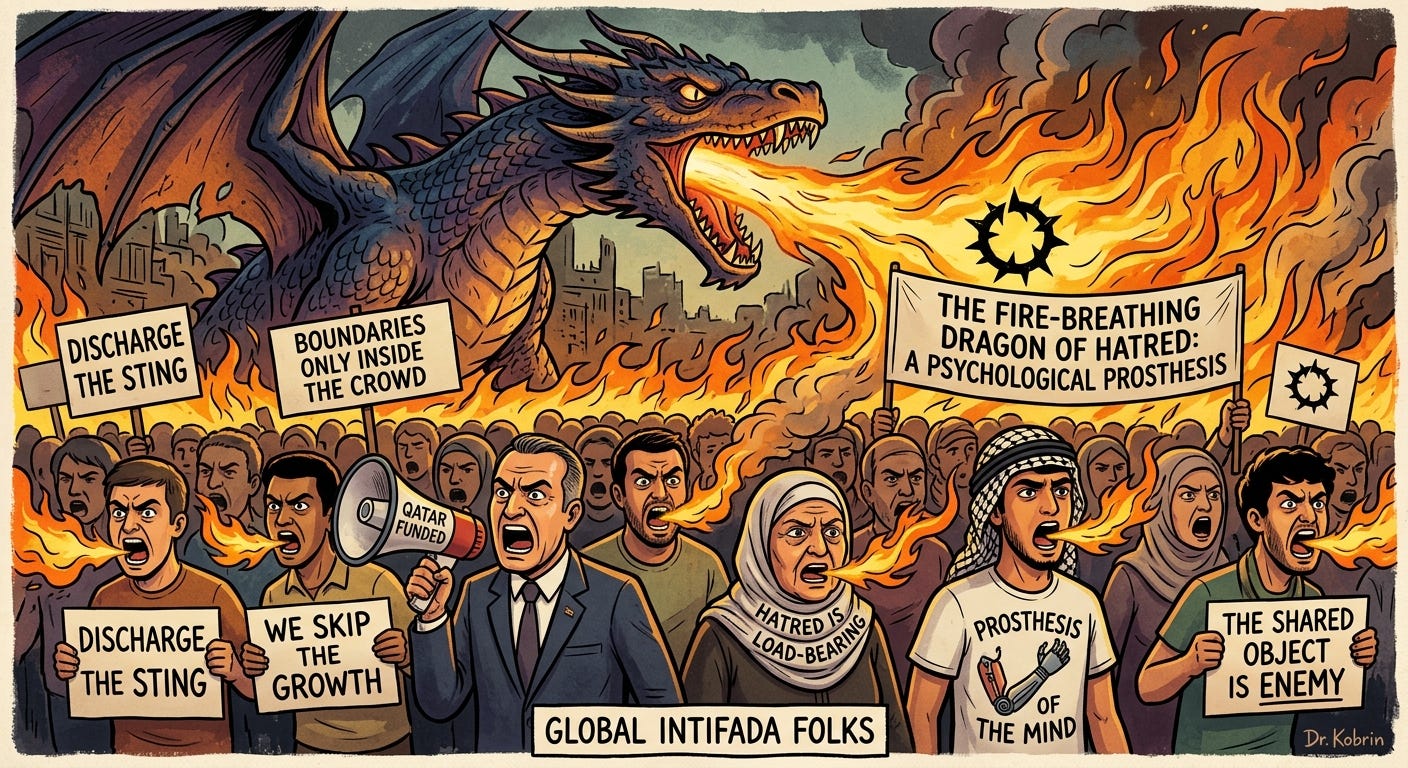
A prosthesis does not restore what was lost. It substitutes for it, and the body learns to function as if the limb were there. I have written before about the weapon in the jihadi’s hand as a psychic prosthesis, standing in for a self that could not otherwise act. The claim holds specifically where the weapon cannot be laid down — Hamas and Hezbollah’s refusal to disarm is the case in point. A tool can be set down; a prosthesis cannot, because the body has already organized itself around it.
A weapon is a hard object. It draws a boundary in physical space, between the hand that holds it and the body it is aimed at. Hatred draws that same boundary in emotional space like a fire-breathing dragon, marking self from other by feeling where nothing else built the line — and hatred is fitted deeper than the weapon, holding up the self that then reaches for it. Once fitted, the person functions, moves, speaks as if whole, because the prosthesis is doing the holding.
This is not a claim about individuals. A person who has not individuated cannot be described as one — individuation is the outcome of a developmental task, not a birthright — and the three figures below are exhibit A of that gap. Each reached adulthood without the separation that would have let hatred remain optional. For each, it is load-bearing.
The Hating Trio: Tamim, Zohran, and Abdul
Sheikha Moza’s son, Emir Tamim, never underwent the separation from his mother that culture makes taboo to attempt. Her Judaeophobia did not become his policy; it remained her psyche occupying the space where his own was meant to form. Her hatred lives on in his psyche → his psyche controls Qatar’s money → that money funds the outlets that make “Israeli” do the work “Jew” used to do.
Zohran Mamdani inherited the same code word ready-made. He did not coin “Israeli = Jew = Zionist = Genocidaire”; he received it, already doing psychic work, and leans on it the way a person leans on a cane he never had to learn to walk without.
Abdul El-Sayed’s own unseen years were cut short. His parents divorced when he was about three, and custody passed to his father’s side. Volkan, the Turkish Cypriot Muslim psychiatrist, argues a child needs an enemy in place by age three; in El-Sayed’s case, that need was already forming out of the loss, before he had language for it. What began as an unmet need in infancy found an institutional home later: from fifteen to twenty, his mother, Fatten Elkomy, worked for a Treasury-designated terror-financing network, giving the hatred a second window in which to take on adult shape.
None of the three built a hatred. Each was fitted with one, in the years or the household where a self should have been assembling itself instead, and each depends on it now without ever feeling the limp.
The Global Intifada Folks
Elias Canetti’s Masse und Macht supplies the collective register for the same mechanism. Canetti locates the founding fear of human life not in death but in the touch of the stranger — Berührungsfurcht, the dread of an unknown body against one’s own. Only inside the crowd does that fear reverse itself. Packed among others, the person no longer has to hold a boundary at all; every touch becomes a touch from within the mass rather than an intrusion from outside it. The crowd does not ask its members to individuate. It offers the opposite — dissolution — and for a person who never completed that developmental task, dissolution is not a loss but a relief. There is no separate self left to protect.
Canetti’s open crowd wants only to grow, indefinitely, until nothing outside itself remains, and it discharges (Entladung) the moment its members feel equal in the presence of a shared object. That object is what Canetti calls the sting, the Stachel — a foreign body lodged in the psyche that produces no rest until it is expelled outward, onto an enemy. The global intifada crowd chanting the same three or four phrases in a dozen capitals is not organized around an argument. It is organized around a sting it needs discharged, and “Israeli,” fitted by Al Thani money and Mamdani’s borrowed vocabulary and El-Sayed’s inherited wound into a single interchangeable target, is the discharge point. The crowd does not need the target to be true. It needs the target to be shared, because the sharing is what lets each un-individuated person feel, for the length of the march, whole.
This is the same prosthesis at scale. What Tamim, Mamdani, and El-Sayed each bear alone, the crowd bears together, and bearing it together is the appeal — it substitutes the mass’s boundary for the boundary none of its members separately possess. A prosthesis, once it is bearing the weight, cannot be talked out of the body wearing it. Evidence does not remove a limp that hatred alone is holding upright. Only the growth that was owed in the first place — the separation from the mother, the object relations that should have formed in the unseen years, the individuation that gives a person a self sturdy enough to stand without an enemy — replaces it. Everyone examined here skipped that growth. The crowd is where they go to skip it together.
Dr. Kobrin is a counterterrorism expert and psychoanalyst holding a PhD in Islamic literature. She is a graduate of the Human Terrain Program, Leavenworth, KS. Her most recent book is A Soldier’s Guide to Hamas’s Genocidal Psychosis: The Unconscious in Psychological Warfare -- Beyond Ideology, Before Words. Atzmaut Press 2025. She is currently working on her seventh book Between Empire and Covenant—The Jewish Bond: Lotman, The Refuseniks and The Bukharan Jews, 1977. See her full body of work at her Amazon author page: https://www.amazon.com/stores/author/B002RF9D5Y