

President Trump’s framing of the Flydubai co-pilot — “perhaps a terrorist, or perhaps insane [a whack-job], and he stabbed the pilot” — treats jihad and insane as two separate bins, as though confirming one rules out the other. With jihadi suicide bombing, it never does.
Suicide terrorism is not an alternative to psychological breakdown; it is a vehicle for one. My own work on the mother-infant bond and Islamic suicide terrorism has argued for over two decades that the moment of attack is a dissociative, fused state — just as the Japanese kamikaze manual itself instructed the pilot to see his mother’s face at the moment of impact, death reimagined as return and fusion rather than annihilation. It is a classic rebirth fantasy that one encounters routinely in severely disturbed suicidal psychopathology grounded in grandiosity, omnipotence and magical thinking. I am not diagnosing but rather using these terms as descriptors to clarify what is shown to us.
The return to the mother is the return to the womb where all of one’s unconscious unmet psychological needs will be met. Outside of the womb in a shame honor culture it is a different kettle of fish. This is not to say that there aren’t stress hormones that the prenatal mother in the shame honor jihadi culture doesn’t experience or impact on the fetus. That isn’t a metaphor for insanity. It’s a description of it — the Flydubai jihadi copilot suicide bomber, given a flight plan and a cause.
Psychoanalytic Visual Intelligence — reading what the body does rather than what the ideology says — picks up a detail here that neither “terrorist” nor “whack job” can hold: witnesses reported that the copilot asked the others on the plane to kill him. That is not confession and it is not combat. It is like “suicide by cop,” played out mid-air. A man who could not complete his own death outsources the final blow to someone else, turning his own passengers into the executing hand he could not be for himself. The rebirth fantasy survives the request intact — being killed is still a return, still passive, still done to him rather than by him, the same configuration as an infant acted upon rather than acting. He did not want to die alone by his own hand. He wanted someone else’s hands to do what his own could not.
Ideology doesn’t replace the break with reality; it organizes it, legitimizes it, and hands it a target. A man in the grip of exactly the kind of psychotic dissociation Trump gestured toward with “whack job” doesn’t stop being that man the moment he also has a cause. He becomes more dangerous, not less, because the cause supplies him a script and a community — not a container but a fused mass, behaving as one enraged body that holds together by masking exactly what it needed and never received. In a shame-honor culture those needs were never going to be met: there are no personal boundaries, everyone lives under surveillance and attack from their own group, their own hamula, and each generation’s fallout — the shame, the rage with nowhere else to go — rolls downhill onto children not yet mature enough to carry it. That same frame — suicide bombing is the same murder-suicide configuration as domestic violence, dressed in martyrdom — converts a private rupture into a public act with a name other than psychosis.
“Jihadi” and “insane” are themselves artificially constructed labels, sorting behavior in ways that make sense to a court, a newsroom, or an intelligence briefing — not to the mind that produced the act. Holding onto those categories makes it harder to see what is actually driving the behavior: a delusional fantasy, not a motive in the ordinary sense. And the rage inside that fantasy exceeds murder itself — it is not calibrated to the force needed to kill one man in a cockpit. It is a rage formed during the unseen years, zero to three, when the psychological needs that should have been met were not, and it has been waiting since then for an object large enough to receive it.
There is a second bin problem running underneath the first: was he a lone wolf, acting on his own, or was he recruited and directed by Iran? That question assumes the answer changes what happened in the cockpit, when it doesn’t. The culture itself doesn’t need a handler to produce a man capable of this; it produces the psychic material first, in the home, in the clan, in the first three years, and ideology and intelligence services alike simply know where to find it and how to aim it. The global intifada runs on the same supply. There are billions of people in these cultures carrying the same unmet early needs, the same rage with no sanctioned place to go, and only a small number of them will ever be contacted by a recruiter — not because the rest are psychologically different, but because the funnel is narrow and the raw material is not. Asking lone wolf or state-directed is asking who pulled the trigger on a gun that was already loaded by something much older than any recruitment call.
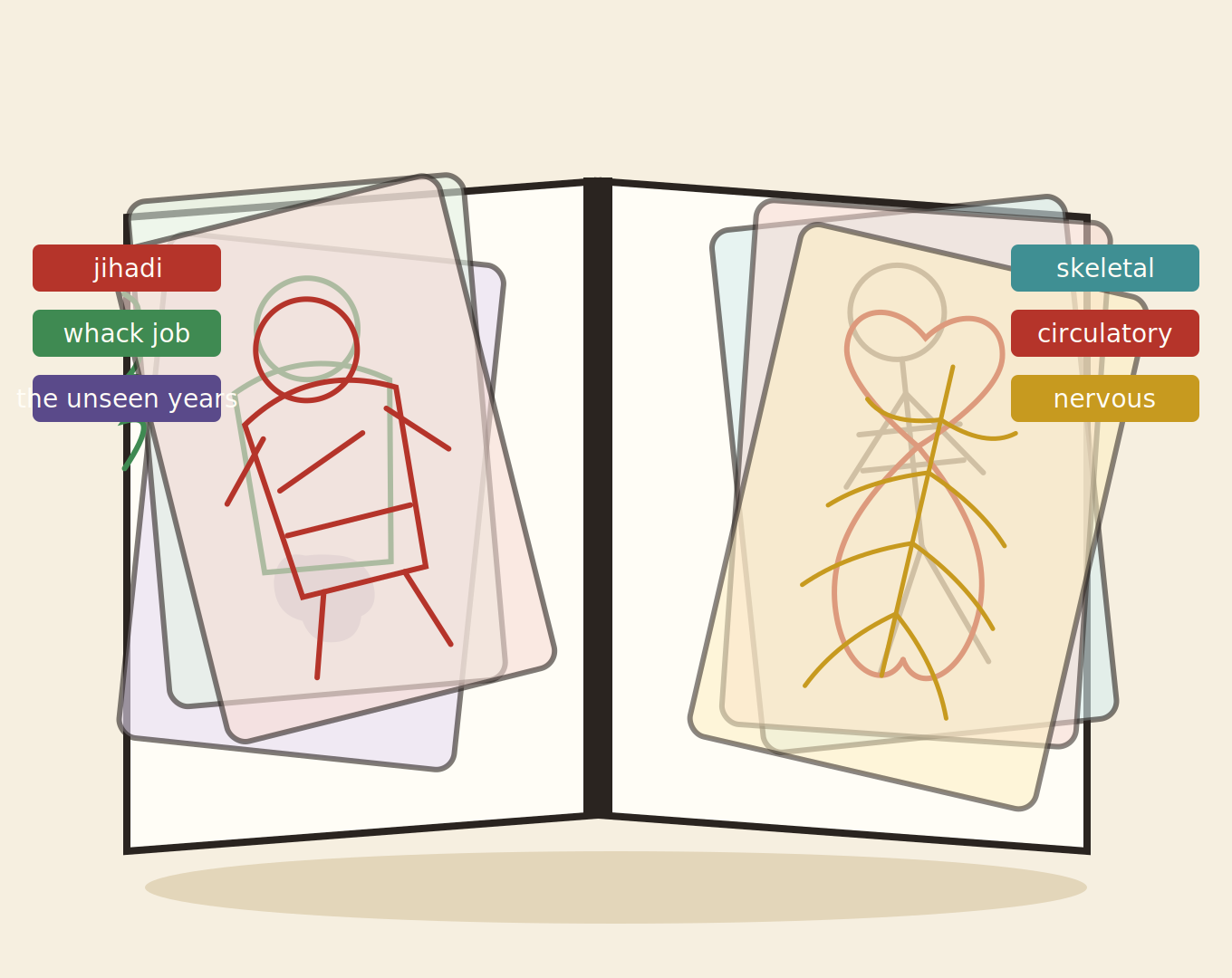
This is also why “jihadi” and “insane” keep showing up together, case after case — not as a diagnostic puzzle to resolve into one or the other, but as the actual structure of these events: a developmental rupture, ideologically channeled. We need to read this functionally, the way old biology textbooks used transparency overlays — skeletal system, circulatory system, nervous system, each printed on its own clear page, meaningless alone, legible only stacked together. “Jihadi” and “insane” are two such transparencies, pulled apart and asked which one is the “real” picture. The honest answer to Trump’s formulation isn’t A or B. It’s the overlay — and we keep missing it because admitting what it shows would mean facing unconscious dynamics we’d rather deny.
Nancy Hartevelt Kobrin, PhD, is a Tel Aviv–based psychoanalyst and counterterrorism scholar. https://www.amazon.com/Nancy-Kobrin/e/B002RF9D5Y