

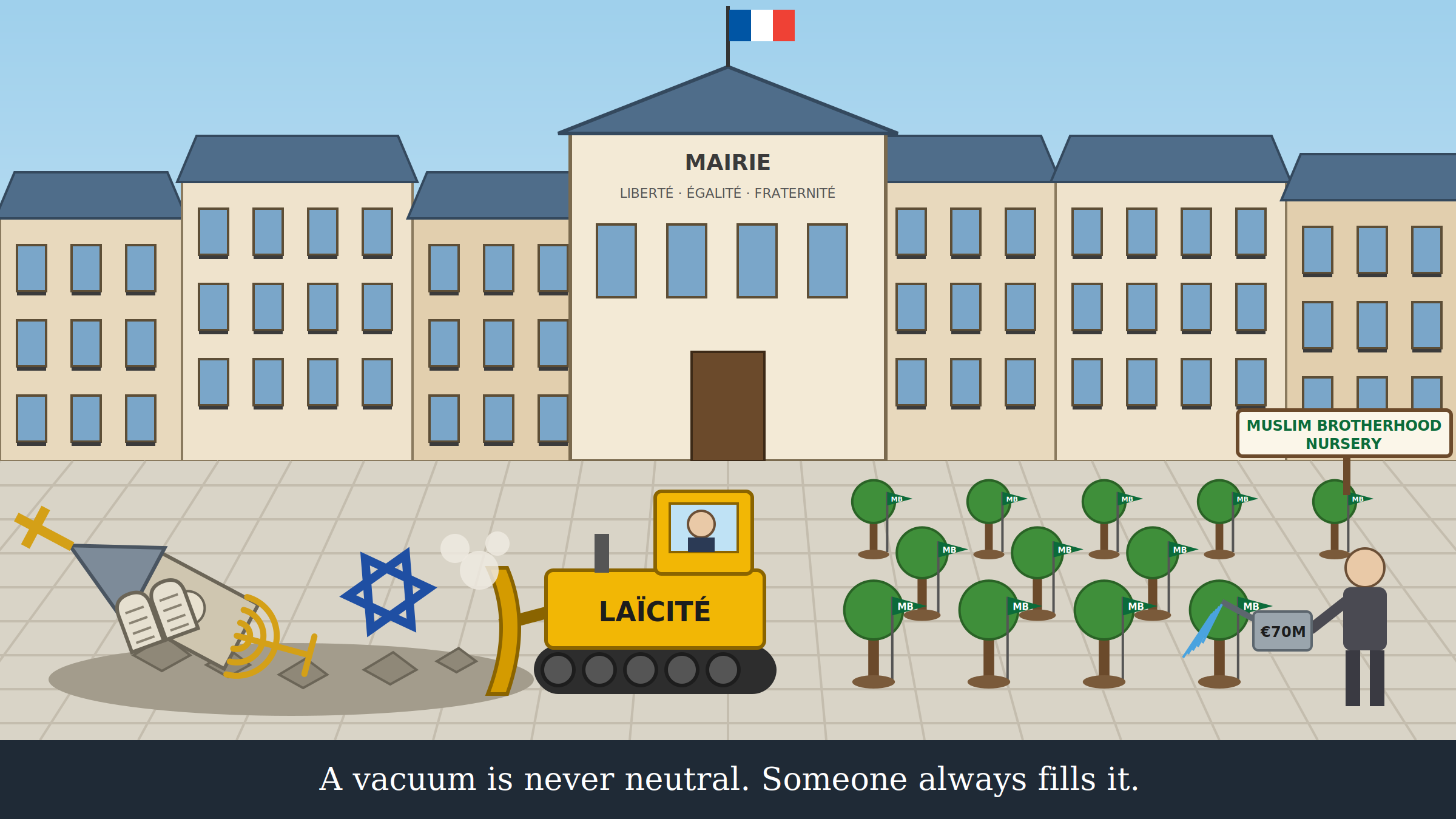
Nature abhors a vacuum, and so does the human mind. A child who is not held by a mother will attach to whoever offers holding. A society that empties its public square of meaning will find that someone else rushes in to fill it. France is now living through that lesson.
For more than a century, French laïcité, grounded in the 1905 law separating church and state, promised neutrality. The state would favor no faith and protect all of them. Over time, however, French elites came to treat neutrality as absence. Christianity, the religion that shaped France’s calendar, cathedrals and moral vocabulary, was pushed to the margins of public life as an embarrassment. Many Jews, who had long found in the Republic a guarantee of equal citizenship, learned to keep their kippot under caps on the metro. The public square did not become neutral. It became empty, and then it became violent.
Into that emptiness came a movement that knew exactly what it wanted. On May 21, 2025, Interior Minister Bruno Retailleau presented to President Macron’s Defense Council a government report titled “The Muslim Brotherhood and Political Islam in France.” Commissioned in April 2024 by his predecessor, Gérald Darmanin, and written by a senior diplomat and a prefect after months of field visits, the report named Musulmans de France as the national branch of the Brotherhood. It counted 139 places of worship affiliated with the federation and 68 more close to it, about 7 percent of France’s 2,800 Muslim places of worship, and 10 percent of those built between 2010 and 2020. It identified some 280 associations in sport, education, charity and finance, and 21 private schools with 4,200 pupils.
The report’s authors did not describe an armed insurgency. They described something subtler and, they warned, no less subversive for French institutions: a strategy of entryism that builds local networks meant to shape Muslim life from birth to death. Mosques with Quran classes, community businesses, sports clubs, tutoring and job support, dating sites and social-media preachers together form a parallel world. That is precisely what a vacuum invites. Where the Republic stopped offering belonging, the Brotherhood offered it.
There is a bitter irony here for Jews. The bargain France offered us was stated at the birth of the Republic. In December 1789, Count Stanislas de Clermont-Tonnerre told the National Assembly: “To the Jews as a nation, nothing; to the Jews as individuals, everything.” (“Il faut tout refuser aux Juifs comme nation et tout accorder aux Juifs comme individus.”) Jews could become citizens only by ceasing to be a people. They accepted the bargain and kept it for more than two centuries. Today the same Republic that required Jews to dissolve their nationhood into citizenship tolerates a movement building precisely the separate community it once forbade to them.
The money followed the ideology. In their 2019 book Qatar Papers, the French journalists Christian Chesnot and Georges Malbrunot drew on internal documents of Qatar Charity, an organization tied to Qatar’s ruling family, to describe some 140 projects across Europe, mosques, schools and associations linked to the Brotherhood, worth roughly 70 million euros. Qatar has long hosted Hamas’s political leadership, funds Al Jazeera and pours money into Western universities. France is where its influence stops being abstract and becomes a school down the street.
Critics of this argument deserve a hearing, and they raise a serious point. Many French Muslims and scholars argue that laïcité has not been applied evenly at all, but most strictly against Muslims: the 2004 ban on headscarves in state schools, the 2023 ban on abayas, and a steady stream of rules aimed at Muslim dress rather than at crosses or kippot. The report itself states that no recent document shows a desire among Muslims in France to establish an Islamic state or impose Sharia. Both points are true, and neither refutes the problem. The great majority of French Muslims want what other citizens want. That is exactly why they are the first to suffer when an organized minority claims to speak for them, and when a state that has abandoned its own moral language can answer that minority only with bans on clothing.
Here is the psychological point French elites missed. Secularism that is confident in its values can contain religious difference, much as a secure parent contains a child’s strong feelings. Secularism that has become hollow cannot. It swings between two failures: timid concessions offered in the name of multiculturalism, and sudden prohibitions offered in panic. Neither builds attachment to the Republic. Both leave young Muslims searching for a home, and the Brotherhood is waiting with one.
The violence came to Christians and to the Republic itself. In 2016 Father Jacques Hamel was murdered at the altar of his church in Saint-Étienne-du-Rouvray. In 2020 the schoolteacher Samuel Paty was beheaded outside his school for showing caricatures in a class on freedom of expression. Jews know this story from the inside. In 2012 Mohammed Merah murdered a rabbi and three children at a Jewish school in Toulouse. In 2015 a gunman killed four Jews at the Hyper Cacher market in Paris. Since October 7, 2023, antisemitic acts in France have surged, and the government’s own report noted a rise of anti-Zionist activity in some mosques. When the public square is emptied of Judaism and Christianity, Jews do not become safer. They become more exposed.
The answer is not to bring back an established church, nor to ban every headscarf in sight. It is for France to recover a confident public culture that is willing to name its Judeo-Christian roots and its Enlightenment commitments without apology, and to offer every citizen, Muslim included, something worth belonging to. A Republic that believes in itself can say no to foreign-funded entryism and yes to its Muslim citizens in the same breath.
A vacuum is never neutral. Someone always fills it. The only question is whether France will fill its own public square, or leave it to those who have been waiting patiently to take it.
Dr. Kobrin is a counterterrorism expert and psychoanalyst holding a PhD in Islamic literature. Her most recent book is A Soldier’s Guide to Hamas’s Genocidal Psychosis: The Unconscious in Psychological Warfare – Beyond Ideology, Before Words (Atzmaut Press, 2025). She is currently working on her seventh book,Between Empire and Covenant—The Jewish Bond: Lotman, The Refuseniks and The Bukharan Jews, 1977. See her full body of work at her Amazon author page: https://www.amazon.com/stores/author/B002RF9D5Y