

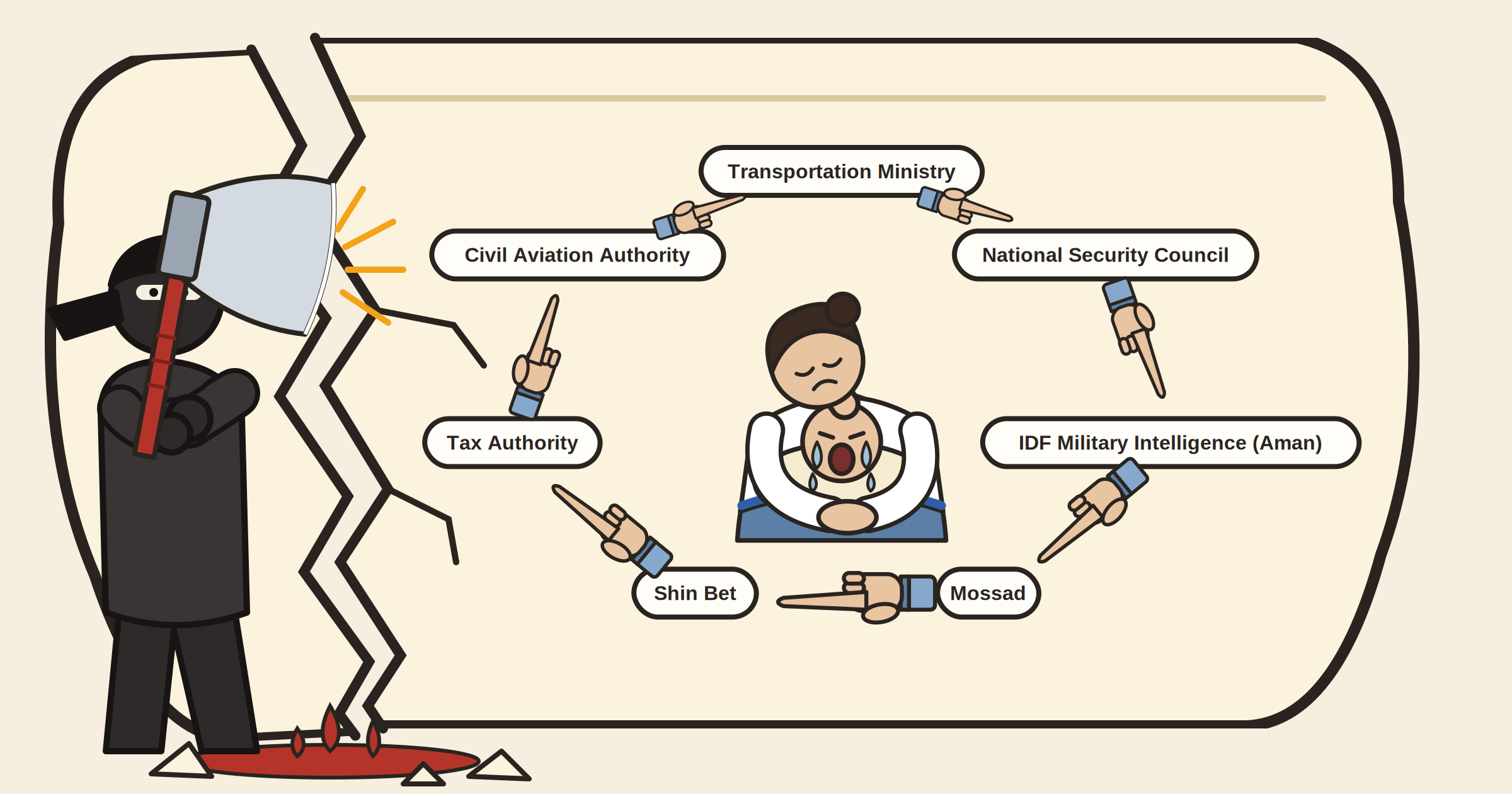
Just as it is important to understand the mind of the perpetrator, so too is it crucial to understand that, since the jihadis bond to us violently, we must look inward into our engagement in the bonding dynamic. What we have repeatedly seen is the inability to see and to listen, leading to the problem of the konseptzia, and, in true Middle Eastern fashion, the reflex is to deflect responsibility and ownership. Such is the case now with Flydubai and vetting.
On September 30, a Flydubai copilot named Hamam al-Hammami, reportedly an Omani national whom Oman Air had removed from flying duties in 2024 after extremist material was found in his possession, struck his captain from behind in the cockpit of a flight to Tel Aviv. The wounded captain opened the cockpit door, Israeli passengers pulled the copilot away, and other pilots on board landed the plane in Saudi Arabia. Since then Israel has been asking a question it should recognize from three years ago: how did this man reach the cockpit of an Israel-bound aircraft?
The Shame is that Great
The facts reported so far point away from a lack of information and toward a lack of an owner. Under a law the Knesset passed in 2023, airlines must send Israel the names, nationality and travel documents of every crew member. The Tax Authority confirms that the list for flight FZ1073, including the Omani copilot, arrived before takeoff. The law lets the Shin Bet, the Mossad, the police and the Transportation Ministry use that data, explicitly for counterterrorism and aviation security. Hebrew-language analyses of the law note that it gives these bodies the power to query the data and does not oblige anyone to review every list. Channel 12 reports that al-Hammami had flown into Ben Gurion before, most recently a week earlier.
Since the attack, each body has said, in one form or another, that the matter lies elsewhere. The Transportation Ministry’s Security Division says it is not an intelligence body, that it relies on airlines to declare their pilots vetted, and that its procedures did not contemplate a pilot carrying out an attack. The head of the Civil Aviation Authority says that under a government decision his authority is responsible for safety and not security. The minister says the crew list went to the intelligence services, that the Shin Bet covers Israeli carriers and the Mossad foreign ones. Channel 12’s sources say neither checks foreign crews. The Jerusalem Post’s headline called it pointing fingers. The Transportation Ministry also has a security unit of its own: according to Ynet, its Security Division is formally responsible for aviation security, including security assessments of foreign flights, and runs an aviation security operations center.
The concern itself was known. Shin Bet chief David Zini had warned for months that security on flights from the UAE was inadequate, and the Shin Bet barred Israeli airlines from flying to Dubai. Foreign carriers, Flydubai among them, kept flying some ten flights a day on the same route. His warnings concerned mainly the Israeli carriers under his authority. And a State Comptroller’s audit published in May 2024 had recommended a comprehensive review of civil aviation security, foreign aircraft entering the country included, and clearer arrangements for who is responsible. The public portion did not mention UAE flights or foreign crews, and much of the chapter is classified.
The Blindness of the Seeing Eye and the Finger
Every body holds a piece, and each says the duty lies in another’s hands. I do not offer that as a charge against anyone. It is a pattern, and the pattern is what I want to look at. The psychoanalytic use of the phrase is John Steiner’s, from his 1985 paper on the cover-up for Oedipus, and it follows Freud’s “blindness of the seeing eye.” It names something more specific than denial. Denial refuses to perceive. Disavowal, Freud’s Verleugnung, perceives and then refuses the meaning, so that two attitudes toward reality live side by side, what Freud called the splitting of the ego. Steiner’s point is that one glimpses the truth and then arranges not to look. The usual reading of Oedipus is of an innocent man who gradually learns who he is. Steiner reads Sophocles’ play as a cover-up: the oracle, a taunt about his birth and the unsolved murder of Laius were all within reach, and Oedipus, Jocasta and the city around them each looked away until the plague made looking unavoidable. That is the collusion: each participant, for his own reasons, looks away so that the others can. The knowledge exists. It is cut off from action.
Pointing at someone else is the blind eye’s sibling. It is unconscious behavior: the part of us that failed is placed in another, who is then exposed or attacked, and for a moment we feel clean. In The Jihadi Dictionary I describe scapegoating as a primitive defense that shifts blame so that one need not feel one’s own failure. I described it in the jihadi. It would be a mistake to think it is only his. It is also within us.
Melanie Klein gave this a name and a place. In what she called the paranoid-schizoid position the infant splits the world into good and bad and puts the bad outside, into someone else, so that it can feel safe. Pointing a finger is that position at work in grown men and women. The depressive position comes later and costs more: the infant realizes that the mother it attacked and the mother it loved are one, that it has harmed the one it needs, and it bears the guilt and the wish to repair. Joint responsibility is the depressive position. Steiner described what lies between the two, the psychic retreat, a place where one neither blames nor grieves and where one can know and not look. The blind eye is how we avoid mourning what we failed to protect. This has significant meaning for October 7th.
That is the shape of October 7. Israeli intelligence had the Jericho Wall blueprint more than a year before the attack and judged it aspirational. In July 2023 a Unit 8200 analyst warned that a Hamas exercise tracked it closely, and she was brushed off. And along the Gaza fence the observers, the tatzpitaniyot, reported for months that Hamas was rehearsing fence breaches, attacks on mock posts, drones. Their warnings were not acted on. Fifteen of the Nahal Oz observers were killed on October 7 and seven were abducted. One mother has said her daughter asked her why they were there if no one was listening.
The gender of that failure should not be passed over. The task of watching and listening, the receptive task, was given to young women of eighteen to twenty, and what came up from that position was not heard. In Bion’s terms the institution could not act as a container: a receiver that can take in a frightening message and make something of it. An organization that identifies with action, with the armed and the certain, has no place for the one who says, I am worried. The warning came from the devalued position and so was not received. I have written for years about the devalued female inside shame–honor cultures. It is uncomfortable to find her inside Israel’s own security culture, but the record points there. This is an interpretation. The reporting stresses rank, a bias toward technology and the certainty of commanders, and I have seen no official finding that attributes the failure to gender.
Ben Gurion is a looser parallel, and I hold it with care. Disavowal requires that someone knew. No one in Israel has yet been shown to have known about al-Hammami himself: Oman Air’s information reportedly never reached Israel, and he spent a short period at Royal Air Maroc before Flydubai hired him. What the record does show is knowledge of the gap: the Shin Bet chief’s months of warnings, the ban on Israeli carriers while a foreign carrier flew on, the Comptroller’s call to clarify responsibility. To know that there is a gap and to leave it as someone else’s problem is the blind eye. Lawmakers have asked for a Knesset hearing on exactly this.
What a Frightened Public Needs
A frightened public does not need to watch its institutions point at one another. The mother is in this too. A nation, uma, is a mother to its citizens, the motherland, and the public’s first question after October 7 was the infant’s: is anyone there, and is she listening? The question one Nahal Oz observer put to her mother, why they were there if no one was listening, was the whole country’s. In Bion’s terms the infant projects its terror into the mother, who takes it in, bears it, and gives it back as something that can be thought. Finger-pointing gives the terror back as it came, nameless. Containment sounds like this: “We missed this. Here is who owns it now. Here is what changes.” A minister, a general or the head of an agency can say that, and it is not an admission of guilt. It is an act of ownership.
This is also where the opening returns. The jihadi bonds to us violently, and violence is the infant’s cry thrown at its target: terror that cannot be borne is pushed into us. If we pass it along by blaming one another, we complete the bond the jihadis have intended, because we have taken in the projection and acted on it. If we contain it, with joint ownership and a plain account of what we missed, we break it. There are other ways to communicate that the responsibility is joint, and all of them begin by dropping the finger: the officials, the Knesset, the press, and the rest of us, who were reassured by the Gulf agreements and stopped asking who checks.
The konseptzia was a belief that a deterred Hamas would not attack. Its cousin at the airport is the belief that the airline will vet its own pilots, that peace with the Gulf is protection, that data in a database means someone has looked at it. Learning from October 7 would mean that someone is now required to listen, whatever the age, rank or sex of the one who speaks. Fifteen young women at Nahal Oz were senselessly murdered after warning that no one was listening. At Ben Gurion the question is the same: who owns the duty to hear? A nation that can answer together, we do, has learned something. Joint responsibility is not a way of spreading the blame. It is the only way a nation learns to listen.
Sources: Jerusalem Post, “Gov’t, security bodies deflect responsibility after flydubai hijacking attempt” (Oct. 4, 2026); Times of Israel, “Regev passes buck on probing pilots as Israel said ‘racing’ to ID potential threats” (Oct. 4, 2026), and “Flydubai captain says copilot asked to pray then struck him from behind” (Oct. 3, 2026); Ynet, “How was an Omani pilot flagged for extremism cleared to fly to Israel? The failures and hard questions” (Oct. 3, 2026); Haaretz, “Flydubai Hijacking Attempt Exposed Blind Spots in Israel’s Aviation Security” (Oct. 1, 2026); Ynet and Walla (Hebrew) reports of Oct. 4, 2026; State Comptroller, audit of international civil aviation security (May 2024); the Passenger Data Law, 5783-2023 (Hebrew text: https://www.nevo.co.il/law_html/law00/215455.htm)
Hadassah Magazine, “The Tragic Fate of Israel’s Female Observer Soldiers” (June 28, 2024); Nancy Hartevelt Kobrin, The Jihadi Dictionary (2016), entry “Scapegoating”; Melanie Klein, “Notes on Some Schizoid Mechanisms,” International Journal of Psycho-Analysis 27 (1946), and “A Contribution to the Psychogenesis of Manic-Depressive States,” International Journal of Psycho-Analysis 16 (1935); Wilfred Bion, “A Theory of Thinking,” International Journal of Psycho-Analysis 43 (1962); John Steiner, Psychic Retreats (Routledge, 1993); John Steiner, “Turning a Blind Eye: The Cover-Up for Oedipus,” International Review of Psycho-Analysis 12 (1985): 161–172; Sigmund Freud, “Splitting of the Ego in the Process of Defence” (1940 [1938]), Standard Edition 23.
Nancy Hartevelt Kobrin, PhD, is a Tel Aviv–based psychoanalyst and counterterrorism scholar. https://www.amazon.com/Nancy-Kobrin/e/B002RF9D5Y
Ty Lynette 🙏❤️