

What the Strait of Hormuz Reveals: Terror, Exposure, and the Logic of Control
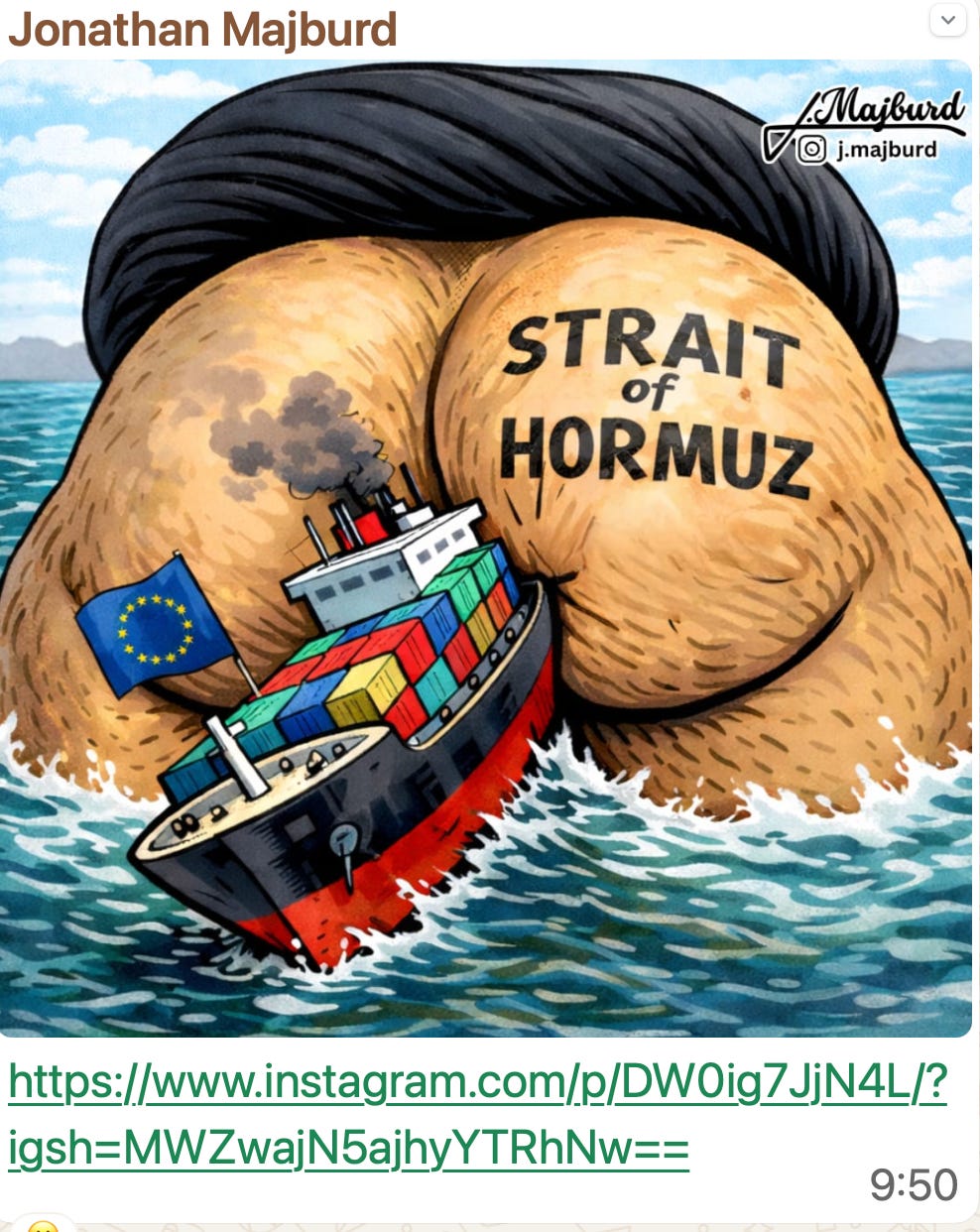
This piece was inspired by a recent graphic by Jonathan Majburd.
Hebrew (עברית)
התרגום לעברית המובא להלן נעשה בסיוע בינה מלאכותית ומוצג לצורכי נגישות.
Portuguese (Português)
A tradução para o português abaixo foi realizada com o auxílio de inteligência artificial e é fornecida para fins de acessibilidade.
English
A recent graphic by Jonathan Majburd captures something that standard geopolitical analysis misses. The image does not simply depict the Strait of Hormuz as a strategic chokepoint. It conveys something more immediate—fear, pressure, and a sense of exposure.
This matters.
The dominant language used to describe the Strait is technical: flow, blockage, closure, opening. Oil moves through a narrow passage. The Strait can be sealed or released. These are treated as neutral, strategic terms. But they are not experienced that way from within.
At a deeper level, this imagery is bodily.
A narrow passage. Pressure building. The threat of forced opening. The fear of exposure. The loss of control.
Even the term “chokepoint” itself is revealing. It is meant as a technical descriptor, but it carries unmistakable bodily resonance. To choke is to cut off air, to induce panic, to bring the other to the edge of suffocation.
In this sense, control of the Strait is not only about regulating flow, but about the capacity to constrict—to withhold, to apply pressure.
From this vantage point, what is being defended is not only territory or leverage, but a form of psychic containment. Opening is not simply a policy decision. It is experienced as destabilization—an enforced transition into the unknown.
To understand this, it is necessary to clarify what is meant by symbolization.
Symbolization is the process through which experience becomes thinkable—linking feeling, perception, and bodily states with thought and language, so that what is lived can be held in mind rather than acted out. It does not begin with words, but emerges when early, pre-verbal experience becomes organized in a way that can later be named, thought, and shared. A symbol, therefore, is not just a word, but a word that carries lived meaning—where feeling, thought, and language come together. Unconscious processes precede symbolization.
Consider the word “home.” A dictionary defines it as a place where one lives. But symbolically, it carries safety, memory, smell, bodily experience, and attachment. It is this second layer—where feeling, thought, and language converge—that constitutes symbolization.
When experience is not fully symbolized, it cannot be held in mind in this way. It is managed instead through action.
This is where another dimension enters: the role of sadism.
In my essay “The Sadomasochism of the Jihadi Death Cult” (Tablet Magazine), I argued that violence reflects a deeper organization in which domination, humiliation, and control are bound together.
The response can take on a distinctly theatrical quality—marked by repetition, excess, and the visible staging of suffering. At moments, it recalls the theatricality of practices such as tatbir, where suffering and martyrdom are publicly enacted—not as a religious claim here, but as a structural pattern in which vulnerability is transformed into a controlled display.
If exposure is experienced as threat, then control must be reasserted. The ability to close, to choke, to withhold becomes a way of reversing vulnerability.
This may also help explain why demands that appear entirely reasonable from the outside—disarmament in the case of Hamas, or de-escalation in the case of Iran—encounter such persistent resistance. The issue is not simply unwillingness. What is being confronted is experienced as necessary to internal coherence. To give it up is not felt as compromise, but as exposure.
The Strait of Hormuz, in this sense, is not just a maritime corridor. It is a site where deeper anxieties about containment and exposure are played out.
Until that level is recognized, we will continue to misread both the behavior and its persistence.
עברית (Hebrew)
איור עדכני של ג’ונתן מג’בורד לוכד דבר מה שחומק מן הניתוח הגיאופוליטי הרגיל. האיור אינו מציג רק את מצר הורמוז כנקודת חנק אסטרטגית, אלא מעביר תחושה מיידית של פחד, לחץ וחשיפה.
השפה הרווחת לתיאור המצר היא טכנית: זרימה, חסימה, פתיחה וסגירה. אך ברמה עמוקה יותר, הדימויים הם גופניים.
מעבר צר. לחץ מצטבר. איום של פתיחה כפויה. פחד מחשיפה. אובדן שליטה.
גם המונח “נקודת חנק” עצמו טעון משמעות גופנית—חנק, מניעת אוויר, בהלה.
במובן זה, השליטה במצר אינה רק שליטה בזרימה, אלא היכולת לכווץ, לעצור ולהפעיל לחץ.
כדי להבין זאת יש להבהיר מהי סימבוליזציה.
סימבוליזציה היא התהליך שבו חוויה נעשית ניתנת לחשיבה—חיבור בין רגש, תפיסה וחוויה גופנית לבין מחשבה ושפה.
כאשר חוויה אינה עוברת סימבוליזציה, היא אינה ניתנת להחזקה במחשבה, ולכן מתבטאת בפעולה.
כאן נכנס ממד נוסף: סדיזם.
אלימות אינה רק אמצעי, אלא משקפת ארגון עמוק יותר של שליטה והשפלה.
התגובה יכולה לקבל אופי תיאטרלי מובהק—חזרתי, עודף, והצגה גלויה של סבל. לעיתים הדבר מזכיר את התיאטרליות של פרקטיקות כגון תתביר, שבהן סבל ומרטיריות מוצגים בפומבי—לא כטענה דתית, אלא כתבנית מבנית שבה פגיעות מומרת לשליטה.
אם חשיפה נחווית כאיום, השליטה חייבת להיות מושבת. היכולת לחנוק, לעצור ולשלוט הופכת לאמצעי להפוך פגיעות.
ייתכן שזה גם מסביר מדוע דרישות הנראות סבירות מבחוץ—כגון פירוק נשק או הסלמה—נתקלות בהתנגדות עיקשת.
מצר הורמוז אינו רק מעבר ימי, אלא זירה שבה חרדות עמוקות יותר מתבטאות.
כל עוד רובד זה אינו מוכר, נמשיך להחמיץ את משמעות ההתנהגות.
Português (Portuguese)
Uma imagem recente de Jonathan Majburd revela algo que escapa à análise geopolítica convencional. Ela transmite medo, pressão e exposição.
A linguagem dominante é técnica, mas em um nível mais profundo, é corporal.
Uma passagem estreita. Pressão crescente. Ameaça de abertura forçada. Perda de controle.
O próprio termo “ponto de estrangulamento” evoca sufocação.
O controle do estreito não é apenas estratégico, mas envolve restringir, conter e pressionar.
Para compreender isso, é necessário definir simbolização.
Simbolização é o processo pelo qual a experiência se torna pensável.
Quando não há simbolização, a experiência é descarregada em ação.
Aqui entra outra dimensão: o sadismo.
A violência reflete uma organização mais profunda de controle.
A resposta pode assumir uma qualidade teatral—marcada por repetição, excesso e encenação do sofrimento. Em certos momentos, lembra práticas como o tatbir, nas quais o sofrimento e o martírio são exibidos publicamente—não como afirmação religiosa aqui, mas como um padrão estrutural.
Se a exposição é vivida como ameaça, o controle precisa ser reafirmado.
Isso ajuda a explicar por que exigências externas encontram resistência persistente.
O Estreito de Ormuz não é apenas um corredor marítimo, mas um espaço onde ansiedades profundas são encenadas.
Enquanto esse nível não for reconhecido, continuaremos a interpretar mal esses comportamentos.