


About twenty years ago, a senior Israeli terrorism expert picked up a paper I had written, said, “What is this shit?” and threw it down. I have carried that moment ever since.
He had once taken an interest in my work and drew on me informally, as an outside reader of the terrorist mind. But he never asked me to present. Someone else did. At a dinner I sat next to a former head of Arabic research in Israel’s security service. When I told him my doctorate was in Islamic literature, he lit up. He invited me to present at the annual counterterrorism conference in Herzliya, and after hearing me, he called to ask me to present at a closed NATO meeting in England on suicide bombing. Eventhough he was one of Israel’s leading experts on Arabic culture, he had confessed to me that he had never really understood the psychodynamics of the family/clan and the important dominant role of the mother. The expert who had first drawn on me never opened that door. At some point in those years, he closed his own. The paper landing on the table was how I knew.
I had hosted him in my home in America and opened doors for him after 9/11. Now a door had opened for me that he had not opened. I believe that it was hard for him to bear. Envy, too, is a primitive feeling. It belongs to the nursery, where whatever the other has, feels as if it were taken from oneself.
The paper said what I had been arguing since 2001: that the suicide bomber’s act is rooted in the earliest years of life, in the bond with the mother, in the shame-honor family, and in a separation from her that never took place. Childhood development is not a footnote to terrorism. It is where terrorism begins.
I felt crushed. Not because he disagreed. Disagreement is how scholarship moves forward. I was crushed because he did not disagree. He asked no question and made no argument. He treated my work with contempt and me with it, in front of a witness. I understood then that he could not grasp what childhood development means for the making of a jihadi, and that he did not want to know.
The witness was his assistant, a young man who had studied philosophy and read widely in psychoanalysis. He walked me out. Under his breath he said, “I hope one day your work will be appreciated.” He could not say it in the room. The one person present who could see what the paper was about had to whisper.
His choice of word—shit— was not an accident. Freud showed that the child’s first product, the first thing he makes and offers, is his feces. In “On Transformations of Instinct as Exemplified in Anal Erotism” (1917), Freud traced how feces become the infant’s first gift, later linked in the unconscious with money, with babies and with whatever one creates. To call a colleague’s work “shit” is to drag the gift back down to the anal stage, where the struggle is over control, and where what comes from the other is soiled and expelled. Throwing the paper down completed the gesture. It was a regression in miniature to the age at which contempt is the only answer to what one cannot master. The paper was about the earliest years of life, and he answered it from there.
Contempt is a defense. To throw the paper down was to throw away what it asked him to look at: the nursery, the mother, the infant’s terror of abandonment and helplessness, the shame. Those are not foreign terrors. Every one of us knew them once and buried them. A mind that cannot bear to remember its own beginnings will not look for them in the enemy. It will look at ideology, networks and incitement, the 5 percent above the waterline, and call that expertise.
That is the konseptzia at its smallest scale: one man, one paper, one room. On October 7th we saw it at the scale of a nation. Today, after Flydubai flight FZ1073, the experts again explain the attacker through his networks and his inspirations. None of them asks who he was, who raised him, or what happened in the years no one saw. The question is still being thrown down.
I am not writing this to settle a score. I am writing it because the cost of not looking is now counted in lives. The assistant’s whisper has stayed with me for twenty years. It is time to say out loud what he could not.
Nancy Hartevelt Kobrin, PhD, is a Tel Aviv–based psychoanalyst and counterterrorism scholar. https://www.amazon.com/Nancy-Kobrin/e/B002RF9D5Y
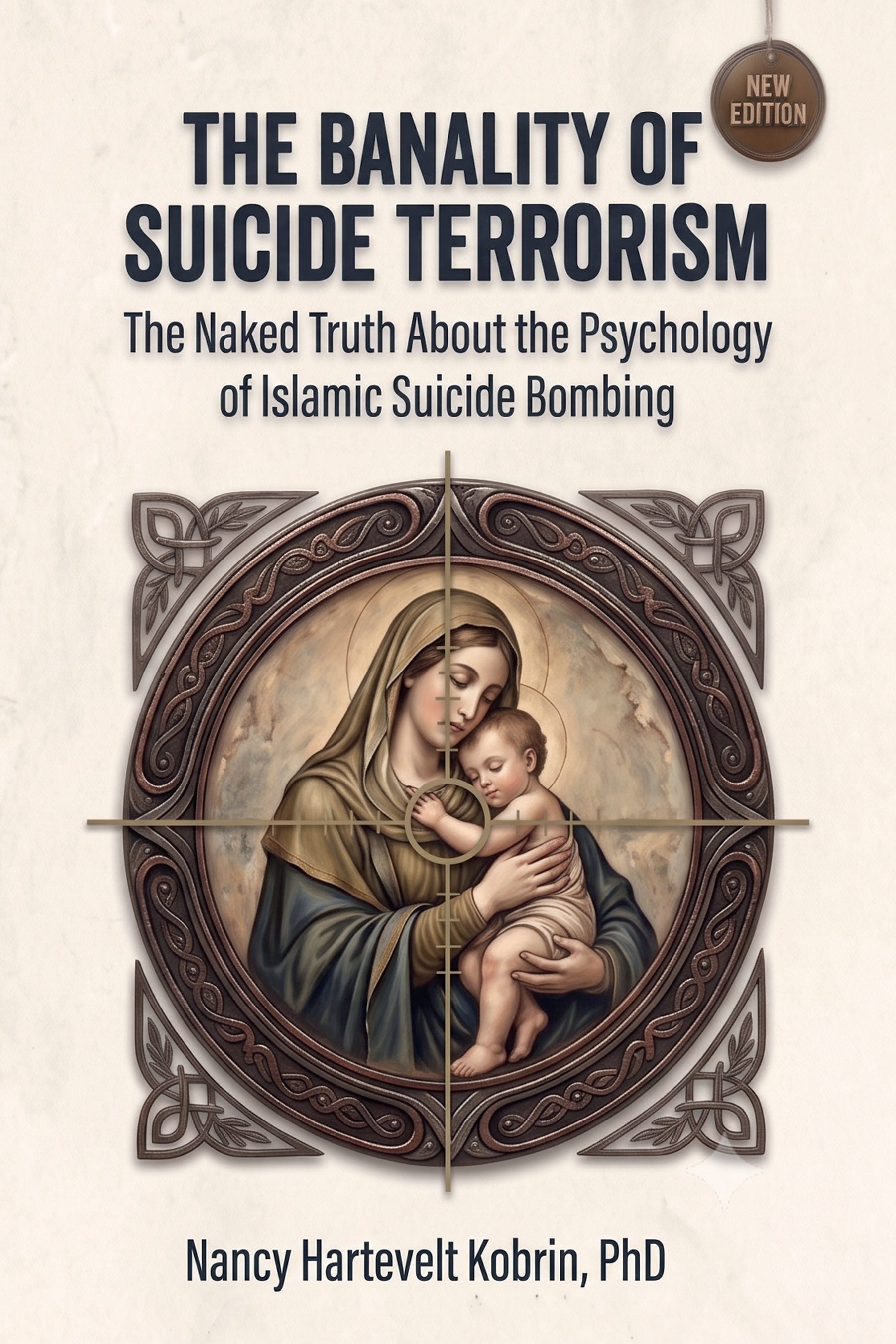
Thank you, Peter. The theology is real and it matters. Jeffrey Herf documented the Nazi propaganda piece in Nazi Propaganda for the Arab World. But scripture does not explain why so many take it up with such passion, while others read the same texts and do not kill. Theology gives permission and a vocabulary. The hatred itself is rooted much earlier, in the first years of life, when the child is not allowed to separate from the mother and cannot tolerate difference. The Jew becomes the one onto whom all that unbearable rage and shame is projected. That is why I look at the psychology underneath the texts and not only at the texts. Both are needed to see the whole picture.
I have no reason to doubt you at all, except: Freudianism? Really? You do not regard (I almost typed “know”) that theory as exploded?